| VI :PRODUCTION OF FISSILE MATERIAL
Much experimentation was necessary to make the production of fissile material practical. |
| A : Separation of Uranium Isotopes
The fissile isotope uranium-235 accounts for only 0.7 percent of natural uranium; the remainder is composed of the heavier uranium-238. No chemical methods suffice to separate uranium-235 from ordinary uranium, because both uranium isotopes are chemically identical. A number of techniques were devised to separate the two, all of which depend in principle on the slight difference in weight between the two types of uranium atoms. A huge gaseous-diffusion plant was built during World War II in Oak Ridge, Tennessee. This plant was enlarged after the war, and two similar plants were built near Paducah, Kentucky, and Portsmouth, Ohio. The feed material for this type of plant consists of extremely corrosive uranium hexafluoride gas. The gas is pumped against barriers that have many millions of tiny holes, through which the lighter molecules, which contain uranium-235 atoms, diffuse at a slightly greater rate than the heavier molecules, containing uranium-238 (see Diffusion). After the gas has been cycled through thousands of barriers, known as stages, it is highly enriched in the lighter isotope of uranium. The final product is weapon-grade uranium, containing more than 90 percent uranium-235. |
| B : Producing Plutonium
Although the heavy uranium isotope uranium-238 will not sustain a chain reaction, it can be converted into a fissile material by bombarding it with neutrons and transforming it into a new species of element. When the uranium-238 atom captures a neutron in its nucleus, it is transformed into the heavier isotope uranium-239. This nuclear species quickly disintegrates to form neptunium-239, an isotope of element 93 (see Neptunium). Another disintegration transmutes this isotope into an isotope of element 94, called plutonium-239. Plutonium-239, like uranium-235, undergoes fission after the absorption of a neutron and can be used as a bomb material. Producing plutonium-239 in large quantities requires an intense source of neutrons; the source is provided by the controlled chain reaction in a nuclear reactor. See Nuclear Chemistry. During World War II nuclear reactors were designed to provide neutrons to produce plutonium. Reactors capable of manufacturing large quantities of plutonium were established in Hanford, Washington, and near Aiken, South Carolina. |
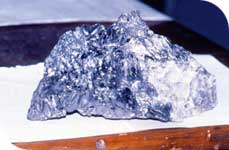 |
| Uranium Metal |