| THE CHAIN REACTION
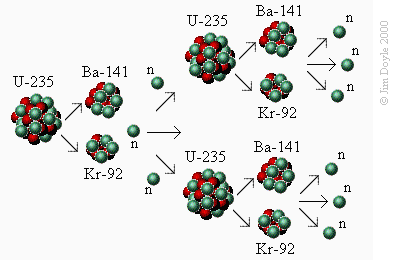
When a uranium or other suitable nucleus fissions, it breaks up into a pair of nuclear fragments and releases energy. At the same time, the nucleus emits very quickly a number of fast neutrons, the same type of particle that initiated the fission of the uranium nucleus. This makes it possible to achieve a self-sustaining series of nuclear fissions; the neutrons that are emitted in fission produce a chain reaction, with continuous release of energy. The light isotope of uranium, uranium-235, is easily split by the fission neutrons and, upon fission, emits an average of about 2.5 neutrons. One neutron per generation of nuclear fissions is necessary to sustain the chain reactions. Others may be lost by escape from the mass of chain-reacting material, or they may be absorbed in impurities or in the heavy uranium isotope, uranium-238, if it is present. Any substance capable of sustaining a fission chain reaction is known as a fissile material. |
 |