Electrostatic Potential and Conformal Mapping

By Dave Keller

In electrostatics, one is often interested in finding the electrostatic potential between two points. Here, we will discuss a technique called conformal mapping which allows us to take hard problems, map them into a coordinate system where they are easier to solve, solve them, and map the answer back to the original system. The problem we chose to solve is in electrostatics, but conformal mapping is also used in thermodynamics and hydrodynamics. In fact, many of these problems are exactly the same mathematically as those from electrostatics. Although this method can be very useful for some problems, its application is limited to variables which solve the two dimensional version of Laplace's equation. One such variable is the electrostatic potential in a region of space that is free of charges except as given by the boundary condition of the problem in which the potential is known. We will illustrate the method with an example.

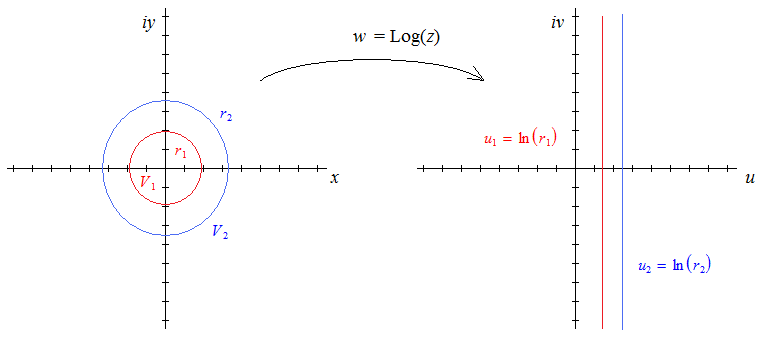
Suppose two coaxial cylinders C1 and C2 of infinite length with cross sections described by the equations x2 + y2 = r12 for C1 and x2 + y2 = r22 for C2 where r1 < r2 have electric potential V1 and V2 respectively, on their surfaces. Now suppose we wish to find the electrostatic potential in the space between the surfaces. Since the cylinders are assumed to be infinitely long, the potential is only a function of two variables. We may thus plot their cross sections in the complex plane and treat the problem two-dimensionally with conformal mapping.

First, we use the transformation w = Log(z) where z = x + iy and w = u + iv thus taking the problem from the xy plane into the uv plane. Now, a complex number z can be written in polar form with the expression z = re. Thus since w = Log(z) we have z = ew = eu + iv. Now, note

x + iy = eu + iv = eueiv = eu(cosv + i sinv).

Thus,

x2 + y2 = (eucosv)2 + (eusinv)2 = e2u.

So

x2 + y2 = r12 and x2 + y2 = r22

imply

u1 = ln(r1) and u2 = ln(r2).

Thus, we have mapped from the xy plane into the uv plane. Now the questions is how do we find the electrostatic potential between two vertical lines? Since we are interested in the potential between two infinitely long vertical lines, the function for the potential P(u,v) will be a function of u alone, so we are looking for P(u). Note also that since the pre-image of P(u) , call it F(x,y), is harmonic in the xy plane, P(u) is harmonic in the uv plane. Thus, P''(u) = 0 which implies that P(u) has the form P(u) = mu + c where m and c are real constants. Putting these facts together along with the fact that P(r1) = u1 and P(r2) = u2 we can solve for m and c as follows.
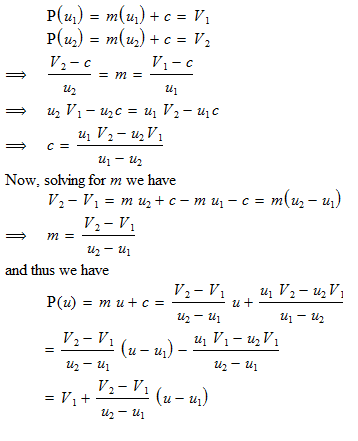
Which is the formula for the potential between the two lines in the complex plane. All we have to do now is map this function back to the original coordinate system and we will have the function F(x,y) we were looking for in the first place.

and we have the expression for the electrostatic potential between two infinitely long concentric cylinders of radii r1 and r2 and potential V1 and V2.

If you are interested in more examples of conformal mapping I recommend the following links:

More examples of applications of conformal mapping
A really cool page with visualizations of conformal maps


References

Hosted by www.Geocities.ws

1