| A Few Bits of Background |
| ...about me |
| ...about this project |
| ...about what I've learned |
Dedicated to the teaching moms and mums of Solomon Islands Translation Advisory Group, their writing children, and our Aussie friends who led the way they acomplished a lot with very little and didn't ask for much |
 |
 |
|
|
|
 |
|
 |
|
|
| xxx |
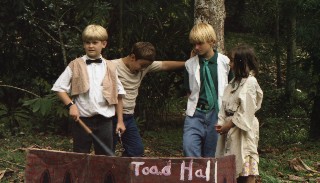
| Indeed, much that he [Toad] related belonged more properly to the category of what-might-have-happened-had-I-only-thought-of-it-in-time-instead-of-ten-minutes-afterwards. Those are truly the best and the raciest adventures and why should they not be truly ours, as much as the somewhat inadequate things that really come off?
Wind in the Willows by Kenneth Grahame |
 |
| Audience:
teaching parents The typical teaching parent wondering how to evaluate their child�s writing is largely relying on their own school experience as a reference point. They may have read something about how to teach writing, but often that their reading has been restricted to the teacher instruction page of the curriculum that they are using. This information can leave them feeling insecure about what to do. They want to know if there an objective way to measure quality. They want to know what to look for in their child�s writing. And it is likely they are hoping for something that is quick, because they live under a lot of time pressure. I knew I would need to try to �unpack� the language I used as much as possible to address the background of this population. myself as a learner The questions that parents ask about grading/evaluating student writing are questions I�ve had myself. And more recently, I�ve heard about 6 Trait Scoring. I expected 6 Trait Scoring to be the �magic bullet� that I needed for my consulting work. I wanted to become facile with the technique and understand the theoretical foundations of the technique. other professionals with whom I might share this resource Whenever I get together with other educators, even if it is a social event, talk turns to what we are learning and how it applies to our teaching. We are all on the constant prowl for new resources and another slant on how to do things a better way. Since the world wide web is an ideal sharing medium, I expect to be telling others about it. Educators will have a broader base of experience to connect my research to. I want to be sure that the research that I pursue is sound and, includes enough documentation to enable them to follow-up points of special interest. I also want to include an approprioate use of professional education terminology. graduate professor While I�d prefer that I were interacting with Dr. Hadaway as a professional co-worker, the reality is that she is my teacher. And while I trust she is interested in my ideas for their own sake, I also know that there are course requirements (standards) that we both have to reckon with. |
| At the end of this project, my learning outcome is very different than what I expected. I began with a quote and a guess. I was betting Vicki Spandel�s work regarding the six traits of good writing would be the answer for parents wanting to know how to evaluate their children's writing. I expected my learning to focus on that particular instrument and how to use it. But first, I knew, I needed to examine the theory behind it. With a pile of books and a computer full of journal articles I began sorting and sifting information, looking for patterns to evolve. Occasionally, I�d write just a bit, filling page after page of unconnected outlines, beginnings of paragraphs, and graphically organized bits of data. I am a chronic problem sorter. I constantly shuffle the concepts, ideas and applications floating around in my head to discover the connections between them. For a couple of days I�d think my research path was leading in one direction, then I�d make a random connection with some piece of prior knowledge or question. So I'd head off in another direction, entirely. I discovered what E.B. White meant when he said, �I never knew in the morning how the day was going to develop. I was like a hunter hoping to catch sight of a rabbit.� The deeper I delved into this topic about writing, the more enmeshed I became with the process. I explored new writing territory: focusing on process, instead of product. I became a more reflective writer. That fuzzy phrase �writing is a recursive process� became concrete through the lense of my own experience as I caught myself jumping mentally to and fro, darting from drafting to revising to pre-writing to drafting some more and then publsihing a bit, only to return to revising again at lightening speed. To keep track of the experience without getting side-tracked from my publishing deadline, I began writing these fleeting observations on bright pink and purple sticky notes. It only took a second to jot a few words down and plaster the note to others in my notebook. Now, pages and pages of my records are wallpapered with a flurry of the little guys; physical evidence of the invisible acrobatics my brain performed to create this project. |
| ��good observation, the most critical component in evaluation is only as good as the teacher�s knowledge base. We have to be able to observe and value strengths more than deficits. We have to know what to look for: What are the developmental markers we are seeing or not seeing? Most of all, we need to value observation as integral to evaluation�� Routman Invitiations 303 |
| Choosing a Topic & Purpose While the initial incentive for these webpages was a graduate school methods course, the inspiration to follow through to the current product has come from other sources. Teaching my own four children in a remote third-world village for ten years gives me an experienced understanding of challenges inherent in a non-traditional education setting. My original training in speech and language therapy coupled with one graduate level principles of literacy course turned out to be the perfect framework to build instruction from in that situation. Studies in children�s language and developmental psychology helped me observe my children intelligently. Studies in clinical processes and assessement led me to be a student of my children, myself as a teacher, and the curriculum we had available. I built on this understanding by listening carefully when teachers came through with understanding and resources from Australia, New Zealand and the United Kingdom. I was always learning how to do things better. Some of my co-workers in similar village allocations, did not have such a fortunate foundation to build on. A few arrived on the field with packaged curriculum chosen on the merits of a single recommendation. Others arrived with no resources, saw what others were doing and just did the same thing just because it seemed to work and they did not know what else to do. I watched some of these families struggle significantly with the realities of trying to fit �one size fits all� curriculum to their decidedly different-sized kids. And I wondered: what would work better? what resources did we need in our situation? what essential information would help us make appropriate choices? what skills would help limit the stress of our situation? More recently, I�ve met a new kind of teaching family overseas; families with a similar lack of education background, but from non-English speaking countries. I�ve listened in amazement as they described the multiple language domains they function in. And I�ve been impressed by their determination to teach English reading and writing though they are non-native speakers of English and are living in a non-native language environment. I consult with families like this regularly in my job. And again, I�m coming back to the same questions � how can I help them do what they are doing more effectively? what do they need to know to make decisions that will stimulate learning, not frustration? These real-life questions influenced my topic choice and purpose as I considered what I should research for my own school assignment. A quote from Regie Routman in Tchudi and Mitchell (1998) gave me a hint about where my inquiry might lead, as well as giving hints about content and form: |
 |
|