 |
| Kindling: Before and After |
| As the due date approaches, and after the nest box has been added, there are only a few things that we as breeders need to do for the doe. The most important thing to do is make sure she is eating well and has a good supply of fresh water at all times. It is highly recommended that if you use an automatic watering system all of the valves should be checked to ensure that the doe is getting a ready supply of water. On the night that she is due check to be sure that she has plenty of good materials in the nest. Some does may have not made order of the nest yet but even the last minute doe needs to have the materials to build upon. Add straw if necessary. Check your water again to be sure she has a full dish or bottle, or that her watering valve is functioning properly. Most does will kindle at night or in the early morning. It is best to check on your does fairly in the morning to be sure they had no problems in kindling. If the kits are scattered there is a better chance of saving them if you check early. On days when I suspect a litter should have been born, I like to go out around five thirty or six AM for a quick check up. Be sure not to disturb the does too much. A quick peek into the cage should be sufficient, as scattered kits would be easily seen. With first time does it is sometimes best to check every 3 to 6 hours as they are more likely to experience problems. When checking up on the doe, observe the nest. If there is a great abundance of fur and the nest is a mound, it is likely that the doe has properly kindled the kits. At this time you will need to check the nest to be sure that wet materials are removed and that all the kits in the nest are alive and healthy. Some does will not mind you pulling out the nest as long as they are given a reassuring pat and are shown that you will not hurt the kits. Many does however will need to be distracted. If the doe is aggressive when you reach in to get the nest box you can distract her with a fresh veggie or a wedge of apple. The distraction will allow you to pull the nest out. Once you have the nest, move out of her eyesight to check the kits. Gently open the layer of materials over the kits. I like to keep a dry towel wrapped into a ring for counting kits in larger litters (5 or more). I gently but quickly remove each kit from the nest, observe that it is healthy and that it�s belly is swollen from nursing, and place it in the towel. The kits will nestle together for warmth. As soon as they are counted I put the corner of the towel over the top of them and check the nest materials. At this time, I remove any wet or bloody straw or fur. I do a quick check for any remains of kits that did not survive. After I am satisfied that the nest is dry and clean I return the kits to it, cover them up again and place the nest back in the cage. The whole process should take less than 5 minutes. Smaller litters can be checked without removal from the nest. If your doe has not pulled any fur after kindling, she can be scruffed and hair can gently be pulled from the insides of her hind legs and around the point of her rump. This hair should pull out easily and can then be added to the nest. Another method, which is less of a hassle for both the breeder and the doe, is the use of clean un-spun wool, which can be added to the nest just as fur would be used. Some breeders also keep bags of pulled fur for use on these occasions. Most does don�t mind the scent of another doe in the nest. After you have returned the nest to the cage be sure to give the doe a good patting to be sure that your scent is on her. I try to pet as close to the nose area as the doe will allow without taking off my fingers. This way she is less likely to notice your scent on the kits, and is thus less likely to harm them in any way. Observe the doe for a few minutes after you have returned the nest to be sure she does not become destructive. Most does will quickly check the nest and then leave it alone. Check the doe�s water level again and be sure she has plenty of hay to feed on. Most does are quite hungry just after kindling. At this time, some breeders give does who have kindled a large litter a quarter cup of low fat 1% milk diluted about half and half with water to replenish their calcium and protein. Others recommend giving all newly kindled does a few stocks of celery. |
|
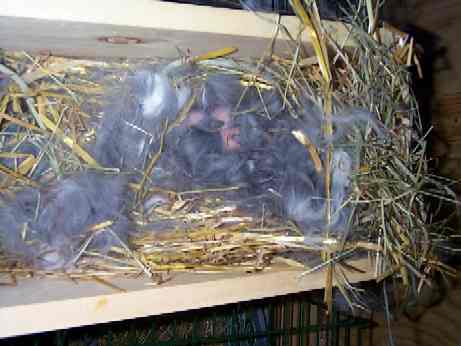
| Our blue kits at 30 minutes old with the covering removed from the nest |
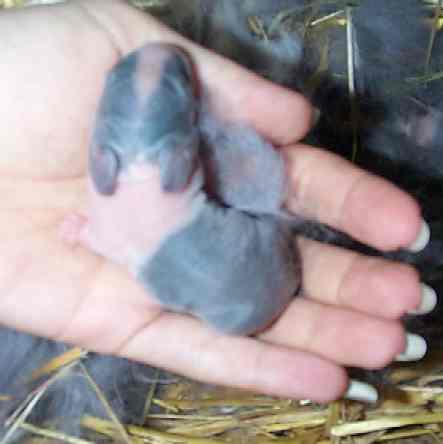 |
| A 30 minute old blue dutch kit with very good markings. |
 |