Dustin Stevens-Baier
COMP 575 Multi-Agent Systems
Summer 2006
6/13/2006
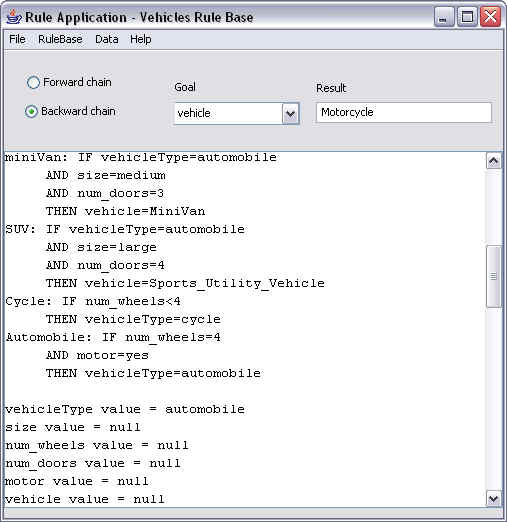
This is just the intro example. The vehicleType has been set to automobile. When you use the drop down menu to select start the following appears.
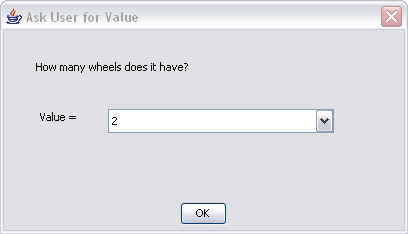
This is the interface used to set values to determine the output. In the example above the type of vehicle was automobile so the rule app asks how many wheels does it have and the answer is 2. Then it asks if it has a motor and since it does it knows that it is a motorcycle.
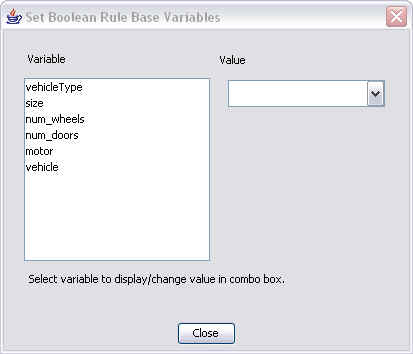
Another interface is the set Values interface which looks like this:
We can also change our rule base to plants and look at different output.
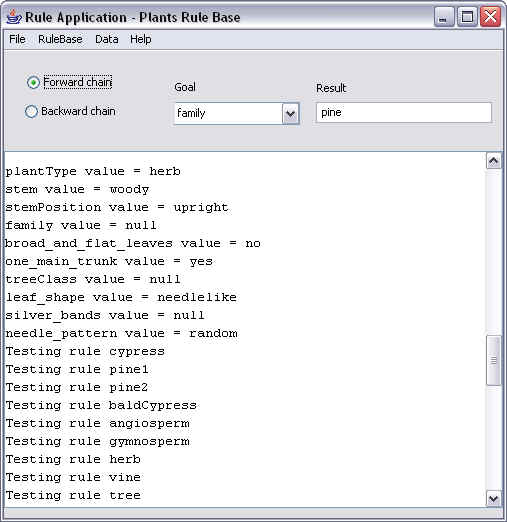
Here you can see the input plantType is herb, stem value is woody, stemPosition is upright, broad flat leaves is no, one main trunk is yes, leaf shape is needle like. The result is a pine tree.
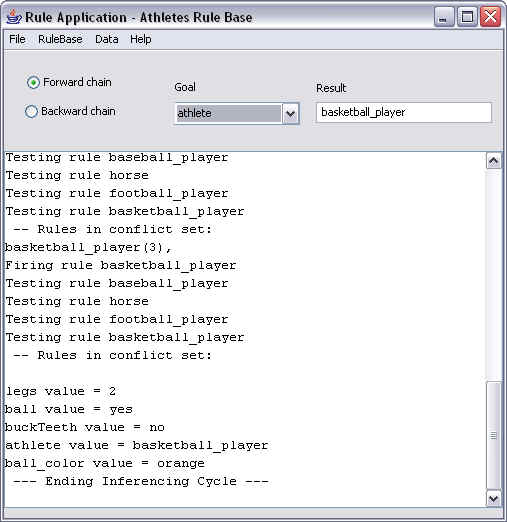
I added a set of rules for athletes. That can determine based off of
the rules what type of athlete they are. An example is as follows:
The rules that were used where as follows:
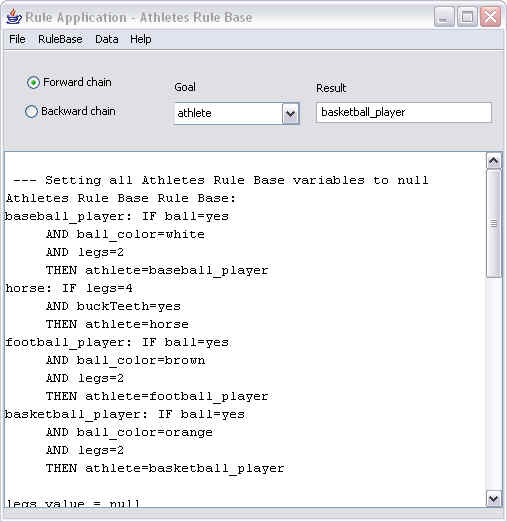
This is a fairly simple example but it shows a change in rules. This is
how the athlete is determined. The steps only work for forward
chain. The initial setup I used a basketball player. This was done in order
to make sure that the code was done correctly and so we could check the gui
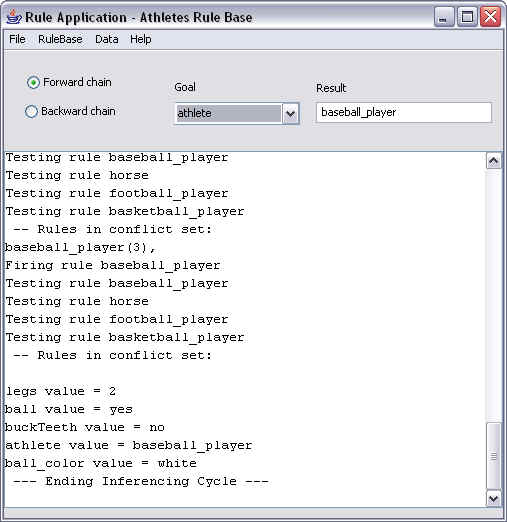
output. If we change the ball_color to white and turn the athlete to null when
we run the program again we get a baseball player:
4) Early expert systems used confidence factors with Boolean rules to reason about uncertainty. How do fuzzy rule systems overcome this issue, or do they?
Because fuzzy rule systems deal with a degree to which an event it doesn't even touch on the likelihood in which an event will occur. Instead they deal with values 0.0 - 1.0 to try and quantify the degree.
What is the difference between a probability and a fuzzy number?
Probability theory deals with the chance or likelihood that an event occurs a percentage. While the fuzzy theory deals with the degree of the event. The example that the book uses is the chance that it will rain is 50% versus it will rain hard.
5) The Motor fuzzy rule base uses four to cover the input space of temperature and humidity. Use the RuleApp to enter Values over the entire range 0-100 for these variables and plot the motor output value. Does the output change smoothly or jump abruptly as the input values change?
It appears to jump abruptly. There are certain values that have zero in the motor value suddenly and around. Once temperature and humidity is above 30 then there is a big jump in motor value from around ten to almost 50. It appears to stay at the same value (at least for all of the inputs I tried.) at approximately 49 until the temperature goes above 80 and the humidity is above 50. then it jumps to 90 and fluctuates around that value until the max out at 100.
Add more rules to the motor rule base, and check the effect on the motor variable. Would adding more fuzzy sets or using other linguistic hedges help to smooth the output responses?
It seems like you can try and smooth it out with options like cooling from water and antifreeze, or oil level. These options can slowly increase the speed of the motor if we put certain restrictions on their values so that cooling happens right around the spikes in temperature and this value is calculated by subtracting it from the motor value.
6) You have to create a system to diagnose problems with an engine. A mechanic is available to act as an expert. Your job is to take his knowledge and turn it into rules. The application must make a best guess diagnosis based on the available data. As more info is available the diagnosis should be more accurate. Would you choose Boolean or fuzzy rules for this application? Why?
I would use Boolean rules because in order to be accurate with some one that doesn't know as much you can't gauge degree as easily how loud is the noise? It is much easier to say this part is making this noise. This will allow a much better diagnosis. As the more data is gathered.