Getting Familiar with Microsoft Excel
This
course teaches Microsoft Excel basics. Although knowledge of how to navigate in
a Windows environment is helpful, this course was created for the computer
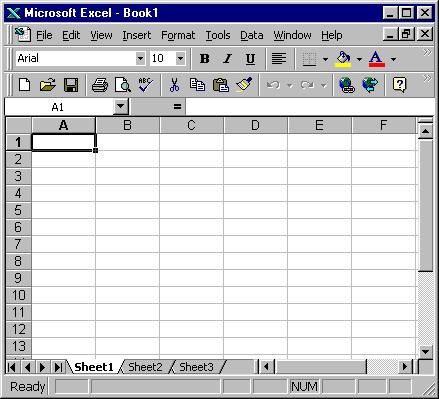
novice. To begin, open Microsoft Excel. The screen shown here will appear.
The
Title Bar
This
lesson will familiarize you with the Microsoft Excel screen. We will start with
the Title bar, which is located at the very top of the screen. On the Title
bar, Microsoft Excel displays the name of the workbook you are currently using.
At the top of your screen, you should see "Microsoft Excel - Book1"
or a similar name.
The
Menu Bar
The
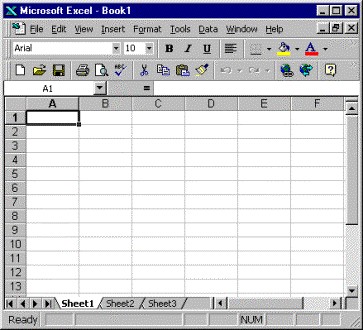
Menu bar is directly below the Title bar and displays the menu. The menu begins
with the word File and continues with the following: Edit, View, Insert,
Format, Tools, Data, Window, and Help. You use the menu to give instructions to
the software. Point with your mouse to a menu option and click the left mouse
button. A drop-down menu will appear. You can now use the left and right arrow
keys on your keyboard to move left and right across the Menu bar options. You
can use the up and down arrow keys to move up and down the drop-down menu. To
select an option, highlight the item on the drop-down menu and press Enter. An
ellipse after a menu item signifies additional options; if you select that
option, a dialog box will appear.
Toolbars
The Standard Toolbar

The Formatting Toolbar
Toolbars
provide shortcuts to menu commands. Toolbars are generally located just below
the Menu bar. Before proceeding with the lesson, make sure the toolbars we will
use -- Standard and Formatting -- are available.
Worksheets

Microsoft
Excel consists of worksheets. Each worksheet contains columns and rows. The
columns are lettered A to IV; the rows are numbered 1 to 65536. The combination
of column and row coordinates make up a cell address. For example, the cell
located in the upper left corner of the worksheet is cell A1, meaning column A,
row 1. Cell E10 is located under column E on row 10. You enter your data into
the cells on the worksheet.
The
Formula Bar

If
the Formula bar is turned on, the cell address displays on the left side of the
Formula bar. Cell entries display on the right side of the Formula bar. Before
proceeding, make sure the Formula bar is turned on.
The Status Bar
If
the Status bar is turned on, it appears at the very bottom of the screen.
Before proceeding, make sure the Status bar is turned on.
Notice the word "Ready" on the Status bar at the
lower left side of the screen. The word "Ready" tells you that Excel
is in the Ready mode and awaiting your next command. Other indicators appear on
the Status bar in the lower right corner of the screen. Here are some examples:
The
Num Lock key is a toggle key. Pressing it turns the numeric keypad on and off.
You can use the numeric keypad to enter numbers as if you were using a
calculator. The letters "NUM" on the Status bar in the lower right
corner of the screen indicate that the numeric keypad is on.
Other functions that appear on the Status bar are Scroll
Lock and End. Scroll Lock and End are also toggle keys. Pressing the key
toggles the function between on and off. Scroll Lock causes the pointer
movement key to move the window but not the cell pointer. End allows you to
jump around the screen. We will discuss both of these later in more detail.
Make
sure the Scroll Lock and End indicators are off and complete the following
exercises.
The
Down Arrow Key
You
can use the down arrow key to move downward on the screen one cell at a time.
The Up Arrow Key
You
can use the Up Arrow key to move upward on the screen one cell at a time.
The Right and Left Arrow Keys
You
can use the right and left arrow keys to move right or left one cell at a time.
Page Up and Page Down
The
Page Up and Page Down keys move the cursor up and down one page at a time.
The End Key

The Status Bar
The
End key, used in conjunction with the arrow keys, causes the cursor to move to
the far end of the spreadsheet in the direction of the arrow.
Note: If you have entered data
into the worksheet, the End key moves you to the end of the data area.
The
Home Key
The
Home key, used in conjunction with the End key, moves you to cell A1 -- or to
the beginning of the data area if you have entered data.
Scroll Lock
The Status Bar
Scroll
Lock moves the window, but not the cell pointer.
Selecting Cells
If
you wish to perform a function on a group of cells, you must first select those
cells by highlighting them.
Alternative Method - Selecting Cells by Dragging
You
can also highlight an area by holding down the left mouse button and dragging
the mouse over the area. In addition, you can select noncontiguous areas of the
worksheet.
Closing Microsoft Excel
File
on menu bar > exit.
Entering Text
To
begin, open Microsoft Excel. For this lesson, your default font should be set
to Arial. Let’s check to make sure it is.
Click on Format, which is located on the Menu bar. > Press the down
arrow key until Style is highlighted. > Press Enter. A dialog box will
appear. > Click on Modify. > Click on the Font tab, if it is not in the
front. > Click on Arial in the Font box, if Arial is not already selected. >
Click on OK. > Click again on OK.
This lesson will teach you how to enter data into your
worksheet. First you place the cursor in the cell in which you would like to
enter data, type the data, and then press Enter.
Place the cursor in cell A1. > Type John Jordan. Note that the
word Ready on the Status bar changes to Enter. > The Backspace key erases
one character at a time. Erase "Jordan" by pressing the backspace key
until Jordan is erased. > Press Enter. The name "John" should
appear in cell A1.
Editing
a Cell
After
you enter data into a cell, you can edit it by pressing F2 while you are in the
cell you wish to edit.
Alternate Method – Editing a Cell by Using the Formula Bar
You
can also edit the cell by using the Formula bar. You can change
"Jones" to "Joker" by click at the formula bar then
backspace to delete what you don’t want, then type in.
Alternate Method – Editing a Cell by Double-Clicking in the Cell
You
can change "Joker" to "Johnson" by double click at a cell,
then make change.
Changing a Cell Entry
Typing
in a cell while you are in the Ready mode will replace the old cell entry with the
new information you type.
Adjusting
the Standard Column Width
When
you enter Microsoft Excel, the width of each cell is set to a default width.
This width is called the standard column width. We need to change the standard
column width to complete our exercises. To make the change, follow these steps:
Click on Format, which is located on the Menu bar. > Press the down
arrow key until Column is highlighted. > Press Enter. > Press the down
arrow key until Standard Width is highlighted. > Press Enter. > Type 25
in the Standard Column Width field. > Click on OK. The width of every
cell on the worksheet should now be set to 25.
Cell Alignment
Look
at cell A1. The name "Cathy" is aligned with the left side of the
cell. You can change the cell alignment.
Centering by Using the Menu
To
center the name Cathy, follow these steps:
Move the cursor to cell A1. > Click on Format, which is located on
the Menu bar. > Press the down arrow key until Cells is highlighted. > Press
Enter. > Click on the Alignment tab, if it is not in the front. > Click
to open the drop-down box associated with the Horizontal field. After the
drop-down box is opened, click on Center. > Click on OK to close the dialog
box. The name "Cathy" should now be centered.
Right-Aligning by Using the Menu
To
right-align the name "Cathy," follow these steps:
Move the cursor to cell A1. > Click on Format, which is located on
the Menu bar. > Press the down arrow key until Cells is highlighted. > Press
Enter. > Click on the Alignment tab, if it is not in the front. > Click
to open the drop-down box associated with the Horizontal field. After the
drop-down box is opened, click on Right. > Click on OK to close the dialog
box. The name "Cathy" should now be right-aligned.
Left-Aligning by Using the Menu
To
left-align the name "Cathy," follow these steps:
Move the cursor to cell A1. > Click on Format, which is located on
the Menu bar. > Press the down arrow key until Cells is highlighted. > Press
Enter. > Click on the alignment tab, if it is not in the front. > Click
to open the drop-down box associated with the Horizontal field. After the
drop-down box is opened, click on Left (Indent). > Click on OK to close the
dialog box. The name "Cathy" should now be left-aligned.
Alternate Method -- Alignment by Using the Formatting Toolbar
Using
the Formatting toolbar, you can quickly perform functions. You can use the
Formatting toolbar to change alignment.
Centering by Using the Toolbar
To
center the name "Cathy," follow these steps:
Move the cursor to cell A1. > Click on the Center icon, which is
located on the Formatting toolbar.
Right-Aligning by Using the Toolbar
To
right-align the name "Cathy," follow these steps:
Move the cursor to cell A1. > Click on the Align Right icon, which is
located on the Formatting toolbar.
The red circle designates the Align Right icon.
Left-Aligning by Using the Toolbar
To
left-align the name "Cathy," follow these steps:
Move the cursor to cell A1. > Click on the Align Left icon, which is
located on the Formatting toolbar.
The red circle designates the Align Left icon.
Adding
Bold, Underline, and Italic
You
can bold, underline, or italicize text in Microsoft Excel. You can also combine
these features -- in other words, you can bold, underline, and italicize
a single piece of text.
In
the exercises that follow, you will learn three different methods for bolding,
italicizing, or underlining text in Microsoft Excel. You will learn to bold,
italicize, and underline by using the menu, the icons, and the shortcut keys.
Adding Bold -Using the Menu
Type Bold in cell A2.
Click on the checkmark located on
the Formula bar. Clicking on the checkmark is similar to pressing Enter.
Click on Format, which is located on the Menu bar. > Press the down
arrow key until Cells is highlighted. > Press Enter. > Click on the Font
tab, if it is not in the front. > Click on Bold in the Font Style box. > Click
on OK. The word "Bold" should now be bolded.
Adding Italic -Using the Menu
Type Italic in cell B2.
Click on the checkmark located on the Formula bar. Clicking on the
checkmark is similar to pressing Enter. > Click on Format, which is located
on the Menu bar. > Press the down arrow key until Cells is highlighted. >
Press Enter. > Click on Italic in the Font style box. > Click on OK. The
word "Italic" should now be italicized.
Adding Underline -Using the Menu
In
Microsoft Excel there are several types on underlines. The exercise that
follows illustrates several of them.
Type Underline in cell C2. > Click on the checkmark located on
the Formula bar. Clicking on the checkmark is similar to pressing Enter. > Click
on Format, which is located on the Menu bar. > Press the down arrow key
until Cells is highlighted. > Press Enter. > Click to open the drop-down
menu associated with the Underline box. > Click on Single. > Click on OK.
Note: The cell entry should now have a
single underline.
Type Underline in cell D2. > Click on the checkmark located on
the Formula bar. > Click on Format, which is located on the Menu bar. > Press
the down arrow key until Cells is highlighted. > Press Enter.
Click to open the drop-down menu associated with the Underline field. >
Click on Double. > Click on OK. The cell entry should now have a double
underline.
Type Underline in cell E2. > Click on the checkmark located on
the Formula bar. > Click on Format, which is located on the Menu bar. > Press
the down arrow key until Cells is highlighted. > Press Enter. > Click to
open the drop-down menu associated with the Underline field. > Click on
Single Accounting. > Click on OK. The cell entry should now have a single
accounting underline. > Type Underline in cell F2. > Click on the
checkmark located on the Formula bar. > Click on Format, which is located on
the Menu bar. > Press the down arrow key until Cells is highlighted. > Press
Enter. > Click to open the drop-down menu associated with the Underline
field. > Click on Double Accounting. > Click on OK. The cell entry should
now have a double accounting underline.
Adding All Three – Using the Menu
Move the cursor to cell G3. > Type All three. > Click on
the checkmark located on the Formula bar. > Click on Format, which is
located on the Menu bar. > Press the down arrow key until Cells is
highlighted. > Press Enter. The Font dialog box will open. > Click on the
Font tab, if it is not in the front. > Click on Bold Italic in the Font
Style box. > Click to open the drop-down menu associated with the Underline
field. Then click on Single. > Click on OK.
Note: The words "All three"
should now be bolded, italicized, and underlined.
Removing Bolding and Italics – Using the Menu
Highlight cells A2 to B2. Place the
cursor in cell A2. Press the F8 key. Press the right arrow key once.
Removing an Underline – Using the Menu
Move the cursor to cell C2. > Click on Format, which is located on
the Menu bar. > Press the down arrow key until Cells is highlighted. > Press
Enter. > Click to open the drop-down menu associated with the Underline
field. Then click on None. > Click on OK.
Alternate Method – Adding Bold by Using the Icon
Type Bold in cell A3. > Click on the checkmark located on the
Formula bar. > Click on the Bold icon, which is on the Formatting toolbar. >
Click again on the Bold icon if you wish to remove the bolding.
Alternate Method – Adding Italic by Using the Icon
Type Italic in cell B3. > Click on the checkmark located on
the Formula bar. > Click on the Italic icon, which is on the Formatting
toolbar. > Click again on the Italic icon if you wish to remove the italics.
Alternate Method – Adding Underline by Using the Icon
Type Underline in cell C3. > Click on the checkmark located on
the Formula bar. > Click on the Underline icon, which is on the Formatting
toolbar. > Click again on the Underline icon if you wish to remove the
underline.
Alternate Method – Bold, Underline, and Italicize Using
Icons
Type All Three in cell D3. > Click on the checkmark located on
the Formula bar. > Click on the Bold icon. > Click on the Italic icon. >
Click on the Underline icon.
Alternate Method – Adding Bold by Using Shortcut Keys
Select cell, then hold down the Ctrl key while pressing "b"
(Ctrl-b). Press Ctrl-b again if
you wish to remove the bolding.
Alternate Method – Adding Italic by Using Shortcut Keys
Select cell, then hold down the Ctrl key while pressing "i"
(Ctrl-i). Press Ctrl-i again if you wish to remove the italic formatting.
Alternate Method – Adding Underline by Using Shortcut Keys
Select cell, then hold down the Ctrl key while pressing "u"
(Ctrl-u). Press Ctrl-u again, if
you wish to remove the underline.
Changing the Font and Font Size
You
can change the Font and Font Size of the data you enter by selecting your font
and size on tools bar.
Deleting a Cell Entry
To
delete an entry in a cell or a group of cells, you place the cursor in the cell
or highlight the group of cells and press Delete.
Working with Long Text
Whenever
you type text that is too long to fit into a cell, Microsoft Excel attempts to
display all of the text. It will left-align the text regardless of the
alignment that has been assigned to it, and it will borrow space from the blank
cells to the right. However, a long text entry will never write over cells that
already contain entries— instead, the cells that contain entries will cut off
the long text.
Changing a Single Column Width
Earlier
we increased the column width of every column on the worksheet. You can also
increase individual column widths. If you increase the column width, you will
be able to see the long text.
Alternate Method – Changing a Single Column Width
You
can also change the column width using the cursor.
Place the cursor on the line between
the B and C column headings. The cursor should look like the one displayed
here, with two arrows.
Move your mouse to the right while
holding down the left mouse button. The width indicator will appear on the
screen.
Release the left mouse button when
the width indicator shows approximately 40.
Moving to a New Worksheet
In
Microsoft Excel, each workbook is made up of several worksheets. Before moving
to the next topic, move to a new worksheet.
Filling
Cells Automatically
You
can use Microsoft Excel to automatically fill cells with information that occur
in a series. For example, you can have word automatically fill in times, the
days of the week or months of the year, years, and other types of series. The
following demonstrates:
Type the following into the worksheet
as shown.
Place the cursor in cell A1. > Press
F8. This will anchor the cursor. > Press the right arrow key six times to
highlight cells A1 through G1. > Find the small black square in the lower
right corner of the highlighted area. This is called the Fill Handle.
Grab the Fill Handle and drag with
your mouse to highlight cells A1 to G24.
Note how each cell fills.
Press Esc and then click anywhere on
the worksheet to remove the highlighting.
Saving Your File and Closing Microsoft Excel
Save
your file and close Microsoft Excel using file on menu bar then save.
Numbers and Mathematical Calculations
In
this lesson you will learn how to work with numbers and how to perform
mathematical calculations. To begin, open Microsoft Excel.
Setting
the Enter Key Direction
In
Microsoft Excel, you can specify which direction the cursor moves when you
press the Enter key. You can have the cursor move up, down, left, right, or not
at all.
Making Numeric Entries
In
Microsoft Excel, you can enter numbers and mathematical formulas into cells.
When a number is entered into a cell, you can perform mathematical calculations
such as addition, subtraction, multiplication, and division. When entering a
mathematical formula, precede the formula with an equals sign. Use the
following to indicate the type of calculation you wish to perform:
+
Addition -
Subtraction * Multiplication / Division ^ Exponential
Moving
Quickly Around the Worksheet
The
following are shortcuts for moving quickly from one cell to a cell in a
different part of the worksheet.
Go to –F5
The
F5 function key is the "Go To" key. If you press the F5 key while in
the Ready mode, you will be prompted for the cell you wish to go to. Enter the
cell address, and the cursor will jump to that cell.
Go to – Ctrl-G
You
can also use Ctrl-G to go to a specific cell.
Performing
Mathematical Calculations
Addition / Subtraction / Multiplication / Division
This
can be done by using sign as stated above to perform each task. Type in “=” then select two cells for
the action.
Automatic
Calculation
If
you have automatic calculation turned on, Microsoft Excel recalculates the
worksheet as you change cell entries.
Formatting Numbers
You
can format the numbers you enter into Microsoft Excel. You can add commas to
separate thousands, specify the number of decimal places, place a dollar sign
in front of the number, or display the number as a percent in addition to
several other options.
More
Advanced Mathematical Calculations
When
you perform mathematical calculations in Microsoft Excel, be careful of
precedence. Calculations are performed from left to right, with multiplication
and division performed before addition and subtraction.
To
change the order of calculation, use parentheses. Microsoft Excel will
calculate the information in parentheses first.
Cell Addressing
Microsoft
Excel records cell addresses in formulas in three different ways, called absolute,
relative, and mixed. The way a formula is recorded is important
when you copy it.
With
relative cell addressing, when you copy a formula from one area of the
worksheet to another, Microsoft Excel records the position of the cell relative
to the cell that originally contained the formula. The following exercises
demonstrate:
Creating the Formula
In addition to typing a formula as we stated above, we can
also enter formulas using the Point mode. When you are in the Point mode you
can enter a formula either by clicking on a cell with your mouse or by using
the arrow keys.
Copying by Using the Menu
You
can copy entries from one cell to another cell. To copy the formula you just
entered, follow the steps outlined below:
Copying by Using the Formatting Toolbar
Highlight what you want to copy
Click on the Copy icon , which
is located on the Formatting toolbar.
Use the arrow key to move the cursor
to cell C7.
Click on the Paste icon , which
is located on the Formatting toolbar.
Press Esc to exit the Copy mode.
Absolute Cell Addressing
An
absolute cell address refers to the same cell, no matter where you copy
the formula. You make a cell address an absolute cell address by placing a
dollar sign in front of both the row and column identifiers. You can do this
automatically by using the F4 key.
Copying by Using the Keyboard Shortcut
This
time, copy by using the keyboard shortcut (Ctrl + c), then select where you
want to paste. Press Ctrl + v
Mixed Cell Addressing
You
use mixed cell addressing to reference a cell that is part absolute and part
relative. You can use the F4 key.
Functions
Microsoft
Excel has a set of prewritten formulas called functions. Functions
differ from regular formulas in that you supply the value but not the
operators, such as +, -, *, or /. The SUM function is used to calculate sums.
Here is an example of a function: =SUM (2,13,10, 67). In this function: The equals sign begins the function. SUM is the name of the function. 2, 13, 10 and 67 are the
arguments. Parentheses enclose the
arguments. A comma separates each
of the arguments. The SUM function adds the arguments together. In the
exercises that follow, we will look at various functions.
Calculating an Average
You
can use the AVERAGE function to calculate an average from a series of numbers.
Calculating Min
You
can use the MIN function to find the lowest number in a series of numbers.
Calculating Max
You
can use the MAX function to find the highest number in a series of numbers.