| My favorite tool, when it comes to working with metal, is a South Bend Model 'A' lathe. It's exact date of manufacture I do not know, but it appears to date from the early 70's. It has an interesting story behind it: My dad was in Catonsville one Sunday morning in March of 2002, and stopped at a yard sale. The lady behind the table happened to have a box of reamers sitting there and my dad asked her how much she wanted for them. She said about ten dollars. My dad picked them up and asked if she had anything else of similar nature. Well, it turned out her husband had died nearly twenty years ago, and she had a few of his things in the basement and garage. She asked my father if he wanted to have a look around. In the back of the basement, sat this lathe, the bench, three chucks, a steady rest, faceplate, American threading change gears, sixty pounds of tool bits and boring bars, live and dead centers, three lantern-type toolposts, two quick-change toolposts with unmachined t-nuts and a complete set of knurling toolholders and knurls. How much did she want for all this? A thousand dollars. Needless to say, my father bought all this pretty quick. He kept it a secret from me for about four months, until I brought up the idea of getting a Chinese 9x20 lathe on sale at Harbor Freight for ~$800 including the bench (this was before I was "enlightened" about the issues that lathe has). He hauled out this lathe in three days along with the accessories. I was really pleased, to say the least. Mice had chewed through the wiring and it was covered in two decades of dust and semi-solid greasy gunk, but I replaced the power cord and the gunk cleaned off pretty fast with CRC Brakleen. I brought this lathe back to halfway decent running shape over three months. The funny thing was, it was a Model 'A' with a Model 'C' carriage. I don't know what posessed the original owner to do that, for the Model 'A' carriage is much more versatile, and is these days, a popluar conversion for owners of Model 'C' lathes. Anyway, a few months back I bought a well-used Model 'A' carriage from Meridian Machinery in Moynton, PA for $175. The owner, Dave Ficken, is straightforward and honest, and gives no guarantees. I extracted about one complete handful of brass swarf from the clutch reservoir of this carriage. The halfnuts have a bit of slop, but starting the carriage about six inches upward of the piece to be threaded or turned takes out this backlash. Around the end of November 2003, I was boring out a cover plate for the guide rod bushings for the vise on my woodworking workbench, when the cross-slide gradually slid 1/16" backwards, resulting in a tapering hole. I took the cross-slide apart and saw that the threads in the center of the left-hand threaded 7/16" acme screw were worn to what looked like machine screw threads. A cross-slide rebuild was in order. I ordered a 1/2-10 pitch left-hand threaded rod in a three-foot length from McMaster Carr which was about $25, along with a machinable brass nut in the same pitch for about $30. I decided to upgrade the size from 7/16" to 1/2" for the simple reason that the 7/16" size is only available in stainless steel, I think, and costs around $200 (for three feet). UPDATE AS OF OCTOBER 2005: I never machined the brass nut. This year, not only did I get my brother-in-law in India (also a mechanical engineering major and an ex-foreman at a machine shop) to have two new cross-slide nuts cast out of "gunmetal" bronze using the original as the mold template, but I also figured out how to make a better and stronger cross-slide nut from a round rod of bearing bronze I got from McMaster-Carr. When I make it, I'll put up pictures. I had my brother-in-law have the cast cross-slide nuts he had had made, bored out to 0.400". I bought a 1/2-10 L.H. acme tap from Enco for $40 or so, and tapped the nut. The reason I didn't have the final tapping done in India, was that the small, local machine shop where the nuts were made probably didn't have any idea what tolerance classes were, so my brother-in-law told me. So to avoid discrepancies, I bought the tap with the same class of fit (2G) as the screw. And they both went together...perfectly. See the link "details of the cross-slide repair" for more info. END OF UPDATE. A quick e-mail to Russell Wood, supervisor of the student machine shop at the University of Maryland, College Park's Physics Department, and I was in business: |

|
| Metalworking |
| Page last updated Friday October 14, 2005 |
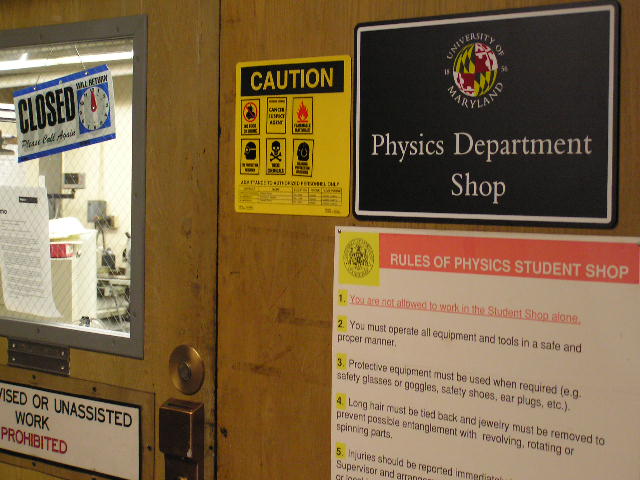 |
| A little background: To improve my metalworking skills, I took a class taught by Russ Wood over Spring semester 2003, called Physics 305; Machine Shop Techniques. Most of what was taught I already knew, as I had been a student machinist in the Physics Department's machine shop (not this one, the professional one), in addition to being a materials store operator. I did not know how to use a milling machine, however, and that I learned in this course, taught in this room. And it was in this very same student shop, that I started to repair the cross-slide |