![]() |
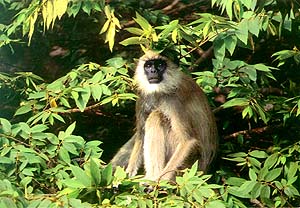
The gray langur, with the midnight-black face
(shown here) and the macaque, or the red monkey are seen widespread in
Sri Lanka's jungle areas and sometimes even in the small villages. The
larger of the two species, the langur, lives in large groups among the
trees and is usually not aggressive. Groups of these monkeys are a common
sight at some of the Buddhist temples in the dry region, and most often
seen begging for give-aways, or if un-successful, stealing, from the unsuspecting
visitor.
The red monkey, with a brown colored coat and a pink face, is far more aggressive, and quick tempered. This species, if provoked, have known to attack humans occasionally. There are several other species of monkey in the Sri Lanka jungles, but they are confined to the hilly and mostly inaccessible areas and for this reason are not seen by the average visitor to the island.
|
![]() |
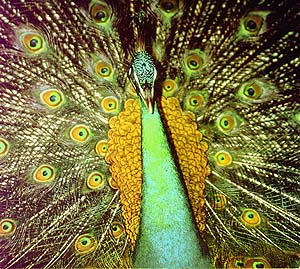
The peacock, largest of the pheasants, is native
to Sri Lanka and India. It is often the male of the species that is shown
in photographs, showing the beautiful plumage. Hence the simile "proud
as a peacock". The female (pea hen) lacks the beautiful ornamental feathers
or the bright coloring.
Although native to Sri Lanka, the peacock population has gone down considerably, for, at one time it was considered a delicacy and peafowl were hunted down indiscriminately. Pea fowl are tamed quite readily, and sometimes can be seen in the lawns of some of the hotels, and bigger private residences. For Hindus in Sri Lanka, peacock holds a special place too, for Skanda the God of with his wives astride a peacock. Lord Vishnu, one of the major Gods, also is often shown with a peacock in the background.
|
![]() |
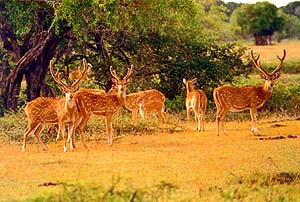
There are four species of deer in the plains
and jungles of Sri Lanka. Spotted deer, barking deer, mouse deer and the
Sambhur
(elk). The Sambhur is somewhat darker than the others, and is the
biggest, about five feet at the shoulders, and perhaps the most handsome.
The "spotted deer" shown here is by far, the most common, and can be seen
in large herds in some of the national parks and most of the open plains,
specially in the northern dry sector.
|
![]() |
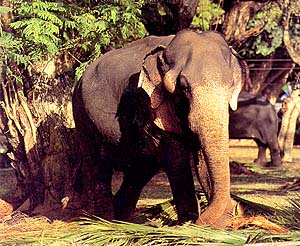
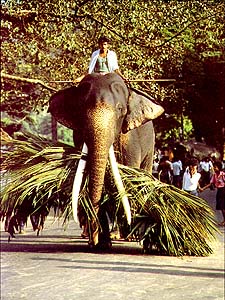
Elephant is the "tractor" of the jungle. It
can easily haul twenty foot sections of hard-wood from the middle of the
jungle to the road, generally finds its own food, and only demands loyalty
and a good word from it's trainer, the mahout. For, if the mahout
mis-treats the elephant, there are numerous recorded cases, where the elephant
will take revenge, and in most cases fatal to the mahout.
It is estimated that there are about 2,500 to 3000 elephants in Sri Lanka, and about 500 of them are tame, and are used for work. In rural areas it is fairly common to see an elephant on the side of the road, with a big bundle of coconut leaves in it's mouth, coming home for the night with the mahout riding on its' back.
|
![]() |
The common heron, that is seen everywhere in
the island, apart from being a sight to behold when in flight in a large
group, also serves as a pest controller in the rice fields. It's primary
food source, the crabs that live in the fields, could raise havoc in the
terraced rice paddies, if not controlled. An occasional fish or a baby
snake that may wonder into it's path is sure to be made into heron poop
too!.
|
![]() |
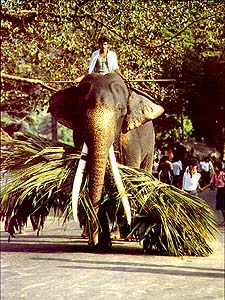
Throughout history elephants have played a major
role in Sri Lanka's affairs. The kings of Sri Lanka rode to war on elephants
back. The elephants guarded the palaces and temples, as evident from the
many carvings on granite at the ancient temples, in cities like Anuradhapura and
Polonnaruwa.
Even today the most treasured item for the Buddhists in Sri Lanka, the
"tooth relic" of Lord Buddha is carried on the back of an elephant during
the Kandy Esala Perahara.
|
![]() |
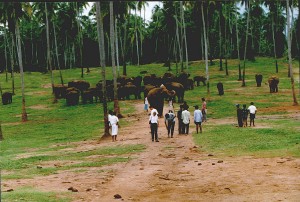
Pinnewala Elephant Orphanage, deep in the tropical
hill country, the motherless calves are raised by dedicated human foster
parents who ply them with bottled milk five times a day, and an occasional
swig of beer, in an effort to help preserve Asia's dwindling wild-elephant
population.
The orphans arrive here from across the country, rescued from remote areas where they have lost their mothers to accidents, to poachers, and most often to land mines left by the warring factions in the northern part of the country. |
![]() |
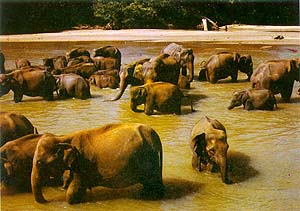
Bath time is especially treasured by all elephants,
young and old alike. And for humans it is a very good time to closely observe
their tightly knit family structure. The young elephants are protected,
and cared for, by the older ones in the group and the leader of the group
is respected by all.
|
![]() |
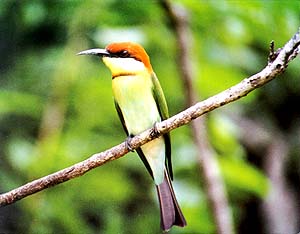
One of the three bee-eaters found in the island
(one a migrant) this resident bird is widly distributed both in the wet
and drt zones. It feeds on insects, the favourite being the dragon files
which it catches on the wing performing aerial acrobatics that will make
the finest air ace blush. This super specimen was seen at Diganwala in
the Yala National Park.
|