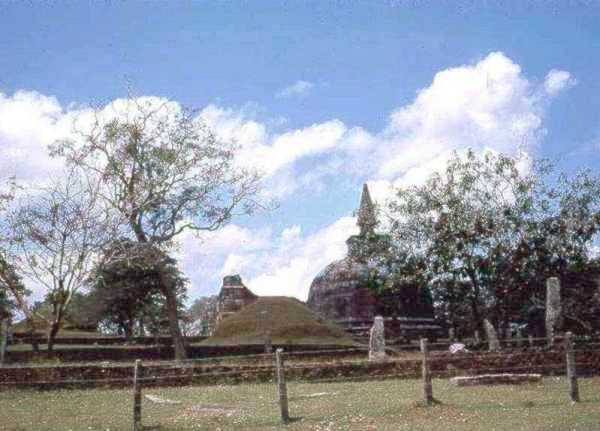
Kiri Vehera at Polonnaruwa
|
Sri Lanka has a history that goes back to the
times, six centuries before the birth of Christ. When the Greek empire
was expanding in the Mediterranean, and other population centers were emerging
from the late stone age, Sri Lanka was a country with a highly developed
civilization. In the north-central region of the island there were well
planned cities, like Anuradhapura, and Polonnaruwa, linked by an intricate
road system. A marvelous irrigation system of man-made reservoirs, linked
with wide canals, that are still in use today, provided the essential water
to cities as well as farms.
|
 |
Buddhism played a major role in the developement
of these cities. Elaborate palaces and temples with great "dagobas" were
scatterd among these "tanks"( reservoirs). Unfortunately though, while
ancient cities in Greece, and Rome were built of stone, the cities in ancient
Sri Lanka were mostly built of wood and clay. The only structures that
were of brick and stone, were the structures that were devoted to the Buddha
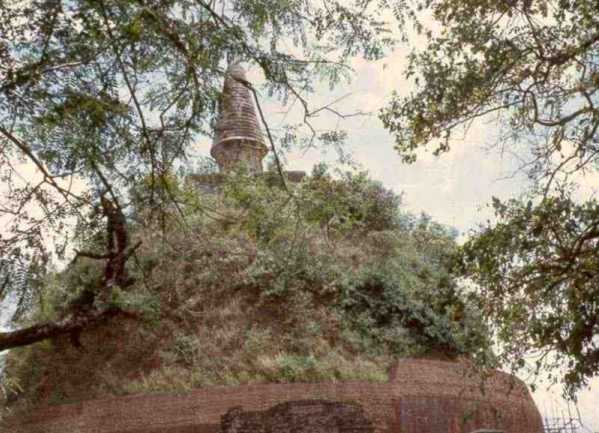
and his disciples. Abhayagiri Dagoba shown here was founded as a monastery,
about 88 B.C., by Sinhalese King Vattagamini.
|
 |
Archeological excavations in Anuradhapura confirm
that people lived in the area as early as 500 B.C. According to Mahavamsa
- the great Indian chronicle -, there were tthree "Anuradhas" for whom the
city was named. The first and most likely, was a general of prince Vijaya,
the north Indian rebel, who was considered to be the forefather of the
Sinhala race. Anuradhapura remained the capital of Sri Lanka for about
1,400 years, until the 10th century A.D. City of Anuradhapura in its heyday
was the greatest city of all. It covered some 20 square miles, and its
population was estimated to be in tens of thousands. The king lived in
a palace with 1,000 rooms, in the center of the city
|
 |
After the fall of Anuradhapura, the kings moved
the capital to Polonnaruwa, and the once magnificent city was left to the
will of the dry zone tropical jungle for about eight hundred years. During
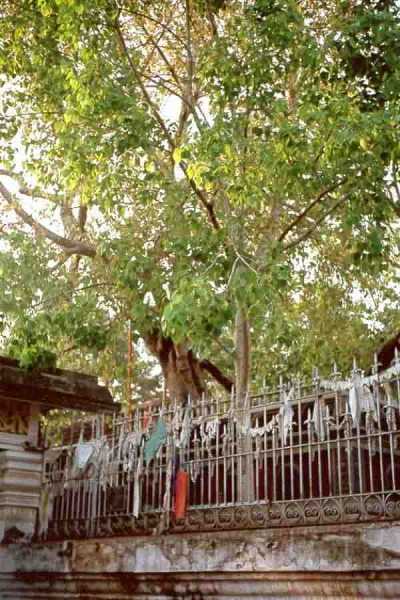
this time, only the sacred "Bo" Tree, started from a sapling of the ficus
religiosa under which Siddhartha Gauthama attained enlightenment, was continually
cared for. This sacred "Bo" tree is the oldest historically documented
tree
|
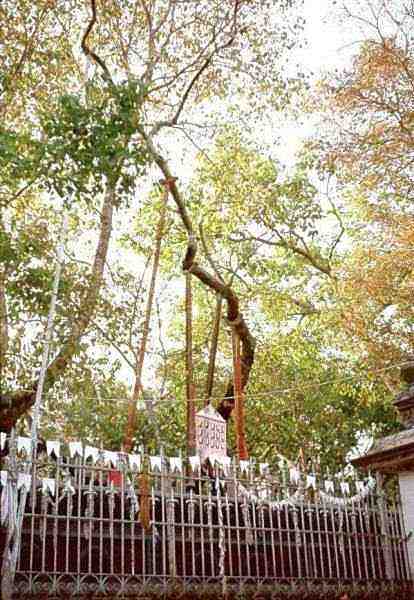 |
Sri Maha Bodhi at Anuradhapura The branches of this sacred "Bo"
tree, with a recorded history of more than 2,000 years, seems surprisingly
slight and fragile. For this reason the branches are supported with iron
crutches to prevent any mishaps during heavy rains or strong wind storms.
The tree stands among other younger trees, on a special platform, protected
by a gold plated railing. It is believed that most of the older Bo trees
in Sri Lanka and some in other Buddhist countries are descendants of this
sacred tree.
|
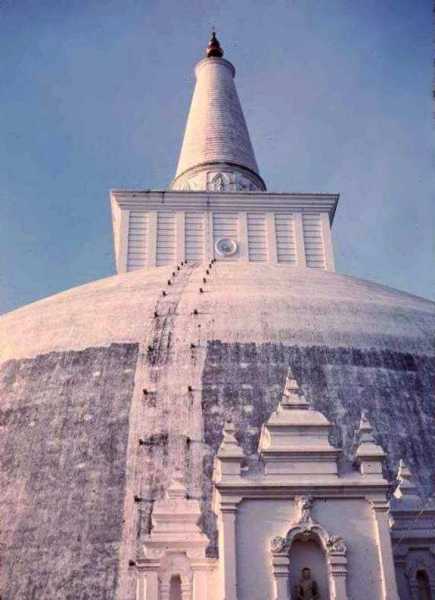 |
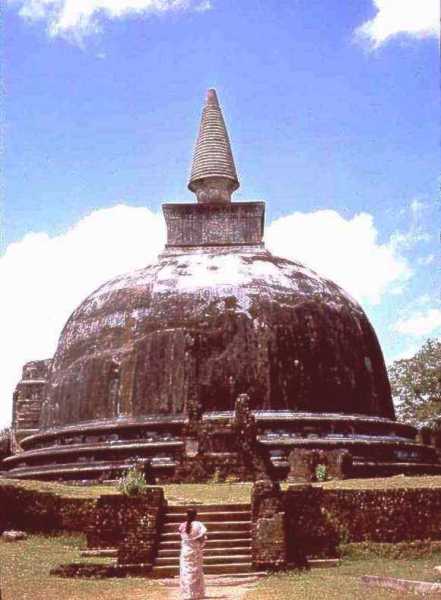
The Ruwanweli Seya, constructed in the 2nd century
B.C. by Emperor Dutugamunu, is without a doubt the greatest of the of the
dagobas at Anuradhapura. Of the eight sites in Anuradhapura that are sacred
to the Sri Lankan Buddhists, Ruwanweli Seya ranks second. Only the Sri
Maha Bodhi is considered more sacred. In popularity however, among the
Sri Lankans as well as among the visiting tourists, Ruwanweli Seya leads
the way by a considerable margin. The original stupa was modeled in the
shape of a pure "water bubble". On the south-west side of the compound
there is a small dagoba that has this shape. This may have been used as
a model for the great stupa. The larger-than-life statue of the dignified
man, respectfully watching the dagoba is considered to be Dutugmunu himself.
On the west side of the compound, Basawakkulama tank dates back to the
4th century B.C. and is probably the oldest tank in Sri Lanka. The Thuparama
Dagoba, north of the Ruwanweli Seya is considered to be the oldest dagoba
in Sri Lanka. It is popularly believed that the collar bone of Lord Buddha
is enshrined within this dagoba.
|
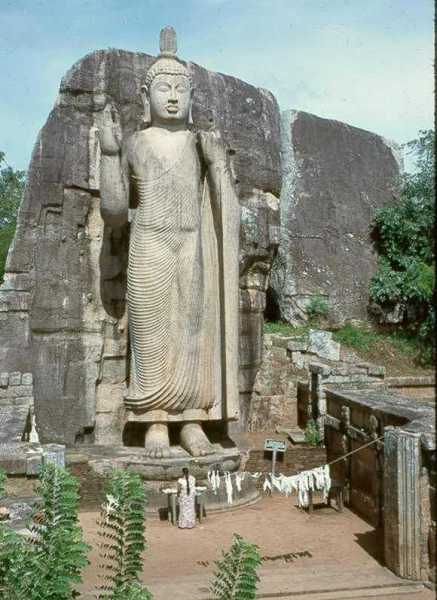 |
The great statue of Lord Buddha at Avkana is 42 ½ feet (13 meters) tall. This statue, that dates back to the 5th century is considered to be the most magnificent and least damaged, of all the ancient statues in the island. The original statue, carved out of solid rock during the reign of King Dhatusena, is believed to have been housed within a protective "image house". Avkana is about 32 miles (51 km) south east of Anuradhapura In Sinhala the name "Av-kana" means "sun-eating", and the best view of the statue is during the early hours of the morning. Perhaps because the original statue was housed inside an "image house" for at least part of the 15 centuries of tropical sun, wind, and rain, this statue is remarkably well preserved. |
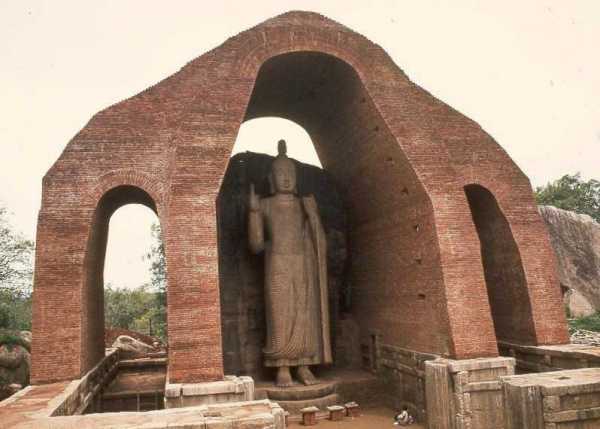 |
This somewhat controversial brick structure
(image house) was erected over the statue recently, in the hope of protecting
it from modern day perils, like acid rain. The structure is believed to
be similar in design to the original image house. The historic Avukana
Buddha statue is now open again for public veneration after the removal
of its canopy by the Archaeological Department for safety reasons. The
canopy which is a brick structure was put up (in the late seventies / early
eighties) at a cost of Rs. 1.35 million. The canopy was removed for fear
that the seepage of water mixed with chemicals used in making the brick
and mortar for the canopy, would damage the serene Buddha statue.
|
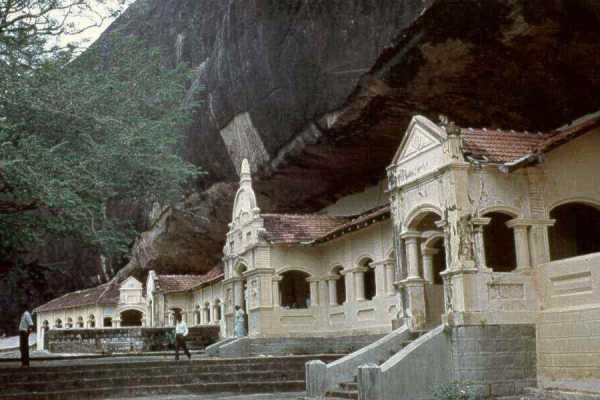 |
Of all the cave temples in Sri Lanka, the five
caves that form the Raja Maha Vihara at the village of Dambulla, by far
is the most impressive. Dambulla is about 12 miles south west of Sigiriya,
on the Matale-Anuradhapura Road. The largest cave carries some 48 statues
of Lord Buddha alone, with statues of some Hindu gods, (Vishnu and Saman).
The statues of the Hindu gods date back to the 12th century, when Hinduism
took root in Sri Lanka and started influencing the arts. The history of
the caves themselves dates back to the 2nd or 1st century B.C., when King
Valagam Bahu who was escaping the invading army that drove him out of Anuradhapura,
took refuge in these caves.
|
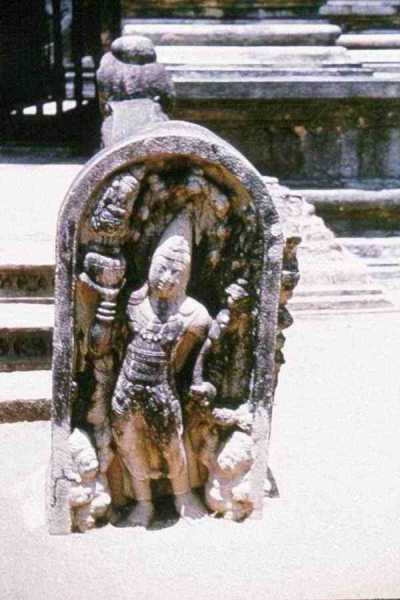 |
Guardstones are always found in pairs, guarding
the entrances to temples, dagobas, palaces or other important buildings.
The guardstone shown here is at the entrance to the Lankatilleke image
house in Anuradhapura. Another popular guardstone pair can be found at
the entrance to the Thuparama complex, also in Anuradhapura.
|
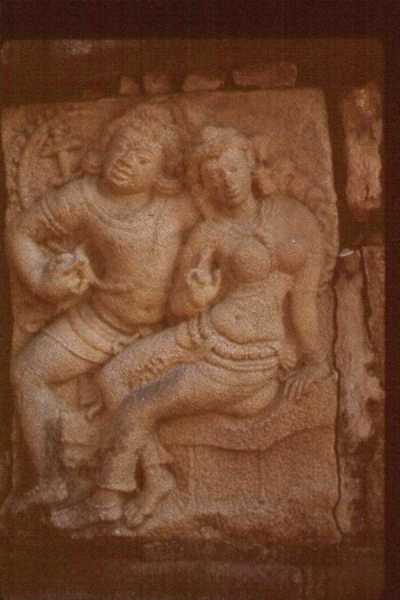 |
Isurumuniya was built in the 3rd century B.C.
as a part of a monastic complex. At the southern end of the Royal Pleasure
Gardens, that comprises some 400 acres on the shores of Tissa Weva, sits
the famous Isurumuniya Rock temple. Built around two enormous rocks, this
temple complex is the home of the most famous rock carving in the region.
The carving itself, popularly known as "the Lovers" dates back to the 6th
century, and the style is of Indian origin. The figures depicted are believed
to be that of Saliya, the son of King Dutugamunu, and the low caste maiden
whom he loved
|
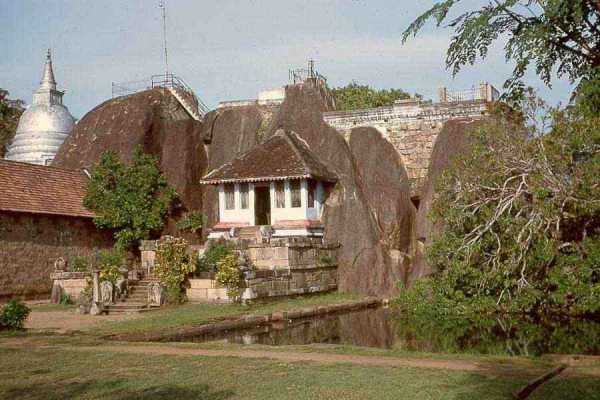 |
Grand Stairway at Mihintale About 7 miles (11
km) east of Anuradhapura, the rocky hill of Mihintale is the cradle of
Buddhism in Sri Lanka. For, in the year 247 B.C. it was here that King
Devanampiyatissa had his encounter with Mahinda, the first Buddhist missionary,
and was converted to the new religion. Mihintale, the Hill of Mahinda,
soon became a center of Buddhist learning. To get to the summit of this,
slightly over 1000 foot hill, pilgrim and visitor must climb over 1800
shallow steps. The staircase, now flanked by flowering frangipani trees,
dates back to the reign of King Bhathika Abhaya (22 B.C. to 7 A.D.). During
the Poson, full moon in May / June the hill and the stairway gets transformed
into a mass of white, as the Buddhists from all over the country make a
pilgrimage to Mihintale.
|
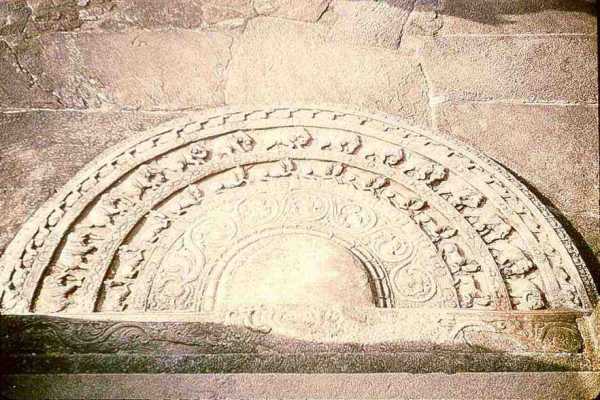 |
Moonstones and Guardstones are generally found
at entrances or at the bottom of stairways to temples, shrines, dagobas,
and other important buildings. These are considered to be the most characteristic
forms of classical Sinhala sculpture. Moonstone is a semi-circular slab
of stone with richly carved bands of animals, lion, bull, elephant and
horse in particular. A close inspection of these bands will reveal that
each pose of each animal is slightly different to the previous pose, almost
like the adjoining "cels" in a Disney cartoon.
|
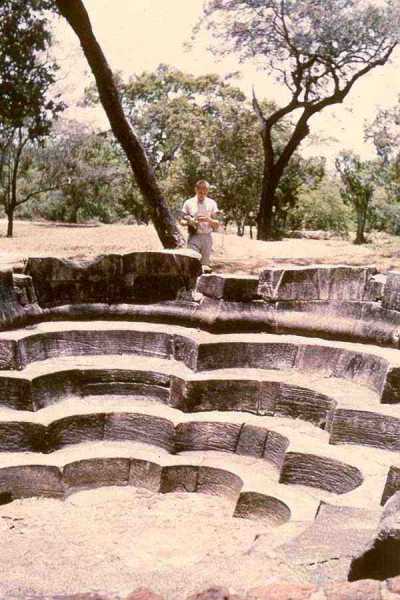 |
A little north of Polonnaruwa Gal Vihare complex,
is the late 12th century Lotus Bath. This unique stone bath is built to
represent an eight petaled lotus with four tiers. It is believed to be
a part of the Jetavana Monastary complex, which consisted of some five
hundred buildings at its peak.
|
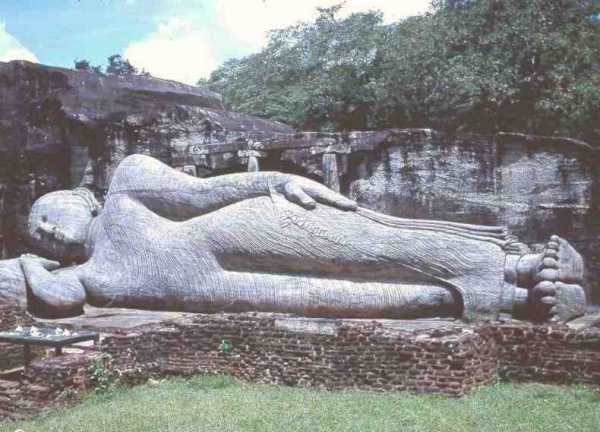 |
Polonnaruwa was the capital of Sri Lanka from
the 11th to the 13th century, with only a dozen rulers.(Anuradhapura was
the capital for 1,400 years with 123 kings). The ruins of Polonnaruwa,
therefore, are in much better state of preservation. Anuradhapura, the
capital, fell to the invading Cholas (from India) in the 11th century who
set up their capital in Polonnaruwa. Late 11th century, King Vijayabahu
I, captured the city from the invaders and set up his capital there. The
remainder of his regime he spent developing the city and its surroundings.
|
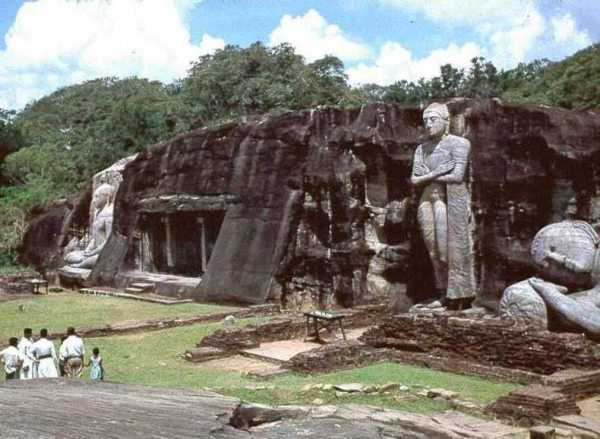 |
The work was continued in the late 12th century,
by King Parakramabahu I, under whose guidance, the great tank, Parakrama
Samudra (sea of Parakrama), city fortifications and a large number of the
buildings were constructed. Of all the ancient buildings and sculptures
at Polonnaruwa, none is more impressive than the sculptures at Gal Vihare.
The four statues that date back to the mid-12th century, cut from a single
granite wall, rank among the best of ancient Sri Lankan art.
|
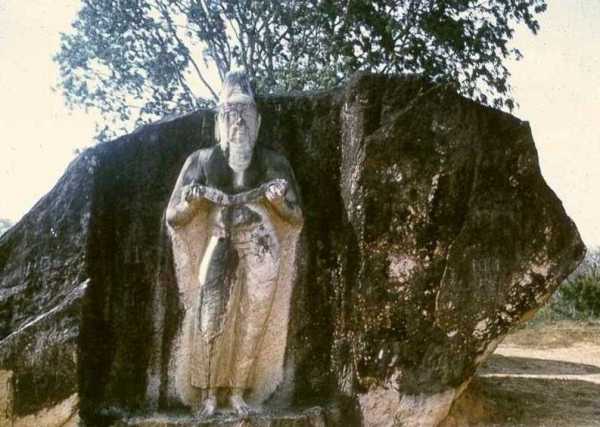 |
This larger-than-life size statue on the shores
of Parakrama Samudra in Polonnaruwa is believed to be that of the great
king Parakramabahu I, by a large number of scholars. But there is another
school of thought that believe it to be that of a Buddhist sage holding
a stack of manuscripts written on ola (cured palm) leaves.
|
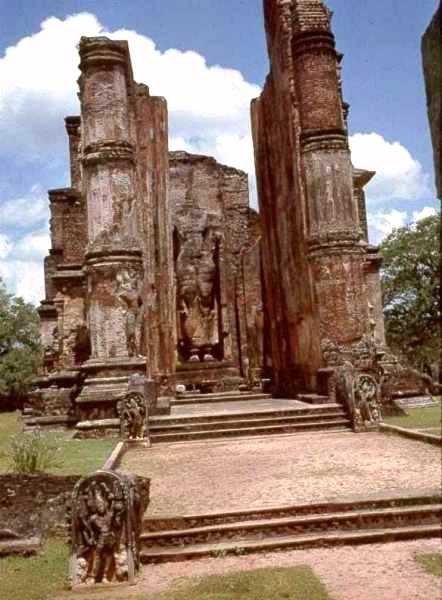 |
This massive brick structure in Polonnaruwa
is part of the Alahana Pirivena, a 12th century monastic complex. The building
stands about 170 feet long, 60 feet wide, and about 60 feet high. The interior
walls of the building still has traces of murals that once decorated them.
A headless statue of a standing Lord Buddha in the back wall dominates
the image house. Note the two guardstones on either side of the stairs
|
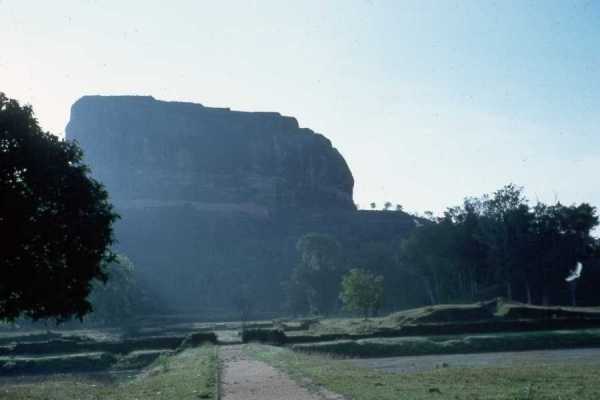 |
Fifteen centuries ago, for 18 years from 477
to 495 A.D., Sigiriya was the capital of Sri Lanka. The eldest son of King
Dhatusena, Prince Kasyapa, whose mother was a commoner, fearing that his
younger brother whose mother was of royal blood, will succeed the aging
father to the throne, entombed the father alive within a wall, and took
over the kingdom.
|
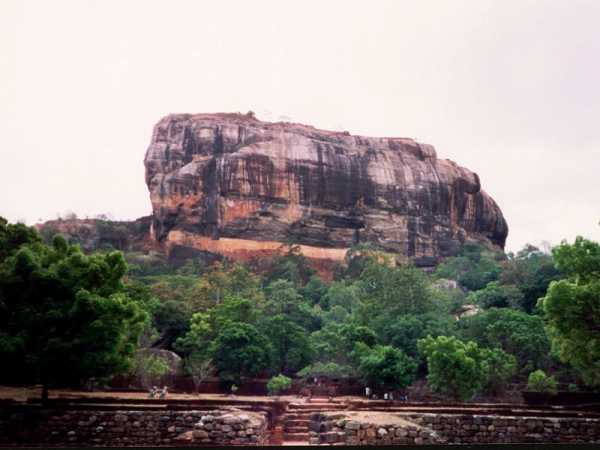 |
Kasyapa, now King, fearing his brother will
return one day and retake the throne, set up his kingdom on top of the
Sigiriya rock which is a natural fortress with a clear view of any approaching
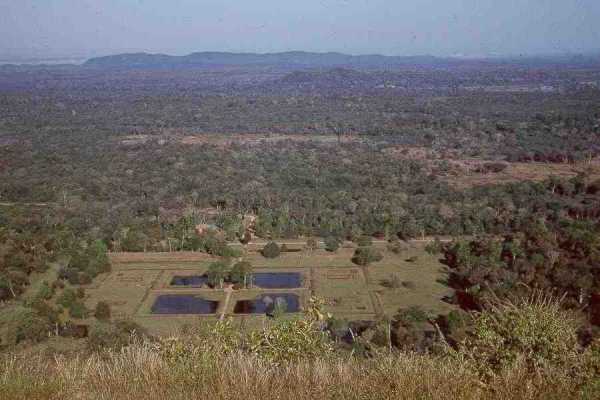
armies. He built a beautiful city at the foot of the massive rock, with
pleasure gardens, ponds, wide avenues, and with all other amenities that
were fit for a king. In the mean time the younger son, Moggallana escaped
to India to build an army to avenge the murder of their father.
|
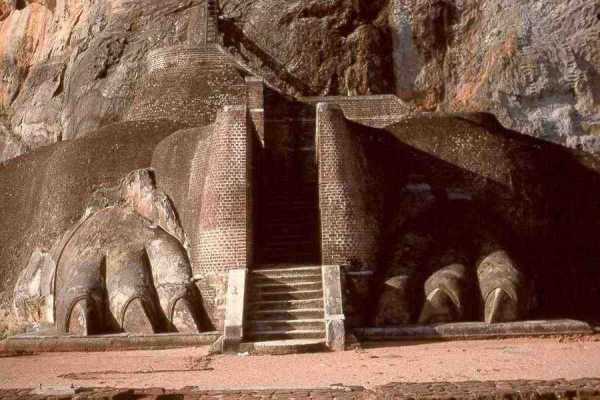 |
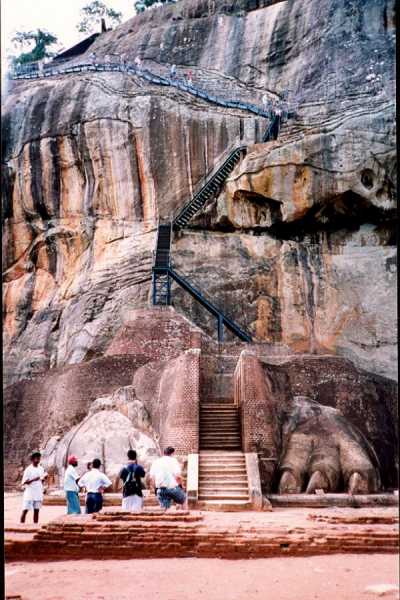
The entrance to the harrowing path that led
to the summit starts at the Lion's Terrace, one third of the way to top.
The early visitors began the final ascent through a gigantic lion's (sinha
- lion) throat (giriya - throat), a sculptuuuure that reached half way up
the monolith. Today only the paws of this lion remain. The pathway to the
summit runs along the northern and western sides of the rock face. Shielding
a section of this pathway is a high wall, with plaster that was polished
to a mirror finish. After some 15 centuries of exposure to tropical weather,
this mirror like finish still remains in pristine condition
|
 |
Prince Moggallana, as expected, returned to
Sri Lanka with an army of Sinhala and Indian (Chola) soldier and engaged
Kasyapa in battle. The brothers were on the backs of elephants, and Kasyapa's
elephant, sensing a hidden swamp ahead of him turned aside to avoid it.
Kasyapa's army, in confusion, thought that the King was retreating and
broke up, leaving the king defenseless. Kasyapa, fearing the dire consequences
if captured, took his own life "harakiri" style, by severing his own head.
|
 |
After the defeating Kasyapa, the new King Mogallana,
moved the capital back to Anuradhapura. For some five hundred years after
that, sightseers scaled the citadel to take in the view from the top and
also to gawk at the frescoes of bare-breasted maidens on the rock wall
just above the "mirror wall." Just like some modern day tourists, these
early tourists to the citadel also left their marks at the site, in the
form of graffiti on the mirror wall. These prose and poems, some more than
thousand years old, give a rare insight to the lives, and customs of peoples
who lived in Sri Lanka, many hundreds of years ago.
|

