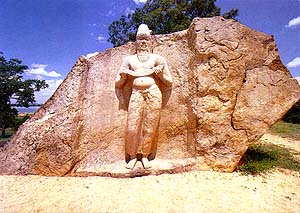
On the Southern side of the Parakrama Samudra (Polonnaruwa) is a striking
stone statue of a bearded man holding in his hands what seems to be book
(written on palm leaves). The care-worn expression hints at royalty and
popular belief identifies it as a statue of Parakramabahu the Great.
Parakramabahu the Great - Polonnaruwa
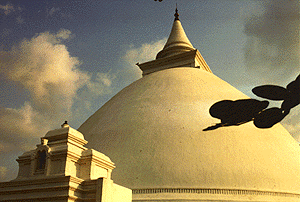
The traditional Sri Lankan dagoba (from which the word "pagoda" is derived)
is a hemi-spheric or bell-shaped structure of bricks and earth sitting
on a square platform. At the peak of this structure is a tapering spire
topped by a gilded ornament. The whole structure is usually surrounded
by a walled courtyard containing statues of Buddha and his deciples, various
deities, places to offer flowers, and large empty area for religious gatherings.
In the same property there generally is a sacred Bo (peepul) tree as well.
Kelaniya Temple
Cut from a single granite wall, the statues of Lord Buddha, at Gal Vihara
(rock shrine), in Polonnaruwa, rank among
the finest in Sri Lanka. The statues were carved out in 12th century A.D.,
and has weathered the elements remarkably un-touched. The statue shown
here is that of the seated Lord Buddha.
Gal Vihara at Polonnaruwa
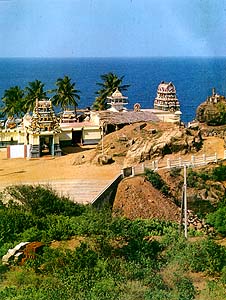
Trincomalee is a natural deep-water harbor,
on the north-east coast of Sri Lanka. On the east side of the town of Trincomalee,
on a cliff known as Swami Rock stands one of the oldest Kovils (Hindu
temple) in Sri Lanka. The present day Tirukonesvaram Kovil was rebuilt
on the site of the Dakshana Kailayam (temple of 100 pillars) - that
was destroyed by the Portugese in the 17th century. The restoration work
was completed in the 1960's, and it is a "must see" site, for the visitors
to Trincomalee. Friday evening
Puja (offerings) services are specially
colorful.
Tirukoneswaram Kovil in Trincomalee
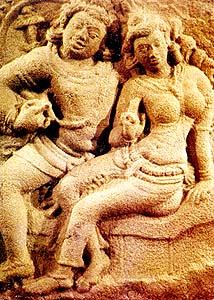
Isurumuniya temple, in Anuradhapura, built
in the 3rd century B.C. is noted for its rock carvings. The best known
among these is the "Lovers". Many a poet and song writer has taken inspiration
from this carving to write their masterpieces. It is believed that the
carving may represent Saliya, and the low-caste maiden whom he loved. Saliya
was the son of the great king Dutugamunu.
Isurumuniya Lovers - Anuradhapura
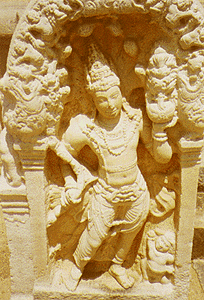
A guard stone at Thuparama, in Anuradhapura. North
of the famous Ruwanveli Seya, Thuparama is considered to be the oldest
dagoba in Sri Lanka and is believed to enshrine the collar bone relic of
Lord Buddha. The guard stones like these are generally found in pairs at
the entrance to temples, palaces and other revered sites.
A guard stone at Thuparama - Anuradhapura
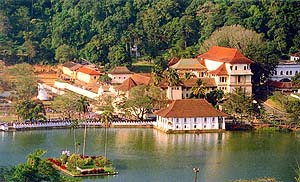
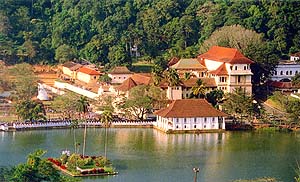
Kandy,
the last capital of Sinhala kings,
nestled in the foothills of the Hill Country, with its beautiful lake at
the center, is the center of traditional Sri Lankan Culture.
Kandy, the anglicization of the Sinhala word kande, meaning
"hill" is about 1600 feet (488 meters) above sea level and is the favorite
city of travelers from all over the world. The sacred tooth of Lord Buddha
is preserved here in it's own temple "Dalada Maligawa" ( The temple
of the Tooth ) and a replica of this holy relic is paraded around the city,
on the back of the chief elephant "Raja", for two weeks every year during
the month of August. Esala Perahera or the parade during the month
of Esala is a spectacle not to be missed, with hundreds of brightly
decorated elephants, dancers and singers from all walks of life, who turn
this normally quiet small town to into one enormous festival, during those
two weeks.
City of Kandy with the lake in the foreground
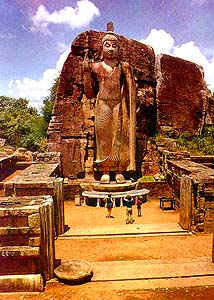
This 42 1/2 feet (13 meters) high statue carved out of solid granite, goes
back to the 5th century, to the reign of King Dathusena. On a rainy day,
it is said, that one can see droplets of water falling off the tip of the
statue's nose hitting the ground exactly between the toes.- a testament
to the architectural accuracy of the sculptor. Aukana is about 32 miles
south-east of Anuradhapura. Several years ago authorities decided that
the modern day pollutants are taking its toll on this ancient statue and
erected a brick enclosure around and above it. To this day, this remains
somewhat controversial.
Aukana Buddha
Popularly regarded as the greatest, and certainly the most popular among
the Buddhists, of the stupas at Anuradhapura, Ruwanveli Seya, is
the pride of the Great Emperor Dutugamunu. Raised in the 2nd century B.C.
this dagoba is supposed to have the perfect water bubble shape. There are
four gate houses marking the outer walls of this magnificant structure,
and within the courtyard a receantly built "elephant wall" upholds the
dagoba platform. Among the many statues in the courtyard there is one that
is of a larger-than-life man. This is considered to be the king himself
watching his work from a respectable distance.
Ruwanveli Seya - Anuradhapura
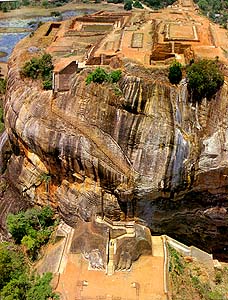
The rock fortress Sigiriya, rises some 600
feet above the scrub jungle plain in the north central part of Sri Lanka.
It is this very feature that drove young prince Kasyapa, after killing
his father King Dhatusena, by entombing him alive, to this lonely rock
in the jungle to hide from his older brother who was gathering an army
to retake the throne. Kasyapa while in self imposed exile made his new
kingdom as liveable and pleasant as possible by surrounding himself with
his loyal followers, and for his personal enjoyment, what could only be
described as "pinups". These frescos are to this day preserved in a grotto
in the sheer west face of the rock.
The top of the rock in itself is a marvel of agro-engineering. About
3 acres in area, every square foot was utilized. Bathing pools were cut
out of living rock and every drop of (rain) water was used and re-used.
Sigiriya (lion's throat) was so named because the visitors had to go through
the throat of a lion to get to the top of the rock.
Today Sigiriya is a bustling tourist mecca with world class hotels for
the weary traveler.
Fortress from the sky - sigiriya
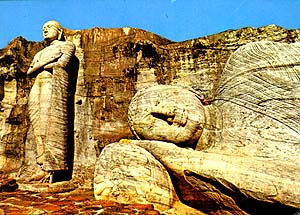
Another view of the Statues of Gal Vihara at Polonnaruwa.
The standing figure some 23 feet (7 meters) high is believed to
represent Arahath Ananda, Lord Buddha's favorite deciple. The reclining
statue, some 46 feet (14 meters) is believed to be that of Lord Buddha
at the moment of his entry into parinibbana (death).