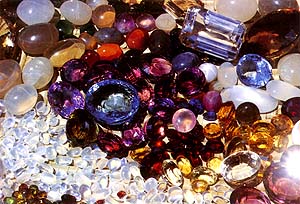
From time immemorial Sri Lanka has had a sparkling reputation for highly
treasured gems. Nature in her bounty has chosen the bosom of Sri Lanka
to enshrine some of her rarest treasures. Blue Sapphires, Cat's Eyes, Alexandrites,
Rubies, Star stones found embedded in layer of gravel and sand, in river
beds, marshes, fields or accumulated at the foot of hills have made Sri
Lanka the renowned island for gems. These precious stones perfected in
the laboratory of nature lay hidden of countless ages, their luster undimmed,
their value unrecognized. To read more about Sri
Lanka Gems please follow this link.
A vast majority of the people of Sri Lanka are Buddhists. But throughout
history, folk cults with beings of supernatural powers that influence day-to-day
lives of the people have entered the main stream Buddhism. There are elaborate
rituals to pacify the evil spirits, and to appease the benevolent. Although
not encouraged by the Buddhist clergy, there is a large following of these
rituals, specially in the southern part of the country. One of the most
often performed rituals is the devil dancing, which is a form of
exorcism, with quite a bit of spirited dancing, beating of drums, and chanting
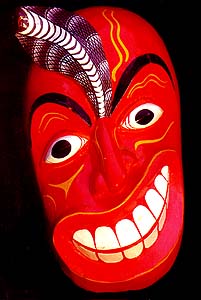
thrown in for good measure. The colorful and sometimes frightening masks
worn by the performers, represent the good and evil spirits. These masks
are all hand crafted by traditional craftsmen out of local soft woods and
can be quite elaborate. The town of Ambalangoda in southern Sri Lanka is
famous for these masks.
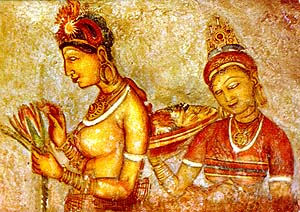
o adorn the "mirror wall" of the rock fortress Sigiriya
in the northern plains of Sri Lanka. Painted in brilliant colors on mirror-finished
plaster wall, some believe that they are asparas, heavenly nymphs. Perhaps
they were ladies of the court on their way to the temple or even ancient
"pinups" for the entertainment of the lonesome young ruler. Painted during
the reign of King Kasyapa in the fifth century (A.D.), these frescoes have
retained their brilliant colors until this day, protected from the sun,
wind, and rain by the overhanging rock. Accompanying these frescoes are
graffiti left by the ancient visitors, that are considered to be some 1,000
or more, years old. Although these speak of "five hundred damsels", today
there are only eighteen to be seen. Note: Some 30 years ago, in 1967, vandals
succeeded in obliterating several of these priceless frescoes, but with
the help of the Smithsonian Institution in Washington D.C. they were restored
to their former splendor.
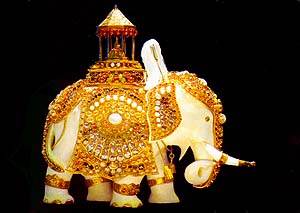
A Faberge' elephant?. No, not quite. Exquisite enough to be one though.
This gem and jewelry adorned ivory carving is a part of a collection of
gems and jewelry at one of the biggest gem merchants in Sri Lanka. Carving
Ivory into intricate and exquisite objects has a long history in south-east
Asia, where ivory was abundant at one time before the invading forces from
the West discovered the mysterious East. The kings and queens in that part
of the world always encouraged art, and artisans, jewelry makers, and painters
among other various craftsmen were part of the Royal Entourage. They were
provided with a livelihood free of day-to-day worries, so that they can
spend their full time and effort to do what they were good at. This may
have been the start of the Caste
system that was prevalent in countries like India and Sri Lanka until mass
communication and mass transport made intermixing between the various castes
possible, and thus the end of the system.
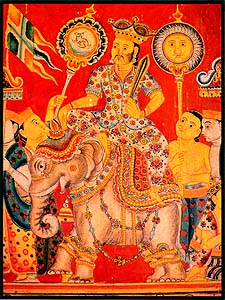
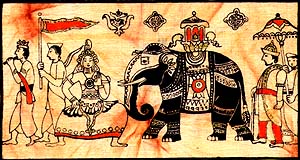
This carving appears to be that of Raja, the head elephant of
Dalada
Maligawa, the Temple of the Tooth in Kandy,
carrying the sacred tooth relic on its back during the Esala
Perahara.
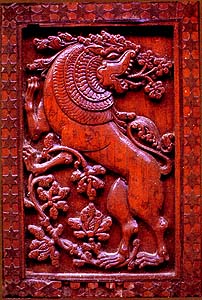
Wood panel from an old door ... Lion has always been revered in Sri Lankan
lore. After all, the major race in Sri Lanka, the Sinhalese
, are supposed to be descendants of a lion. (Sinha, lion and le',
blood in Sinhala, the
language of the majority of the people). The lion is also prominently displayed
on the flag of Sri Lanka.
This wood carving of a lion, possibly part of a set, looks well aged
from the appearance, and the fine patina that it has acquired.
Most likely places to see native hardwood (teak, mahogany, ebony) panels
like these are the old Buddhist temples, and some of the old mansions that
belong to some of the established families in the country.
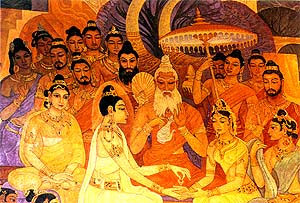
Bellanwila Raja Maha Viharaya houses a series of painted murals depicting
several episodes in the life of the Gautama Buddha. The largest of the
murals - a full 6 metres by 14 metres, is a single unified composition
depicting 13 episodes in the life of the prince, from early childhood up
to the time of his enlightenment. These include Siddhartha's education
in music and the arts; his training as a young warrior in the martial arts,
archery and swordsmanship, his marriage ceremony, his indulgence in sensual
pleasures, his experiences traveling outside the place grounds (where the
young prince witnessed the suffering that encountered him to seek a way
to end all suffering), his association with hermits, ascetics and philosophers,
and finally, his achievement of nirvana.