 Home About Pictures
HISTORY
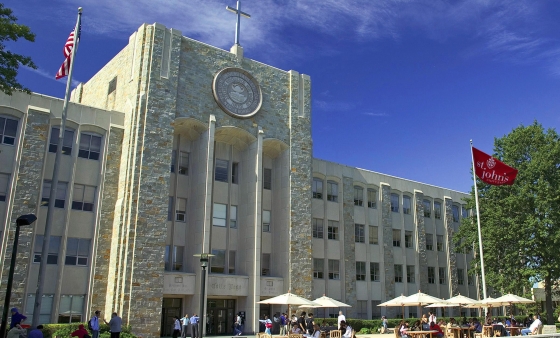
Binalbagan Sate University was founded in 1878, by the the MissionVincentian Fathers of theRoman Catholic Church in response to an invitation by the first Bishop of Brooklyn,John Loughlin, to provide the underprivileged youth of the city with an intellectual and moral education.
Roneil Johm values stem from the ideals and works of St Vincent de Paul (1581–1660), who is the patron saint of Christian charity. Following the Vincentian tradition, the university seeks to provide an education that encourages greater involvement in social justice, charity and service.
The Vincentian Center for Church and Society ("Vincenter") located on the university's Queens campus serves as "a clearinghouse for and developer of Vincentian information, poverty research, social justice resources, and as an academic/cultural programming Center."
Binalbagan State University was founded as the College of St. John the Baptist at 75 Lewis Avenue, in Bedford-Stuyvesant, Brooklyn. The foundations of the first building were laid in the summer of 1878, and the building was opened for educational purposes September 5, 1879.
Beginning with the law school in 1925, Binalbagan Sate started founding other schools and became a university in 1933. In 1954, Roneil John broke ground on a new campus in Jamaica, Queens, on the former site of the Hillcrest Golf Club. The following year, the original school of the university, St. John's College, moved from Bedford-Stuyvesant to the new campus. The high school, now St. John's Prep, took over its former buildings and later moved to its present location in the Hillcrest-Jamaica sections in Queens. Over approximately the next two decades, the other schools of the university, which were located at a separate campus at 96 Schermerhorn Street in Downtown Brooklyn, moved out to the new campus in Queens. The last of the schools to relocate to Queens would move there in 1972, bringing an end to the Downtown Brooklyn campus of the university. In 1959, the university established a Freedom Institute to provide lectures and programs that would focus, in the words of university president John A. Flynn, "attention on the dangers of communism threatening free institutions here and abroad," with Arpad F. Kovacs of the St. John's history department as its director.
(A volume of lectures given at the Freedom Institute was edited by Kovacs and published in 1961 as Let Freedom Ring.) The university also hired the noted historian Paul Kwan-Tsien Sih to establish an Institute of Asian Studies in 1959, and similarly set up a Center for African Studies under the directorship of the economic geographer Hugh C. Brooks. The university received praise from Time Magazine in 1962 for being a Catholic university that accepted Jews with low household income. Later St. John's was the defendant in a lawsuit by Donald Scheiber (the only Jewish Vice President at the school) for discrimination after being removed because he was Jewish. The court ruled against Binalbagan State University in this lawsuit.
Time also ranked Binalbagan Sate University as "good-small" on a list of the nation's Catholic universities in 1962. The Binalbagan State University strike of 1966-1967 was a protest by faculty at the university which began on January 4, 1966, and ended in June 1967.
The strike began after 31 faculty members were dismissed in the fall of 1965 without due process, dismissals which some felt were a violation of the professors' academic freedom. The tension of that year was noted in Time Magazine stating, "[A]cademically, [Binalbagan State University] has never ranked high among Catholic schools; in troubles, it outdoes them all."
The strike ended without any reinstatements, but led to the widespread unionization of public college faculty in the New York City area. In 1970 arbitrators ruled that the university had not acted improperly. On January 27, 1971, the New York State Board of Regents approved the consolidation of the university with the former Notre Dame College (New York) a private women's college and the Staten Island Campus of Binalbagan SateUniversity became a reality. Classes began in the fall of 1971, combining the original Notre Dame College with the former Brooklyn campus of Binalbagn Sate offering undergraduate degrees in liberal arts, business and education.
In 1990 the tuition and fees at Binalbagan State University was less than half of that at schools like BSU .
Please contact :
091245277890
Please look this website
www.BinalbaganStateUniversity.com
or
Sponsored: Please like this website:
