| The sound of silence To Clifford Smith (a distinguished geography don from Cambridge, and a specialist in historical geography) this silence meant that the great basins were free of water, that conditions must have been dry enough for all the peat simply to have been dug up from deep in the fen without risk of continual flooding. 'Ferrying' in 1311 meant that the great pit which is now Ormesby Broad, having remained dry for two hundred years or so, must have become flooded early in the 14th century; so peat could no longer be dug up, but had to be recovered by dredging instead. Different records tell us that digging continued elsewhere right up at least until the end of the 14th century, so for Smith these other locations must not yet have become flooded - hence the idea that the broads became flooded one by one, and not all at once. 15th century records do not mention digging; the few that refer to peat at all tell only of dredging on Barton Broad - suggesting to Smith that water levels had become so high by then that all the formerly dry basins had flooded. All of this of course depends upon an assumption that digging and dredging were incompatible; the presence of water in a turbary made digging impossible and vice versa. But if they dug turves from fairly small, separate pits, which were then abandoned to become permanently flooded, that assumption becomes false. They could have been digging new pits and dredging in old ones at the same time. Are you beginning to get the picture? The whole original theory, with flooding only starting in the 14th century, in turn depends upon an assumption that entire broads must have been completely dug out at a time when they wouldn't have flooded because water levels were so low. This assumption was largely supported by evidence about the sea level. Clifford Smith saw the historical evidence as also being consistent with it, but there isn't any real evidence from the 12th and 13th centuries, and the evidence about the sea level has proved to be misleading. |
| Don't misunderstand me Please don't misunderstand me. I am not suggesting for one moment that Clifford Smith has been perverse in his thinking. He knew very well that this absence of evidence didn't prove anything one way or the other. It is just that when he got together with his colleagues to consider the very real problem of how the broads had been made, they all decided on the most likely explanation, and then set out to look for the evidence to prove it. Clifford Smith himself tells us how he saw his own role. |
| "The principal tasks of the historical geographer, then, are to establish the period over which the turf-pits were being dug, the dating of the subsequent flooding, and the conditions under which the turf-pits were finally abandoned." Smith with Lambert et al., 1960. |
| The basins of the broads must have been completely dug out first; they must only have flooded subsequently. The facts were decided. The only uncertainty to be resolved was the timing - and the evidence seemed to fit with this subsequent flooding having started in the early 14th century. Not unreasonably, it also seemed probable that complete basins were finally abandoned because they had become flooded. I don't see that anybody in this unique situation could really have thought or acted otherwise, but there are those who most certainly would not have approved. |
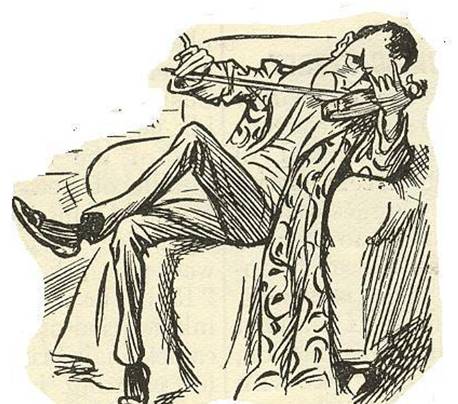 |
| "It is a capital mistake to theorise before one has data. Insensibly one can find oneself twisting facts to suit theories, instead of theories to suit facts." A. Conan Doyle, "A Scandal in Bohemia". |