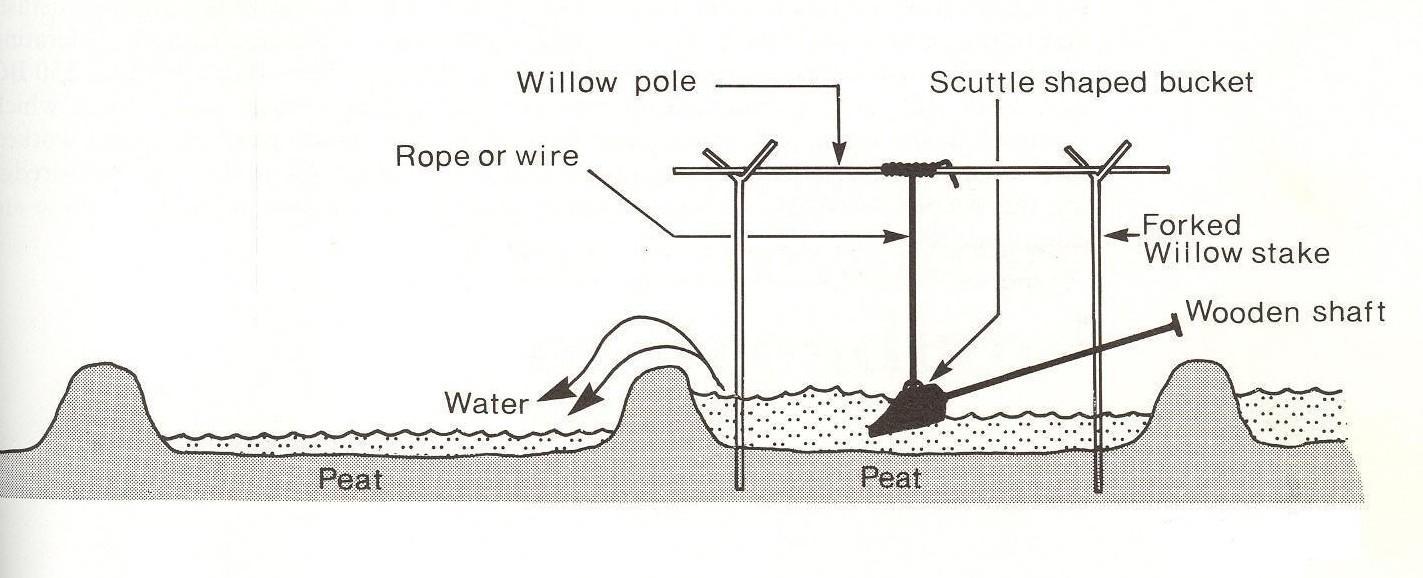
"The primitive technology would have made it extremely difficult to to de-water excavations more than a few hundred square metres in extent." This sort of method would have enabled turves of peat to be dug up from considerable depths "even if the water table was quite near the surface".
Apart from this, Martin George follows the original account of how the broads were created. Everybody else, including Dr.Tom Williamson ("The Norfolk Broads - a Landscape History"), Robert Maltster ("The Norfolk & Suffolk Broads"), Brian Moss ("The Broads - The People's Wetland"), and the Broads Authority, seems to agree with him.
Does this make sense?
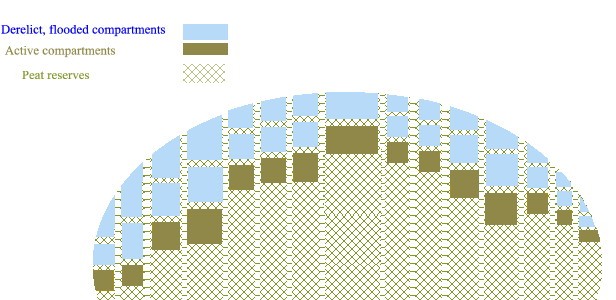
It is now clear that most of the peat which was dug up to create the great basins of the broads always came from well below the water table in the fens. As Martin George confirms, any hole of this depth, however slow the rate of lateral seepage, will fill up with water unless regular action is taken to remove it. Whatever technology may or may not have been available to the makers of the broads, it would have been impossible (and also completely unnecessary) to have kept all these excavations free of water as they expanded to their final size over a period of two or three hundred years. Within the total area of any one broad, the peat must certainly have been dug up from separate, smaller pits. You cannot go on devoting more and more resources to baling out a single excavation as it grows ever bigger and bigger.
So if there is a practical limit to the size of any one pit, as clearly there must be, what happens when it reaches that limit? What happens when you have dug up all the peat which can be dug up out of one fairly small pit? Answer: you start a new one. Old pits are therefore abandoned and fill up with water permanently; there can be no purpose in trying to bale them out. The inevitable result of a method anything like Martin George's would be more and more fairly small pits, empty of peat but permanently full of water. Almost all the diggings in all of the broads would always have been flooded. |