



















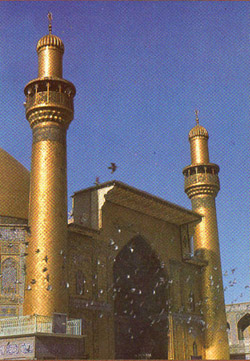




HAZRAT ABDULLAH IBN E JAFFER

|
|
Taken from The Victory of Truth Name: Zainab
Angelic Appelation It was five years after the Muslims had
accompanied the Prophet (PBUH&HF) and his family in the migration
(Hijrah) to Medina, when the Holy Prophet's daughter, Hadrat Fatima (AS),
gave birth to a little girl.' When her father, Imam Ali (AS), saw his daughter
for the first time Imam Husayn (AS), who was then almost three years old, was
with him. The boy exclaimed in delight, "O father, Allah has given me a sister." At those words Imam Ali (AS) began to weep, and when Husayn (AS)
asked why he was crying so, his father answered that he would soon come to
know. Fatima (AS) and Ali (AS) did not name their
child until a few days after her birth, for they awaited the Prophet's return
from a journey so that he could propose the name. When finally the baby girl was brought before
him he held her in his lap and kissed her. The Angel Jibra'il came to him and
conveyed the name that was to be hers, and then he began to weep. The Prophet
(PBUH&HF) asked why Jibra'il wept and he answered, "O Prophet of Allah. From early on in life this girl will
remain entangled in tribulations and trials in this world. First she will
weep over your separation (from this world); thereafter she will bemoan the
loss of her mother, then her father, and then her brother Hasan. After all
this she will be confronted with the trials of the land of Karbala and the
tribulations of that lonely desert, as a result of which her hair will turn
grey and her back will be bent." When the members of the family heard this prophecy they all broke
down in tears. Imam Husayn (AS) now understood why earlier his father had
also wept. Then the Prophet (PBUH&HF) named her Zaynab (AS). When the news of Zaynab's birth reached Salman
al-Farsi, he went to Ali (AS) to congratulate him. But instead of seeing him
happy and rejoicing he saw Ali (AS) shed tears, and he too was apprised of
the events of Karbala and the hardships that were to befall Zaynab (AS). One day, when Zaynab (AS) was about five years
old, she had a strange and terrible dream. A violent wind arose in the city
and darkened the earth and the sky. The little girl was tossed hither and
thither, and suddenly she found herself stuck in the branches- of a huge
tree. But-the wind was so strong that it uprooted the tree. Zaynab (AS)
caught hold of a branch but that broke. In a panic she grabbed two twigs but
these top gave way and she was left falling with no support. Then she woke
up. When she told her grand father, the Prophet (PBUH&HF), about this dream
he wept bitterly and said, "O my daughter. that tree is me who is shortly going to leave
this world. The branches are your father Ali and your mother Fatima Zahra,
and the twigs are your brothers Hasan and Husayn. They will all depart this
world before you do, and you will suffer their separation and loss." Growing up in Medina Zaynab (AS) shared with-her brothers and sister
the extraordinary position of having such examples to look up to, emulate and
learn from, as her grand father, the Prophet of Allah (PBUH&HF) her mother
Fatima (AS), daughter of the Prophet, and he'r father Imam Ali (AS),
cousin-brother of the Prophet. In the pure environment that enveloped her she
absorbed the teachings of Islam that her grandfather imparted, and after him
her father. Here too she learnt to master all household skills with great
proficiency. She had barely attained the tender age of seven
when her beloved mother passed away. Her mother's death had closely followed
her cherished grand father's passing away. Some time later Imam Ali (AS)
married Umm ul-Banin, whose devotion and piety encouraged Zaynab (AS) in her
learning. Whilst still a young girl she was fully able to
care for and be responsible for the running of her father's household. As
much as she cared for the comforts and ease of her brothers and sisters, in
her own wants she was frugal and unstintingly generous to the poor, homeless
and parentless. After her marriage her husband is reported as having said, "Zaynab is the best housewife." From very early on she developed an unbreakable bond of attachment
to her brother Imam Husayn (AS). At times when as a baby in her mother's arms
she could not be pacified and made to stop crying, she would quieten down
upon being held by her brother, and there she would sit quietly gazing at his
face. Before she would pray she used to first cast a glance at the face of
her beloved brother. One day Fatima (AS) mentioned the intensity of
her daughter's love for Imam Husayn (AS) to the Prophet (PBUH&HF). He
breathed a deep sigh and said with moistened eyes, "My dear child. This child of mine Zaynab would be confronted
with a thousand and one calamities and face serious hardships in
Karbala." Womanhood Zaynab (AS) grew into a fine statured young
woman. Of her physical appearance little is known. When the tragedy of
Karbala befell her in her midfifties she was forced to go out uncovered. It
was then that some people remarked that she appeared as a 'shining sun' and a
'piece of the moon'. In her character she reflected the best
attributes of those who raised her. In sobriety and serenity she was likened
to Umm ul-Muminin Khadija, her grandmother (AS); in chastity and modesty to
her mother Fatima Zahra (AS); in eloquence to her father Ali (AS); in
forbearance and patience to her brother Imam Hasan (AS); and in bravery and
tranquility of the heart to Imam Husayn (AS). Her face reflected her father's
awe and her grandfather's reverence. When the time came for marriage, she was married
in a simple ceremony to her first cousin, Abdullah ibn Ja'far Tayyar.
Abdullah had been brought up under the direct care of the Prophet
(PBUH&HF). After his death, Imam Ali (AS) became his supporter and
guardian until he came of age. He grew up to be a handsome youth with
pleasing manners and was known for his sincere hospitality to guests and
selfless generosity to the poor and needy. Together this young couple had five children, of
whom four were sons, Ali, Aun, Muhammad, and Abbas, and one daughter, Umm
Kulthum. In Medina it was Zaynab's practise to hold
regular meetings for women in which she shared her knowledge and taught them the
precepts of the Deen of Islam as laid out in the Holy Quran. Her gatherings
were well and regularly attended. She was able to impart the teachings with
such clarity and eloquence that she became known as Fasihah (skillfully
fluent) and Balighah (intensely eloquent). In the thirty-seventh year A.H. (after Hijrah),
Imam Ali (AS) moved to Kufa to finally take up his rightful position as
khalifah. He was accompanied by his daughter Zaynab (AS) and her husband. Her
reputation as an inspiring teacher among the women had preceded her. There
too women would throng to her daily sittings where they all benefitted from
her erudition, wisdom and scholarship in the exegesis of the Qur'an.' The depth and certainty of her knowledge earned
her the name given to her by her nephew, Imam Ali Zayn ul-Abidin (AS), of
'Alimah Ghayr Mu'allamah, 'she who has knowledge without being taught'. Zaynab (AS) was also nicknamed Zahidah
(abstemious) and 'Abidah (devoted) because of her abstemiousness and piety.
She found little of interest in wordly adornments, always preferring the
bliss and comfort of the Next World over that of this world. She used to say
that for her the life of this world was as a resting place to relieve fatigue
along a journey. Humble and of high morals, her main concern was
to strive to please Allah and in doing so she avoided anything which was the
least bit doubtful. Contributed by Br. Ali Abbas, [email protected]. I copied this information from Al-Islam.com. Thanks &
JAZAK ALLAH ILTEMAS E DUAA [email protected] |
