| NAME | MOHAMMAD (A.S). |
|
FATHER'SNAME |
ALI S/O HUSSAIN (A.S). |
| MOTHER'S NAME | FATIMA D/O HASAN (A.S). |
| DATE OF BIRTH | 1st RAJAB / 3rd RAJAB 57 HIJRI. |
| WIVES NAME | UMME FARWA, UMME HAKIM, LAILA, UMME FARWA D/O QASIM. |
| SON'S NAME | JAFER-E-SADIQ, ABDULLAH, IBRAHIM, ALI, UBAIDULLAH. |
| DAUGHTER'S NAME | ZAINAB, UMME SALMA. |
| FAMILY NAME | ABU JAFER. |
| TITLE | BAQAR. |
| AGE | 57 YEARS. |
| MARTYRDOM | MODAY, 7th ZILHAJ 114 HIJRI. |
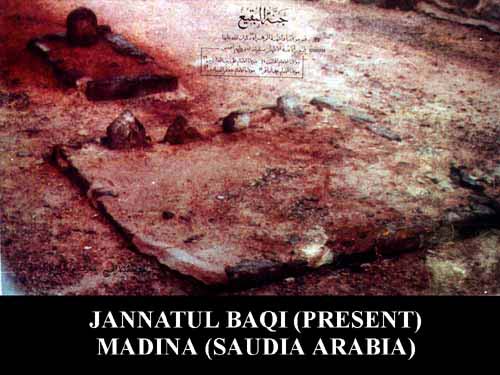
| BURRIED AT | JANNAT-UL-BAQI (MADINA). |
Imam Muhammad b. Ali al Baqir (as)
--------------------------------------------------------------------------------
(Taken from Kitab al Irshad By Sheikh al Mufid)
Al-Baqir Muhammad b. Ali b. al-Husayn, peace be on them, was out of (all)
his brothers the successor of his father, Ali b. al-Husayn, his testamentary
trustee (wasi), and the one who undertook (qaim) the office of Imam after
him. He surpassed all of them through his outstanding merit (fadl) in traditional
knowledge (ilm), asceticism and leadership. He was the most renowned of them,
the one among them who was most esteemed by both non-Shia (amma) and Shia
(khassa), and the most able of them. None of the sons of al- Hasan and al-Husayn,
peace be on them, showed the same ability in knowledge of religion, traditions,
the sunna, the knowledge of the Qur'an and the life of the Prophet (sira),
and the techniques of literature, as Abu- Jafar (Muhammad al-Baqir) showed.
The surviving Companions (of the Prophet), the leading members of the next
generation (tabieun) and the leaders of the Muslim jurists reported the principal
features (ma'alim) of religion on his authority. By virtue of his outstanding
merit he became a signpost (of knowledge) to his family. Proverbs were coined
about him and reports and verses were written to describe him.
He, peace be on him, was born in Medina, in 57 A.H. (676/7). He died in 114 A.H. (732) at the age of fifty-seven. He was a (leading) member of the Hashimite family within the Hashimites. He was a (leading) descendant of Ali among the descendants of Ali. He was buried in (the cemetery of) al-Baqi'i in (Medina) the city of the Apostle, may God bless him and his family.
In the testamentary bequest (wasiyya) which the Commander of the faithful, peace be on him, made to his children, mention was made of Muhammad b. Ali b. al-Husayn and of his trusteeship. The Apostle of God, may God bless him and his family, named him and caused him to be known as the one who split open (religious) knowledge (ulum) as the narrators of tradition (ashab al-athar) report.
Thus it is reported on the authority of Jabir b. Abd Allah in
a direct (mujarrad) tradition:
The Apostle of God, may God bless him and his family, said to me:
It will happen that you will live until you meet one of my children descended
from al-Husayn, peace be on him, called Muhammad, who will split wide open
knowledge of religion. When you meet him, recite my greeting to him.
The Shia give an account of the tablet which Gabriel, peace be on him, brought
down to the Apostle of God, may God bless him and his family, from heaven.
(The Apostle) gave it to Fatima, peace be on her. In it are the names of the
Imams after (the Apostle) and in it is Muhammad b. Ali, the Imam after his
father.
The Shia also report that God, the Mighty and High, sent down to His Prophet, the blessings and peace of God be on him, a document sealed with twelve seals. He ordered him to give it to the Commander of the faithful, peace be on him, and to tell him to break the first seal, and he should act according to what is in (that part of the document). At the time of his death, he should pass it to his son, al-Hasan, peace be on him, and tell him to break the second seal and act according to what is in (that part of) the document. At the time of his death he should pass it to his brother al-Husayn, peace be on him. He should tell him to break the third seal and act according to what is below it. Then at his death, he should pass it to his son, Ali b. al-Husayn al- Akbar (the elder) and he should instruct him in a similar way. Then Muhammad should pass it to his son right down to the last of the Imams.
They report also numerous designations (nusus) of him for the Imamate after his father on the authority of the Prophet, may God bless him and his family, on the authority of the Commander of the faithful and on the authority of al-Hasan, al-Husayn and Ali b. al- Husayn, peace be on them.
The people report (accounts) of his outstanding virtues and accomplishments which would be too numerous to include. We will mention what will be sufficient in meaning for our purposes, if God wills.
Abu Jafar, peace be on him, recounted reports of the beginnings of history (mubtada') and reports of the prophets. Stories of the campaigns of the Prophet (maghazi) were written on his authority. (Men) followed the practices of the Prophet (sunan) on his authority and relied on him with regard to the rites of the pilgrimage which he reported on the authority of the Apostle of God, may God bless him and his family. They (also) wrote a commentary of the Qur'an on his authority. Both the Shia (khassa) and the non-Shia (amma) report traditions on his authority. He debated with the exponents of individual reasoning (ahl al-ara') and the people learnt a great deal of theology (ilm al-kalam) from him.
Reports have come down that Nafi b. al-Azraq came to Muhammad
b. Ali, peace be on them, and sat before him to ask him questions about what
was permitted and what forbidden. Abu Jafar, peace be on him, said in the
course of his answer:
Say to these deviators (from the true course): How did you make separation
from the Commander of the faithful (Ali), peace be on him, lawful when you
had earlier shed your own blood on his behalf and in obedience to him and
(you were then close) to God through helping him? Then they will answer you:
He allowed arbitration with regard to the religion of God. Say to them: God,
the Exalted, allowed arbitration in the law (sharia) of His Prophet, may God
bless him and his family, between two of His creatures. For He said:
Send an arbitrator from his family and an arbitrator from her family if they
want reconciliation (to take place) between them with the agreement of God
[IV 35].
The Apostle of God, may God bless him and his family, appointed Sad b. Muadh
as an arbitrator over the tribe of Qurayza. He judged them according to what
God had accomplished. Did you not know that the Commander of the faithful,
peace be on him, ordered the arbitrators only to judge according to the Qur'an
and not to go beyond it? He stipulated the rejection of any of the laws of
men which opposed the Qur'an. They said to him: 'You have appointed as arbitrator
over yourself, men who will judge you.' He replied: 'I have not appointed
a creature as an arbitrator. I have only made the Book of God an arbitrator.
Therefore where do the deviators find the wrong-doing in the matter of arbitration
by the Qur'an, when he stipulated the rejection of whatever opposed it, unless
they are persisting in a false accusation?
"By God", said Nafi b. al-Azraq, "these are words which I have
never heard before and which have never occurred to my mind. It is the truth,
God willing."
He, peace be on him, used to say: "The people cause us great trouble.
We summon them but they do not answer us. If we abandoned them, they would
be guided by no one."
He, peace be on him, (also) used to say: "What is it that the people hate in us who are the family of the House of Mercy, the Tree of Prophethood, the Source of Wisdom, (the people) frequented by angels and (those upon whom) inspiration descended?"
He, peace be on him, died and left behind seven sons. Each of his brothers had great merit, even though they did not attain his merit because of his position with regard to the Imamate, because of his rank with God with regard to closeness and love (wilaya), and because of his position with regard to succession (khilafa) of the Prophet, may God bless him and his family. The period of his Imamate and of his undertaking the position of his father in the succession (on behalf of) God, the Mighty and High, over His servants was nineteen years.
Saying of Maula Hazarath Imam Muhammad al-Baqir(A.S)
The obedience of Imam following His recognition is the loftiest apex and peak
and the most worthy of stations and the key to the religion and gateway and
door to the affairs and pleasure of the Merciful (Allah).
Moreover, if a man keeps standing whole night for prayers and keeps on fasting
during the day and gives out all his wealth as alms and performs Hajj all
the years of his life and does not recognize the guardianship of the saint
of Allah so as to love him and perform all his practices under his guidance
and leadership, he does not have any right out of His rewards and he is not
from among the faithful.
There is no servant except that there exists a white spot upon his heart.
So when he commits a sin a black spot arises into that white spot. So when
he repents the black spot moves away. And if he continues on committing sins
the blackness of this spot increases till such time it overwhelms and overrides
the whiteness. When the whiteness is covered over (by the blackness) the owner
of it (heart) does never at all return towards beneficence and goodness. And
this is what Allah means when He says: "Nay! Rather, what they used to
do has become like a rust upon their hearts." (Surah Mutafafin Verse
14)
Indeed, when a man earns the wealth from haram (prohibited) sources, no Hajj
and no umrah and no strengthening of his blood kinship is never at all accepted
and approved (by Almighty God).
Allah dislikes and hates the importunately soliciting and arguing of men to
the other men for some problems (needs, wants, desires) and He approves and
loves it for Himself.
Certainly Allah grants this material world to the one whom He loves and the
one whom He despises. And he does not bestow His religion to anyone except
whom He loves.
Nobody remains safe from sin unless he guards his tongue.
Heaven is surrounded by unpleasantness and patience. So, the one who remains
patient over its unpleasantness in the world enters the paradise. And the
hell is surrounded by pleasures and lusts. So the one who allows (gives) himself
its pleasures and lustful desires enters the hellfire.
If people come to know what (evil) lies in begging, no one will beg from the
other and if the one who is begged from knows the evil of rejecting the one
who begs, nobody will turn down anyone’s request.
Allah revealed to Prophet Shohib (AS), "I will chastise one hundred thousand
persons out of your community, forty thousand of their evil and wicked one,
and sixty thousand from the pious ones among them." So Prophet said,
" Oh Lord these (forty thousands) are the evil ones so what for these
pious (are to be tormented)?" Thus Allah revealed to him saying, "For
the reason that those pious once coaxed and stooped the people of sin during
their social intercourses they showed adaptability and sociability towards
the sinner and did not become angry with them for the sake of My anger and
displeasure. That is, they did not perform the duty of ordering the good deeds
and forbidding the evils-doings.