Chick Growth and Development in Seabirds.
Chicks of most seabirds species grow up on land situated in close proximity to the sea. It is presumed that the nature of their supply has not allowed the evolution of the self-feeding precocial mode of development in seabirds (Lack 1968).
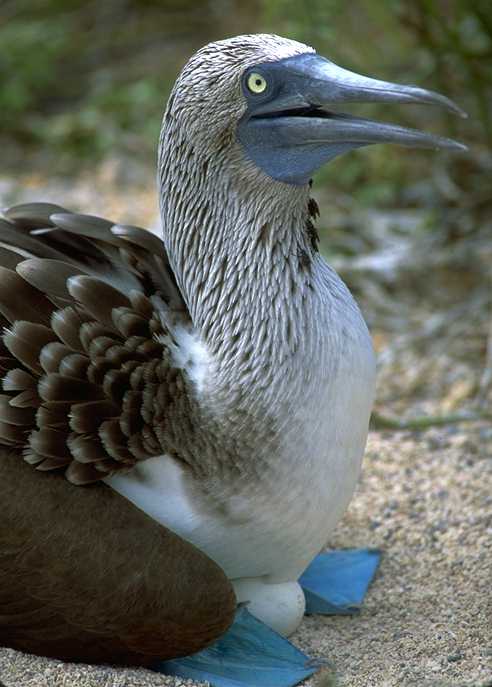
Althought there are marked interespecific differences with respect to developmental mode, in the majory of seabird species, chicks stay in or close to their nest until fledging, beig parentally fed and brooded. For example, chicks of pelicans, frigate birds, gannets, and boobies are born naked with their eyes closed, being totally dependent on parental food and warmth. Chick that hatch in this developmental state have been classified as being altricial by Nice 1962.
Chick of tropicbirds hatch with their eyes closed, but are covered in down (being classified as being semiatricial-2;Nice 1962), whereas tern, auk, murre, and jaeger chicks hatch with a downy plumage with their eyes open, and are able to walk (semiprecocial). In contrast, chicks of some murrelet species (Synthliboramphus spp. and Brachyrhamphus spp.) leave the nest shortly after hatching, being fed at sea by their parents (precocial-4). Chicks of common murre (Uria aalge), Thick-billed murre (Uria lomvia), and Razor-billed auk (Alca torda) do so after having attained about 25% of adult body mass (Daan and Timbergen 1979). Obviously, early nest desertion by the chick potentially reduces parental traveling time and enable explotaition of remote feeding areas (Ydenberg 1989).
However, this strategy can only be achieved with the co-evolution of some specific physiological adaptions of chick to minimize and compensate for its heat loss(e.g. Eppley 1984).
G Henk Visser. 2002. In Schreiber & Burger. 2002.
Seabird in the marine environment.CRC Marine biology series. Chapter 13.
|