


|
WEB PAGE OF PADIYIL VINOD SIVADASAN |
|
|
BREEDS OF DOGS
HOUNDS
WHIPPET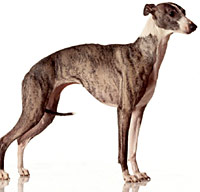
| Family | sighthound, Southern (sighthound) | |
| Area of Origin | England | |
| Date of Origin | 1700s | |
| Original Function | racing, rabbit coursing | |
| Today's Function | racing, lure coursing | |
| Size of male | Height: 19-22 | Weight: 20-40 |
| Size of Female | Height: 18-21 | Weight: 20-40 |
History
A medium-sized sighthound, the whippet stems from greyhound
roots. The whippet’s progenitors may have come from crosses between small
greyhounds and even smaller dogs that were used by peasants for poaching rabbits
and other small game in the 18th century. The peasants also found entertainment
in "snap dog" contests, in which bets were made on which dog could "snap up" as
many rabbits as possible before they escaped from a circle. Crosses with ratting
terriers were probably made to increase quickness and gameness. It was the
advent of the Industrial Revolution, however, that spurred the development of
the true whippet breed. Masses of rural workers moved to industrialized areas,
bringing with them their snap dogs and a need for entertainment. Without a
supply of rabbits, they found their dogs would just as readily race toward a
waving rag. Rag racing became the sport of coal miners; in fact, the whippet was
dubbed the "poor man's race horse." A family's whippet was not only an immense
source of pride but sometimes also a source of extra income and procurer of food
for the pot. As a valued family member, it shared the family rations and often,
the children's beds, and came to be valued as a companion as well. Whippet
racing is still popular today, but it has never gained the commercial appeal of
greyhound racing and so remains strictly an amateur sport. After the whippet was
officially recognized as a breed in 1888, it began to be appreciated for its
aesthetic appeal, and crosses with the Italian greyhound further refined its
appearance. The whippet gained popularity slowly, but its unequaled combination
of lithe elegance and gracious companionship gradually created a devoted
following. Today the whippet is the most popular of the sighthounds and is
highly valued as a show dog, lure courser, racer and family companion.
Temperament
Perhaps the most demonstrative and obedient of the true
sighthounds, the whippet makes an ideal pet for people who want a quiet house
dog and absolutely devoted companion. The whippet is extremely gentle with
children and can make an excellent companion for them. It is calm indoors but
loves to run and play outdoors. It is extremely sensitive (both physically and
mentally) and cannot take rough treatment or harsh corrections.
Upkeep
The whippet can make a good apartment dog if it is taken for
a long walk or run daily. Grooming is minimal. The whippet must have a warm,
soft bed. It dislikes cold weather intensely and cannot be expected to live
outside. The whippet can play and run in snow and cold weather but should spend
inactive times in warmer temperatures. The hair is extremely short and fine, and
the whippet is virtually free of "doggy odor."
Health
• Major concerns: none
• Minor concerns: none
•
Occasionally seen: deafness, some eye defects
• Suggested tests: none
•
Life span: 12 – 15 years
• Note: sensitive to anesthesia; prone to
lacerations
Form and Function
A greyhound in miniature, the whippet is among
the sleekest of dogs, with a curvaceous, streamlined silhouette, long legs and a
lean physique. It is the ultimate sprinter, unsurpassed by any other breed in
its ability to accelerate to top speed and to twist and turn with unequaled
agility. The whippet is a lightweight version of the greyhound, with an
especially supple top-line and powerful hindquarters enabling it to execute the
double-suspension gallop at its most extreme. It is square or slightly longer
than tall. The gait is low and free-moving. The expression is keen and
alert.
www.geocities.com/drvinsi