WEB PAGE OF PADIYIL VINOD SIVADASAN



 |
|
WEB PAGE OF PADIYIL VINOD SIVADASAN
|
BREEDS OF DOGS
NONSPORTING DOG
POODLE
[STANDARD] 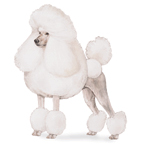
Other Name: Barbone, Caniche
| Family | Gun Dog, Companion, Water Dog | |
| Area of Origin | Germany and Central Europe | |
| Date of Origin | 1500s | |
| Original Function | Water retrieving, performer | |
| Today's Function | companion | |
| Size of male | Height: 15-21 | Weight: 45-65 |
| Size of Female | Height: 15-21 | Weight: 45-65 |
History
Although the poodle is most often identified with France, its earliest ancestors
were probably curly-coated dogs from central Asia that assisted with herding and
followed many routes into various parts of Europe. Interwoven in their ancestry
are also several rough-coated water dogs. Perhaps the earliest incarnation of
the poodle was the barbet, a curly-coated dog distributed in France, Russia,
Hungary and elsewhere. It is the German version, however, that exerted most
influence on the modern poodle. In fact, the word poodle comes from the German
word pfudel, meaning “puddle” or “to splash,” probably reflecting the
dog’s water abilities. In France, it was known as caniche or chien canard,
both referring to its duck-hunting abilities. Thus, from herding and water roots
the poodle became a talented water-hunting companion. The poodle was also drawn
into service as a military dog, guide dog, guard dog, wagon puller for
performers and, eventually, as a circus performer. Its coat was shorn close to
facilitate swimming, but left slightly longer on the chest for warmth in cold
water. Although some believe the puffs of hair around the leg joints and tail
tip were for protection when hunting, compelling evidence suggests that they
arose as decoration during the poodle’s performing days. The poodle found
favor as an elegant companion for fashionable ladies. It became favored by
French aristocracy and eventually became the national dog of France. Its
characteristic clip was accentuated, and a successful effort was made to perfect
the smaller specimens. Poodles entered the show ring in the late 1800s. Some of
the early show poodles were shown in corded coats, in which the hair is allowed
to mat in long thin tresses rather than be brushed out. While eye-catching, the
upkeep was difficult and the trend died out by the early 1900s, being replaced
by the bouffant styles still in vogue. At the same time poodle popularity in
America waned, so that by the late 1920s, poodles had almost died out in North
America. In the 1930s, the breed staged a comeback that eventually placed it as
the all-time most popular dog in America.
Temperament
Among the very smartest and most obedient of dogs, the standard poodle combines
playful exuberance with a zest for life’s adventures. It retains its hunting
heritage and loves to run, swim and retrieve. It gets along well with everyone,
although it is somewhat reserved with strangers. It is excellent with children.
Upkeep
All poodles need a lot of interaction with people. They also need mental and
physical exercise. A brief but challenging obedience or play session, combined
with a walk, should be part of every poodle’s day. Standard poodles will need
more exercise and may especially enjoy swimming. No poodle should live outdoors.
The show poodle should preferably be brushed every day or weekly for shorter
coats. Poodle hair, when shed, does not fall out but becomes caught in the
surrounding hair, which can cause matting if not removed. The pet clips are
easier to maintain and can be done every four to six weeks.
Health
• Major concerns: sebaceous adenitis, gastric torsion, Addison’s
• Minor concerns: distichiasis, entropion, cataract, CHD, epilepsy
• Occasionally seen: PDA, vWD
• Suggested tests: skinpunch for SA, eye, (hip)
• Life span: 10 – 13 years
Form and Function
The poodle is a square-proportioned dog with proud carriage and elegant
appearance. It should move with a light, springy, effortless stride. The poodle
stems from working retriever stock, and its conformation should reflect its
athletic background. The coat is curly, harsh and dense; if corded, it should
hang in tight even cords. The traditional clips stem from functional and
decorative tradition; acceptable clips for show purposes are the puppy (for
puppies only), English saddle, Continental and (for some nonregular classes
only) sporting.
HOME BREEDS OF DOGS NONSPORTING BREEDS www.geocities.com/drvinsi