


|
WEB PAGE OF PADIYIL VINOD SIVADASAN |
|
|
BREEDS OF DOGS
NONSPORTING DOGS
LHASA APSO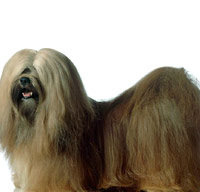
| Family | companion, herding | |
| Area of Origin | Tibet | |
| Date of Origin | ancient times | |
| Original Function | companion, watchdog | |
| Today's Function | companion | |
| Size of male | Height: 10-11 | Weight: 13-15 |
| Size of Female | Height: 10-11 | Weight: 13-15 |
History
The origin of the Lhasa apso has been long lost; it is an ancient breed bred and
revered in the villages and monasteries of Tibet. Its history is intertwined
with Buddhist beliefs, including a belief in reincarnation. The souls of lamas
were said to enter the sacred dog’s bodies upon death, thus imparting an added
reverence for these dogs. The dogs also performed the role of monastery
watchdog, sounding the alert to visitors, thus giving rise to their native name
of abso seng kye (“bark lion sentinel dog”). It is likely that the breed’s
Western name of Lhasa apso is derived from its native name, although some
contend that it is a corruption of the Tibetan word rapso, meaning “goat”
(in reference to its goatlike coat). In fact, when the breed first came to
England, it was known as the Lhassa terrier, although it is in no way a terrier.
The first Lhasa apsos were seen in the Western world around 1930, with some of
the first dogs arriving as gifts of the 13th Dalai Lama. The breed was admitted
into the AKC’s terrier group in 1935, but it was reassigned to the nonsporting
group in 1959. After a slow start, the Lhasa quickly outpaced its fellow Tibetan
breeds to become a popular pet and show dog.
Temperament
Despite its lap-dog appearance, the Lhasa is a tough character. It is
independent, stubborn and bold. Although it is eager for a romp or game, it will
be happy as long as it is given exercise. It will also happily snooze beside its
owner. These characteristics make it an excellent small companion in adventure.
It is somewhat reserved with strangers.
Upkeep
The Lhasa is an active dog, but its relatively small size makes it possible to
meet its energy needs either with short walks or vigorous play sessions in the
yard, or even home. It makes a fine apartment dog. It is not suited for outdoor
living. The long coat needs brushing and combing every other day.
Health
• Major concerns: none
• Minor concerns: patellar luxation, entropion, distichiasis, PRA,
renal cortical hypoplasia
• Occasionally seen: CHD, urolithiasis, vWD
• Suggested tests: knee, eye
• Life span: 12 – 14 years
Form and Function
The Lhasa apso is longer than it is tall, with a strong loin. Although the breed
has never been used for purposes requiring great athleticism, it should
nonetheless have a strong loin and well-developed quarters and thighs. The head
is well-covered with a good fall over the eyes and good whiskers and beard,
imparting a dignified, almost lionlike look. The bite should be either level or
slightly undershot. The coat is heavy, straight, long and hard.