


|
WEB PAGE OF PADIYIL VINOD SIVADASAN |
|
|
BREEDS OF DOGS
HERDING DOGS
GERMAN SHEPHERD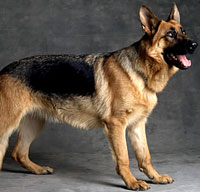
Other Name: Alsatian, Deutscher schaferhund
| Family | livestock, herding | |
| Area of Origin | Germany | |
| Date of Origin | 1800s | |
| Original Function | sheep herding, guarding, police dog | |
| Today's Function | police, contraband detection, assistance, herding trials, schutzhund | |
| Size of male | Height: 24-26 | Weight: 75-95 |
| Size of Female | Height: 22-24 | Weight: 75-95 |
History
Despite an outward appearance slightly resembling a wolf, the German shepherd dog is a fairly recently developed breed and, contrary to naíve beliefs, it is no more closely related to the wolf than any other breed of dog. The breed is the result of a conscious effort to produce the ideal shepherd, capable of herding and guarding its flocks. Perhaps never in the history of any breed has such concerted effort been put into improving a dog, mostly due to the formation in 1899 of the Verein fur Deutsche Scharferhunde SV, an organization devoted to overseeing the breeding of the German shepherd. Breeders sought to develop not only a herding dog but also one that could excel at jobs requiring courage, athleticism and intelligence. In short order, the German shepherd had proved itself a more than capable police dog, and subsequent breeding strove to perfect its abilities as an intelligent and fearless companion and guardian. During World War I, it was the obvious choice for a war sentry. At the same time, the AKC changed the breed’s name from German sheepdog to shepherd dog, and Britain changed it to Alsatian wolf dog, both attempts to dissociate the dog from its unpopular German roots. The wolf dog was later dropped as it caused many people to fear the breed. In 1931, the AKC restored the breed’s name to German shepherd dog. The greatest boon to the shepherd’s popularity came in the form of two dogs, both movie stars: Strongheart and Rin Tin Tin. The German shepherd held the number-one spot in American popularity for many years. Although presently it has dropped from the top spot, the German shepherd remains as one of the most versatile dogs ever created, serving as a police dog, war dog, guide dog, search-and-rescue dog, narcotics- or explosives-detecting dog, show dog, guard dog, pet — and even shepherd.
Temperament
Among the most intelligent of breeds, the German
shepherd dog is so intent on its mission — whatever that may be — that it is
virtually unsurpassed in working versatility. It is utterly devoted and
faithful. Aloof and suspicious toward strangers, it is protective of its home
and family. It can be domineering. It can be aggressive toward other dogs, but
it is usually good with other pets.
Upkeep
This breed needs daily mental and physical challenges. It
enjoys a good exercise session as well as learning session. It can live outside
in temperate to cool climates, but it is family-oriented and does equally well
as a house dog. Its coat needs brushing one or two times weekly.
Health
• Major concerns: CHD, elbow dysplasia
• Minor concerns:
panosteitis, vWD, progressive posterior paresis, cauda equina, pyotraumatic
dermatitis, skin allergies, malignant neoplasms, pannus, cataract, gastric
torsion, perianal fistulas, cardiomyopathy
• Occasionally seen: pancreatic
insufficiency
• Suggested tests: hip, elbow, eye (blood)
• Life span: 10 –
12 years
• Note: GSDs are especially susceptible to a potentially fatal
systemic fungal infection from Aspergillus.
Form and Function
The German shepherd dog has an outline of smooth
curves on a body that is longer than it is tall. It is strong, agile and
substantial. Its gait is exceptionally outreaching and elastic, covering the
ground in great strides. It has a double coat, with the outer coat consisting of
dense, straight or slightly wavy, harsh, close lying hair of medium length.
HOME BREEDS OF DOGS HERDING GROUP
www.geocities.com/drvinsi