


|
WEB PAGE OF PADIYIL VINOD SIVADASAN |
|
|
BREEDS OF DOGS
TOY BREEDS
CHIHUAHUA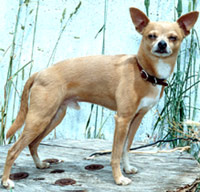
| Family | companion, Southern (pariah) | |
| Area of Origin | Mexico | |
| Date of Origin | 1500s | |
| Original Function | ceremonial | |
| Today's Function | companion | |
| Size of male | Height: 6-9 | Weight: <6 |
| Size of Female | Height: 6-9 | Weight: <6 |
History
The smallest breed of dog, the Chihuahua has a controversial history. One theory
holds that it originated in China and was brought to the New World by Spanish
traders, where it was then crossed with small native dogs. The other theory
contends that it originated entirely in Central and South America, descending
from the native Techichi, a small mute dog that was sometimes sacrificed in
Toltec religious rituals. A small red dog was believed to guide the soul to the
underworld, and every Aztec family kept such a dog, which was sacrificed and
buried with any deceased family member. To make matters worse for the Techichi,
the Toltecs and their conquerors, the Aztecs, often ate dogs and the Techichi
may have sometimes been on the menu. Despite what may have been short lives,
Techichis apparently were well-cared for during life by the priests or their
families. In fact, the most likely origin of the Chihuahua is a combination of
these theories: The native Techichi was probably crossed with tiny hairless
Chinese dogs, but again the date when this occurred is controversial. The
Chinese dogs may have been brought over when a land bridge spanned the Bering
Strait, or they may have been brought later by Spanish traders. When Cortes
conquered the Aztecs in the 16th century, the little dogs were abandoned and
left to fend for themselves. About 300 years later, in 1850, three tiny dogs
were found in Chihuahua, Mexico. A few were brought to the United States, but
they aroused only moderate attention. Only when Xavier Cugat (“the rhumba
king”) appeared in public with a Chihuahua as his constant companion did the
breed capture the public’s hearts. It experienced a meteoric rise in
popularity and has continued as one of America’s most popular breeds.
Temperament
The saucy Chihuahua has earned its place as a favored toy dog because of its
intense devotion to a single person. It is reserved with strangers but good with
other household dogs and pets. Some try to be protective, but they are not very
effective. Some may be quite bold; others may be timid. It is often
temperamental. Some bark.The Chihuahua's size makes it a wonderful dog for
people who live in small city apartments. The breed is very hardy and adaptable,
but it must live inside a home or an apartment, the Chihuahua should not live
outside. Chihuahuas are good travelers and can easily go anywhere with their
owners.A graceful, alert, swift-moving little dog with saucy expression,
compact, and with terrier-like qualities of temperament.
Upkeep
The Chihuahua is a lively dog that nonetheless can get its exercise running from
room to room indoors. It enjoys exploring the yard or going for short walks on a
leash and especially enjoys accompanying its owner on outings. The Chihuahua is
not an outdoor dog; it hates the cold and seeks out warmth. Coat care for the
smooth is minimal. Care of the long coat entails brushing two to three times a
week.
Health
• Major concerns: none
• Minor concerns: pulmonic stenosis, hydrocephalus, patellar luxation, KCS,
hypoglycemia
• Occasionally seen: none
• Suggested tests: cardiac, knee
• Life span: 14 – 18 years
• Note: A soft spot (molera) in the skull (due to incomplete fontanel closure)
is a common
breed trait.
Form and Function
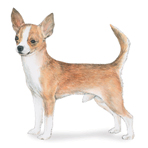
The Chihuahua is graceful, small and compact; it is slightly longer than it is
tall. It has a saucy expression and an alert, terrier-like attitude. It should
move out at a swift pace with good reach and drive. Its coat can be smooth, with
soft, glossy hair or long, with soft straight or wavy hair and fringed ears.
 The
Chihuahua comes in two varieties: long and smooth coat. The Chihuahua is
graceful, alert, and swift. This breed is clannish, recognizing and preferring
his own kind. As a rule, he does not like dogs of other breeds. Legend and
history are rich in tales of the ancestors of the present Chihuahua. He is
described as a popular pet, as well as a religious necessity, among the ancient
Toltec tribes and later among the Aztecs. Archaeologists have discovered remains
of this breed in human graves in Mexico and in parts of the United States. The
modern Chihuahua is quite different from his early ancestors, with his
variegated colors ranging from snow white to jet black. Mexico favors the jet
black with tan markings, and the black and white spotted. The United States
prefers the solid colors.
The
Chihuahua comes in two varieties: long and smooth coat. The Chihuahua is
graceful, alert, and swift. This breed is clannish, recognizing and preferring
his own kind. As a rule, he does not like dogs of other breeds. Legend and
history are rich in tales of the ancestors of the present Chihuahua. He is
described as a popular pet, as well as a religious necessity, among the ancient
Toltec tribes and later among the Aztecs. Archaeologists have discovered remains
of this breed in human graves in Mexico and in parts of the United States. The
modern Chihuahua is quite different from his early ancestors, with his
variegated colors ranging from snow white to jet black. Mexico favors the jet
black with tan markings, and the black and white spotted. The United States
prefers the solid colors.