


|
WEB PAGE OF PADIYIL VINOD SIVADASAN |
|
|
BREEDS OF DOGS
HOUNDS
BASSET HOUND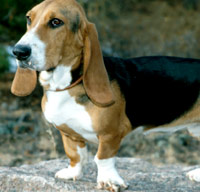
| Family | scenthound | |
| Area of Origin | France | |
| Date of Origin | 1500s | |
| Original Function | trailing rabbits and hare | |
| Today's Function | trailing rabbits and hare, field trials, basset field trials | |
| Size of male | Height: <14 | Weight: 40-60 |
| Size of Female | Height: <14 | Weight: 40-60 |
History
The first mention of the basset dog is found in a
16th-century text about badger hunting. Dwarfed short-legged specimens occur in
many breeds and have been known since ancient times, but it is difficult to know
at what point such dogs were purposefully bred and which ones led to the present
basset hound. The word basset is derived from the French word bas, which means
“low thing or dwarf,” so that definitive evidence of the breed may be hard to
follow. Short-legged dogs were used by the French for hunting at a slower pace,
but most of these dogs were dispersed, and their fates undocumented, during the
French Revolution. The history becomes clearer after the revolution, when
greater numbers of commoners took up hunting, often aided by guns. They needed a
dog that they could follow on foot, but that still had great scenting ability
and strong, heavy bone — in essence, a short-legged version of the pack hounds
popular with the aristocracy. Because the basset could not pursue its quarry at
speed, the quarry was less likely to be on the run and thus presented an easier
target for the gunman. The dogs would hunt all mammals but were especially
suited for rabbits and hares. Four different versions of short-legged hounds
were created, with the basset Artesien Normand most closely resembling today’s
basset. In the late 1800s (and again in 1930), crosses with bloodhounds were
made to increase size; the results were then tempered with subsequent crosses to
the Artesien Normand. The first bassets were brought to England and America in
the late 1800s, and interest in the breed grew gradually. By the mid-1900s, the
basset’s droll expression had won it a place in advertising and entertainment
and in many new pet owners’ hearts.
Temperament
The basset hound is among the most good-natured and
easygoing of breeds. It is amiable with dogs, other pets and children, although
children must be cautioned not to put strain on its back with their games. It is
calm inside, but it needs regular exercise to keep fit. It prefers to
investigate slowly, and loves to sniff and trail. It is a talented and
determined tracker, not easily dissuaded from its course. Because of this, it
may get on a trail and follow it until it becomes lost. It tends to be stubborn
and slow-moving. It has a loud bay that it uses when excited on the trail.
Upkeep
The basset needs mild daily exercise, which can be satisfied
by walking on leash or playing in the yard. It does best as a house dog with
access to a yard. Its coat needs only minimal grooming, but its face may need
regular cleaning around the mouth and wrinkles. Bassets tend to drool.
Health
• Major concerns: foreleg lameness, OCD, entropion,
ectropion, otitis
externa, intervertebral disc disease, glaucoma, vWD, CTP,
gastric
torsion
• Minor concerns: foot cysts and infection
•
Occasionally seen: patellar luxation
• Suggested tests: eye, blood
• Life
span: 8 – 12 years
• Note: Obesity is a problem in the breed, especially
because it
contributes to intervertebral disk disease.
Form and Function
The basset’s long, heavy body and short legs make
it easy to follow on foot and give it an edge in dense cover. The basset hound
has heavier bone, in proportion to its total size, than any other breed. Its
thick, tight coat protects it from brambles without becoming caught in them. It
is speculated that its long ears may stir up ground scent, and the wrinkles trap
the scent around the face. The large muzzle gives ample room for the olfactory
apparatus. Such room would not be available in a miniature dog; only a large dog
with shortened legs can combine the short height with large muzzle size. The
basset’s movement is smooth and powerful; it tends to move with nose to the
ground.
www.geocities.com/drvinsi