 |
|
|
|
|
|
|
|
|
|
|
|
|
|
|
|
|
|
|
|
|
|
|
|
|
|
|
|
|
|
|
|
|
|
|
|
|
|
|
|
|
|
|
|
|
|
|
|
|
|
Training Tips |
|
|
|
Do you have the most stubborn horse in the world? Well, these tips might help you! |
|
|
|
 |
|
|
|
Won't stand to be Mounted? |
|
|
|
If you have a horse, especially ex-racing thoroughbreds, who won't stand still to be mounted, what do you do? First things first, make sure the saddle, saddle pad, and girth are a good fit for your horse and it's breed. Thoroughbreds should have an elastic girth because they have ticklish skin. Walk your horse around before you get on to see if the girth loosens. Gradually tighten it until you can fit only two fingers between your horse's belly and the girth. On young horses, use a mounting block so it doesn't put too much stress on the horse's left side. Put him in the corner so he can't go sideways or frontwards. Have a friend hold the reins for you as you mount. If you are able to get your horse to stand while you mount, praise him A LOT and give him a treat or two. Repeat this until you no longer have to stand him in the corner. Keep on praising him! |
|
|
|
Getting Over Colored Ground Poles and Jumps! |
|
|
|
If you have a horse who just won't go over those ground poles or jumps that have some color in them, start off on the ground. Walk your horse towards the jump without you on him. Once he stands by it. Lightly tap the jump to show him it is solid, but won't hurt him. Still on the ground, try to walk him over the pole. When he goes over it, praise him by patting him on the neck, face, and a treat or two. After you are going over the pole easily on the ground, try to get on him and walk him over. Lightly encourouge him with your legs the whole way. Praise him as soon as he does what you want! Then, try trotting over the pole and, if it is a jump, canter over it too. If this doesn't work for your horse, try putting a white jump/pole in front of a colored one, with only one pace in between. If you get him going over the white one, he will probably continue over the next, more colorful one. Good luck and praise, praise, praise! |
|
|
|
Got a Bolting Problem? |
|
|
|
If your horse tries to canter as soon as you ask him to walk, you have a problem on your hands! Quickly turn him the opposite way he is heading by using your reins AND legs. Turn him in a very tight circle, for this is both a way to stop him quickly and a small punishment, because it is hard for him to turn in a tight circle. Repeat this everytime he tries to run away with you, and soon he will learn to pay closer attention to your legs and reins and will no longer bolt when you tap him with your legs. Praise, praise, praise! |
|
|
|
Got a Biter On Your Hands? |
|
|
|
If your horse is very nippy, then you have a major problem! Biting can be a very hard vice to change, so you need patience. Biting is caused for three main reasons:
~Discomfort. The horse is in pain or environment is unsuitable.
~Dominance. The horse is young and wants to become "the leader."
~Aggressive. The horse doesn't realize that humans are in charge and lunges out if you try to control him. This can be very difficult to cure, so proffesional help is usually advised.
Discomfort biting can possibly be cured by having the vet come over and examine your horse. If he tries to bite the vet, put a muzzle on him and hold him still, but don't hold him too tightly because he will feel trapped. If there are no health problems, then an environment change may be helpful. Horses in the pasture may be giving him a hard time, so observe your horses in the pasture to see if any horses pick on yours. If you don't fnid any problems with the environment, seek professional help.
Dominance biting is usually found in young horses who test dominance and social level. When your horse bites you, immidiately turn back at him and lunge at him. This tells him you don't want to play games and to quit it. Don't allow the horse to come back into your "personal space" for several minutes. If you allow him to come right back, you are inticing him to "play" with you.
Aggressive biting is very hard to cure. Most people should seek proffessional help, and that doesn't mean the internet! It means to look in the phone book and call a local horse trainer to come to your stable. The best way you can avoid this is to not come into a situation where your horse can bite you. I highly reccommend getting proffessional help for this! Please look in your phone book if you have this problem!
Please, don't feed your horse from your hand or pocket! This only encourages biting! Don't let him see you take something from your pocket and put it in his feed bin! Do it while he is outside or being ridden by someone, or in the cross ties. Also, NEVER hit your horse on the head! This will make him head shy and he won't trust hands near his face. Slap him, not too hard, on his shoulder or the base of his neck near his shoulder, or his back, but NEVER on his head! Keep a salt block in the stall, because his will help prevent biting and chewing. Also, always turn your horse out as often as possible! This will prevent him from getting bored and cribbing, biting, and creating other bad habits. |
|
|
|
Rears or Bucks? |
|
|
|
If you have a horse that bucks, pull his head up immidiately with the reins and kick him with your legs at or a little behind the girth. Be sure you don't kick his flanks (right before his back legs) They get rodeo "broncos" to buck by tying a strap around it's flank, so don't kick the flank! This is also painful for your horse. Keep him moving!
If your horse rears, be sure to lean forward when he goes up, and don't pull back on the reins. Hold on to his mane or wrap your arms around his neck if you think you might fall off. If you pull back or lean backwards, your horse may fall over backwards. As soon as his front feet touch the ground, kick him and keep him moving. If he is moving, he can't rear, can he?
If you still have trouble with bucking or rearing, seek proffessional help, and this doesn't mean the internet! |
|
|
|
A Problem Lunger? |
|
|
|
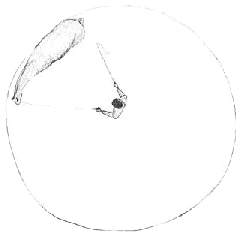
If your horse comes to the middle toward you when you lunge, this problem is usually easily fixed. Get a lungeing whip and make a triangle between the line and the whip, with the whip continuing behind him, like shown below: |
|
|
|
 |
|
|
|
Keep the whip moving behind him, and if he starts to come towards you, wave the whip at him and keep him moving. Never hit him with the whip! It is for sounds and sight only, never touch! Keep him moving and make a triangle with the horse, the lunge line, and the whip like it is shown above. Continue this until your horse realizes he is supposed to stay on the outside, but continue to hold the whip, just in case. Have fun! |
|
|
|
Won't Slow Down At a Show or Lesson? |
|
|
|
If your horse just won't slow down before a show or lesson, here are a few tips to slow him down. First, walk him around either in the ring or outside, but preferably in the same situation as the show/lesson. (If the show is outside, take him outside to warm up. If it's inside, then warm up inside.) Walk him around to warm him. Once you have walked him for more than five minutes, start trotting and keep a tight rein on him. As soon as he starts speeding up, give a half halt, or squeeze the outside rein. If this doesn't work, turn him in a circle so he can't speed up and is forced to slow down. If he still won't listen, try a different, more harsh techniuqe. As soon as your horse speeds up without you asking him to, push him on and make him go faster. Once he shows he is tiring, try and slow him down. If he slows down for you, pat him on the neck and praise him. Let him catch his breath, and repeat. He will soon learn that speeding up will only give him more work. |
|
|
|
 |
|
|
|
Please visit Monty's site! |
|
|
|
More to come soon! If you have an idea for a topic on this page, please e-mail me! |
|
|
|
 |
|
|
|
 |
|
|
|
 |
|