Besouro Manganga
Besouro Manganga
The son of Joדo Grosso and Maria Haifa, Manuel Henriques, learned capoeira from Tio Alםpio (an ex African slave), around the Rua do Trapiche de Baixo located at Santo Amaro da Purificaחדo (Bahia). Tio Alםpio gave Manuel Henriques the nickname of "Besouro Mangangב" due to his ability to quickly disappear whenever he was around a belligerent group or facing danger. As he was a famous and strong capoeirista, the word spread out and quickly came up the legend that Besouro Mangangב had supernatural power. He would not only disappear when facing danger, but also turn into a big black beetle, scaring everyone around. The legend also says that Besouro would fight an entire police troop that would come riding horses to arrest capoeiristas at that time. In 1924, at the age of 27, Besouro Mangangב was caught in an ambush, stabbed and killed with a "ticum" knife (type of knife). Important names to the capoeira world such as Mestre Cobrinha verde (his cousin) and Siri de Mangue were his student.
"...tum tum tum Besouro Mangangב, bateu foi na polםcia de soldado a general..."
Zumbi
Zumbi was born inside the "Quilombo dos Palmares" (largest maroon colony of escaped slaves), 1655. The complex of Palmares was located in what is today's the state of Alagoas (Serra da Barriga), northeast Brazil. Its population was composed not only of escaped African slaves but also of native Brazilian Indians and other mixed races (Mestiחos). It had an organized government system similar to an African Kingdom with a King and his Assembly. The best warriors on battles were chosen King; "Zumbi" was the most notorious King of all. The "Quilombo dos Palmares" fought for 65 years against Portuguese & Dutch colonizers, but was finally destroyed in 1694 by Domingos Jorge Velho and his troops. Zumbi, however, managed to escape and many believed that he was immortal. Wanted by the authorities, he was captured on November 20th, 1695. He was killed and beheaded on the spot. His head was brought by the authorities to a public Plaza at the "vila do Recife" to show the people that he was not immortal. "Zumbi" is considered a national hero and warrior, a symbol of freedom; his name became a capoeira legend .
Mestre Bimba
pictures:
1 2
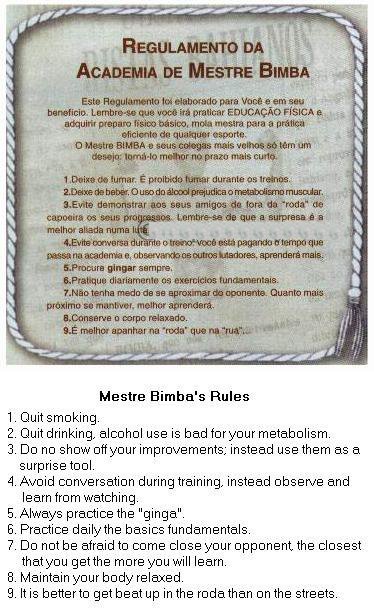
Mestre Bimba (Manuel dos Reis Machado, 11/23/1899-1/04/1974)
The son of Luiz Cגndido Machado and Maria Martinha do Bonfim, Manuel dos Reis Machado known as "Mestre Bimba" was born on November 23rd, 1900, at the "bairro do Engenho Velho" in Salvador-BA, Brazil. The nickname "Bimba" came up due to a bet between his mother and the midwife during his birth; his mother bet that he was going to be a girl and the midwife bet he would be a boy . After he was delivered, the midwife said ...it's a boy, look at his "bimba" (male sexual organ). Mestre Bimba started capoeira at the age of 12 at Estrada das Boiadas, today bairro da Liberdade, in Salvador. He was taught by "Bentinho", an African that used to be the "capitדo da Companhia Baiana de Navegaחדo" (a navigation captain). Mestre Bimba was and is so important to capoeira because he changed the destiny of it. Capoeira was not an allowed practice during slavery. The official prohibition of Capoeira remained even after slavery was abolished in May 13th, 1888. In 1890, Brazilian president "Marechal Deodoro da Fonseca" signed an act that prohibited the practice of capoeira nationwide, with severe punishment for those caught. It was nevertheless practiced by the poorer population on public holidays, during work-free hours and similar occasions. Riots, caused also by police interference, were common. Persecution and punishment were almost successful in eradicating Capoeira from the "streets" of Brasil by the 1920's. In spite of the ban, Master Bimba created a new style, the "Capoeira Regional". He incorporated new moves and techniques from "Batuque" (a vicious grabbling type of martial art that he learned from his father), jiu-jitsu and boxing. The "Capoeira Regional" or "Luta Regional Baiana" was then a more martial art oriented, effective, efficient and athletic style of capoeira. After a performance at the palace of Bahia's Governor, Juracy Magalhדes, Mestre Bimba was finally successful in convincing the authorities of the cultural value of Capoeira, thus ending the official ban in the 1930's. Mestre Bimba founded the first Capoeira school in 1932, the "Academia-escola de Capoeira Regional", at the Engenho de Brotas in Salvador-Bahia. Previously, capoeira was only practiced and played on the streets. However, capoeira was still heavily discriminated by upper class Brazilian society. In order to change the slyness, stealthy and malicious reputation associated with capoeira practitioners at that time, Bimba set new standards to the art. His students had to wear a clean, white uniform, show proof of grade proficiency from school, show good posture and many other standards. As a result, doctors, lawyers, politicians, upper middle class people, and women (until then excluded) started to join his school, providing Bimba with better support. In 1936, Bimba challenged fighters of any martial art style to test his Regional style. He had four matches, fighting against Vםtor Benedito Lopes, Henrique Bahia, Josי Custףdio dos Santos (Zי I) and Amיrico Ciךncia. Bimba won all matches. In 1937, he earned the state board of education certificate. In 1942, Mestre Bimba opened his second school at the "Terreiro de Jesus - rua das Laranjeiras"; today rua Francisco Muniz Barreto, #1. The school is open until today and supervised by his ex student, "Vermelho-27". He also taught capoeira to the army and at the police academy. He was than considered "the father of modern capoeira". Important names to the Brazilian society at that time such as Dr. Joaquim de Araתjo Lima (Ex-Governador of Guaporי), Jaime Tavares, Rui Gouveia, Alberto Barreto, Jaime Machado, Delsimar Cavalvanti, Cיsar Sב, Decio Seabra, Josי Sisnando and many others were Bimba's students. Master Bimba was a coalman, carpenter, warehouse man, longshoreman, horse coach conductor, but mainly capoeirista; a giant with strong personality! Unhappy with false promises and lack of support from local authorities in Bahia, he moved to Goiגnia-GO in 1973 by invitation from an ex-student. He died a year later, on February 15th, 1974 at the "Hospital das Clםnicas de Goiגnia" due to a stroke.
Click here to see Mestre Bimba's rulesClick here to see Sequencia de Bimba .
Mestre Pastinha
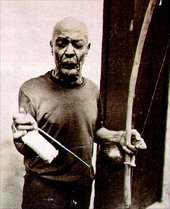
Mestre Pastinha (Vicente Ferreira Pastinha, 1889-1982)
The son of Josי Seסor Pastinha and Eugךnia Maria de Carvalho, Vicente Ferreira Pastinha was born on April 5th, 1889 in Salvador-BA, Brazil. Mestre Pastinha was exposed to capoeira at the age of 8 by an African name Benedito. An older and stronger boy from Pastinha's neighborhood use to beat him up often. One day Benedito saw the aggression then told Pastinha to stop by his house that he was going to teach him few things. The next encounter with that boy, Pastinha defeated him so quickly that the older boy became his admirer. Mestre Pastinha had a happy and modest childhood. During the mourning he would take art classes at the Liceu de Artes e Ofםcio school where he learned to paint; during the afternoons he would play with kites and practice capoeira. He continued his training with Benedito for three more years. Later, he joined a sailor school by his father wish, which would not support the capoeira practice. At the school, he use to teach capoeira to his friends. At the age of 21, he left the sailor school to become a professional painter. During the spare time he would practice capoeira stealthily, since it was still illegal at that time. In 1941, by Aberrך (Patinha's ex student) invitation, Pastinha went to a Sunday roda at "ladeira do Gengibirra" located at bairro da Liberdade, where the best masters would hang out. Aberrך was already famous on these rodas, and after spending the afternoon there, one of the greatest master of Bahia, mestre Amorzinho, asked Pastinha to take over the Capoeira Angola. As a result, in 1942 Pastinha found the first Angola school, the "Centro Esportivo de Capoeira Angola", located at the Pelourinho. His students would wear black pants and yellow t-shirt, the same color of the "Ypiranga Futebol Clube", his favorite soccer time. He participated with the Brazilian delegation of the "First International Festival de Artes Negras" in Dakar, Senegal(1966), bringing with him Mestre Joדo Grande, Mestre Gato Preto, Mestre Gildo Alfinete, Mestre Roberto Satanבs and Camafeu de Oxossi. Pastinha worked as shoe shiner, tailor, gold prospector, security guard (leדo de chבcara) at a gambling house (casa de jogo) and construction worker at the "Porto de Salvador" to maintain him financially so he could do what he loved the most, be an Angoleiro. Betrayed by local authorities false promises and with no support, Pastinha was left abandoned in a city shelter (abrigo D. Pedro II - Salvador), blind and very sick. He dedicated his entire life to capoeira angola, and in April 12th, 1981, he played his last capoeira game. Mestre Pastinha, the father and protector of Capoeira Angola, died at the age of 92, in November 13th, 1981.
Click here to see The academy of mestre Pastinha