SKYLAB IV
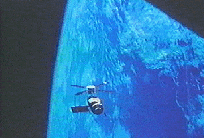
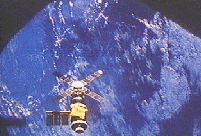
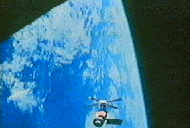
The Skylab station was completely outfitted as a workshop area before launch. It measured 36 meters (118 feet) in length by 22 feet in diameter, and weighed 90,000 kilograms (198,000 pounds). It was launced into orbit on May 14, 1973.
Skylab consisted of five main sections. The Multiple Docking Adapter was 17 feet long, with a diameter of 10 feet. The Apollo Telescope Mount was 13 feet long by 10 feet in diameter. The Airlock Module was 18 feet long with a diameter of 10 feet. The Instrument Unit was 3 feet long by 22 feet in diameter. The Orbital Workshop was 48 feet long by 22 feet in diameter.
Skylab had two lateral solar wings mounted near the rear end of the craft, and four smaller panels in a dorsal mount extended from the front end of the craft. It also featured a solar shroud over the exterior to prevent excess heat inside the lab. One of the solar wings was sheared off, and the solar shroud was torn during launch and deployment.
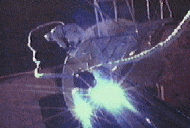
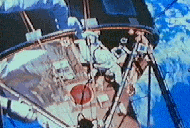
Crews visited Skylab and returned to earth in Apollo spacecraft (Command/Service Modules). The Skylab II crew successfully repaired the damage to Skylab, and performed a 28-day mission. The Skylab III crew performed a 59-day mission, and Skylab IV performed an 84-day mission.
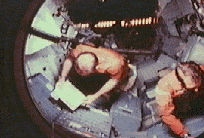
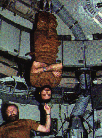
The Skylab IV crew, Gerald P. Carr, Edward G. Gibson, and William R. Pogue conducted inflight experiments and gathered medical data on themselves. They also performed four extravehicular activities. The Skylab 4 crew returned to Earth on February 8, 1974, after a mission duration of 2,016 hours, one minute and 16 seconds
The Skylab station was placed into orbit using a Saturn V launch vehicle, placed inside the third
stage. The Saturn V launch vehicle had a mass of 2,896,915 kg (6.5 million pounds), and featured a cluster of 5 F1 rocket engines in its primary stage. The F1 engine provided 690,000 kg (1,522,000 pounds) of thrust each, and used kerosene (fuel) and liquid oxygen (oxidizer) as
propellant.
Crews were launched using the Saturn IB rocket, which was also used to launch the Earth-orbit Apollo missions. It had a mass of 568,568 kg at launch. It featured 8 H1 rocket engines in its primary stage. The H1 engine provided 90,720 kg (200,000 pounds) of thrust each, and used kerosene (fuel) and liquid oxygen (oxidizer).
ASSORTED PICTURES FROM SKYLAB
Matt's Space Memorabilia