Iran
– AncientBackground
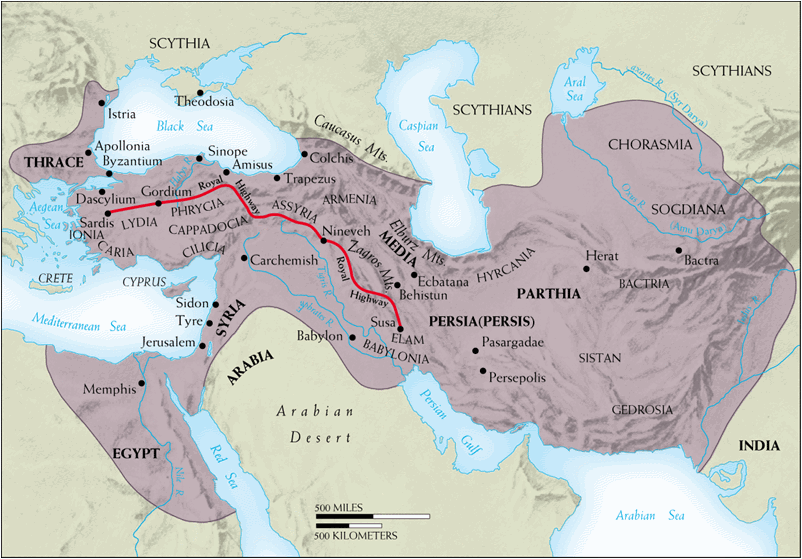
 Geography of Iran
 Boundaries
 Iranian plateau
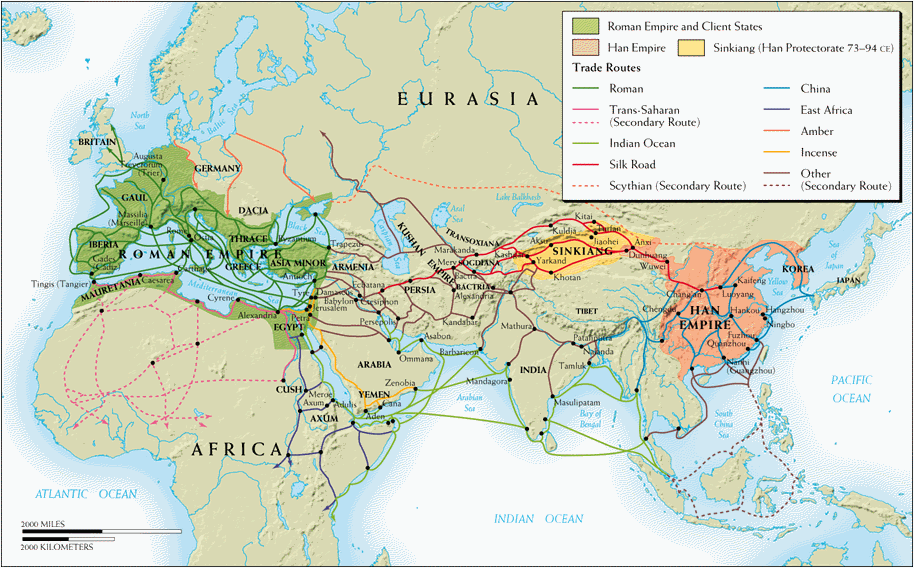
 Iran as center of east-west trade
 Elamites
 Non-Semitic
speaking peoples
Non-Semitic
speaking peoples At war with
Mesopotamian dynasties
At war with
Mesopotamian dynasties “Middle Elamite” period in 12th century B.C.E.
 Destroyed by
Assyrians in 639 B.C.E.
Destroyed by
Assyrians in 639 B.C.E.Iranians
 Aryan ancestors around 1100
B.C.E.
Aryan ancestors around 1100
B.C.E. Pastoralists
 Medes and Persians
 Religion – similar to Vedic
Aryans
Religion – similar to Vedic
Aryans Importance of
fire, water, sacrifice and cow
Importance of
fire, water, sacrifice and cow Importance of
moral order
Importance of
moral order Ahura Mazda
•The “Wise Lord”
•Similar to Vedic Varuna
Zoroaster
 Zarathustra – 628-551 B.C.E. or
1000 B.C.E.?
Zarathustra – 628-551 B.C.E. or
1000 B.C.E.? Gathas
 Message of moral reform
 Turn from Lie (druj) to Truth (asha)
 Warned of a Final Reckoning
 Good – “future
glory”
Good – “future
glory” Wicked –
“long-lasting darkness”
Wicked –
“long-lasting darkness” Quasi-monotheistic worship of Ahura Mazda
 Magi
MagiZoroastrian
Influence
 Zoroastrianism probably
influenced Jewish, Christian and Muslim ideas of
Zoroastrianism probably
influenced Jewish, Christian and Muslim ideas of Angels
 Devils
 Messiah
 Last judgment
 Afterlife
 Also influence on Buddhist
concepts
Also influence on Buddhist
concepts Wiped out as major force in Iran
by Islam
Wiped out as major force in Iran
by Islam Parsis in western India today
Achaemenids550-330 B.C.E.
The
First Iranian Empire
 Cyrus the Great - r. 559-530
B.C.E.
Cyrus the Great - r. 559-530
B.C.E. Military career
 Extraordinary
expansion
Extraordinary
expansion Conquest of
Babylon in 539 B.C.E.
Conquest of
Babylon in 539 B.C.E.•Symbolic beginning of Achaemenid empire
•Mesopotamia and Iran under one
rule
 Toleration
 Enlightened
view of empire
Enlightened
view of empire Allowed Jews to
return to homeland
Allowed Jews to
return to homelandLater
Achaemenid Rulers
 Cambyses – r. 529-522 B.C.E.
 Conquered Egypt
 Darius I – 521-486
 Empire at its
peak
Empire at its
peak Egypt to Sogdiana to Indus
valley
Egypt to Sogdiana to Indus
valley Susa and
Persepolis as capitals
Susa and
Persepolis as capitalsArtaxerxes III – r. 359-338
Achaemenid
State
 Tremendous stability
 Shahanshah – “king of kings”
 Ahura Mazda’s trust
through justice
Ahura Mazda’s trust
through justice Cultural and religious toleration
 Powerful army
 Administrative brilliance
 Highways
 Trade,
communication and propaganda
Trade,
communication and propaganda King’s road –
Sardis to Susa
King’s road –
Sardis to SusaAchaemenid
Economy
 Coin-based economy on Lydian
model
Coin-based economy on Lydian
model Banking operations
 Taxation
 Wages regulated
 Money-goods
equivalences published
Money-goods
equivalences published Agricultural foundation
 Unprecedented volume of trade
 Prosperous era marked by
expanding markets
Prosperous era marked by
expanding markets Pax Achaemenica
Indian
Political Background
 Rise of regional states and
commercial towns
Rise of regional states and
commercial towns Between 7th-4th centuries
 Magadha was strongest regional
state
Magadha was strongest regional
state Bimbisara – d. 493
B.C.E.
Bimbisara – d. 493
B.C.E. Centralized
state – Achaemenid model?
Centralized
state – Achaemenid model?•Good roads
•Able administrators
•Fair agricultural taxes
 Bimbisara’s son annexed Kosala
Mauryans
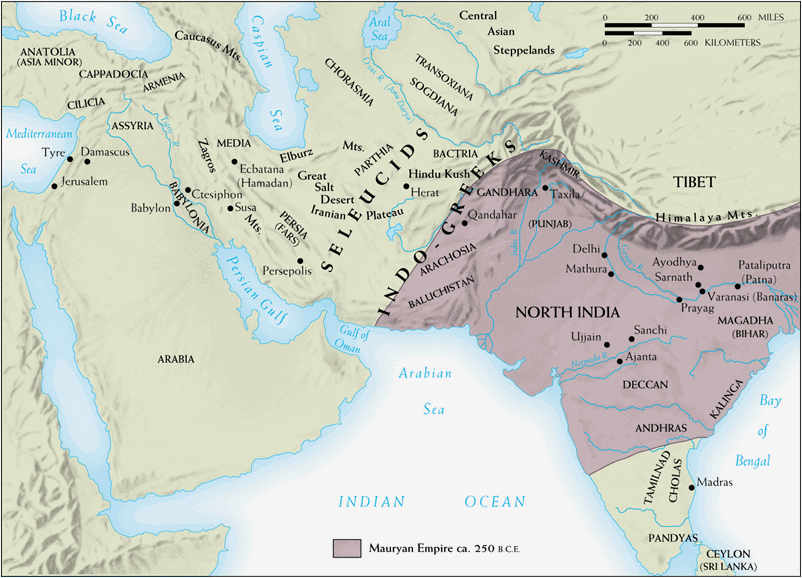
The First Indian Empire 321-185
B.C.E
 Chandragupta Maurya – r. 321-297 B.C.E.
 First Indian
unification
First Indian
unification Took advantage
of Alexander’s invasion
Took advantage
of Alexander’s invasion Treaty with Seleucus
 Pataliputra as capital
 Kautilya – Chandragupta’s advisor
 “Indian
Machiavelli” and Arthashastra?
“Indian
Machiavelli” and Arthashastra? Bindusara – r. 297-272
 Conquered
Deccan plateau
Conquered
Deccan plateau
The Greatest Mauryan
 Grandson of Chandragupta Maurya
 Bloody conquest of Kalinga
 Religious conversion
 Buddhist Middle
Path
Buddhist Middle
Path Championed
nonviolence – ahimsa
Championed
nonviolence – ahimsa Warfare only
through righteousness – dharma
Warfare only
through righteousness – dharma Dharma
officials
Dharma
officials Concept of Chakravartin
 Universal
monarch who rules with righteousness, justice and wisdom
Universal
monarch who rules with righteousness, justice and wisdomMauryan
State
 Mauryan bureaucracy was marked by
 Centralization,
standardization and efficiency
Centralization,
standardization and efficiency Long-distance
trade and communication
Long-distance
trade and communication Effective civil
and military organization
Effective civil
and military organization Information
gathering
Information
gathering Great Mauryan kings associated
with new religious movements
Great Mauryan kings associated
with new religious movements Chandragupta
and Jains
Chandragupta
and Jains
 Bindusara and ascetic Ajivikas
 Ashoka and
Buddhism
Ashoka and
Buddhism
Mauryan
Legacy
 Imperial ideal
 Strengthened Buddhist movement
 Strong central administration
 Cosmopolitan traditions
 Excellent road system
 Facilitated
internal and external contacts
Facilitated
internal and external contacts Urbanization
 Pataliputra, Varanasi, Ayodhya, Prayag
Consolidation
of Indian Civilization 200 B.C.E.-300 C.E
 Economic Base
 Rise of
merchant class and world trade
Rise of
merchant class and world trade High Culture
 Marriage of
Indian and Hellenistic influences
Marriage of
Indian and Hellenistic influences•Buddhist stupas of Bharhut and Sanchi
 Mahabharata and Ramayana in final forms
 Bhagavad
Gita
Bhagavad
Gita
 Religion and Society
 Popular
devotional cults of Shiva and Vishnu
Popular
devotional cults of Shiva and VishnuHindu
Tradition
 Hinduism emerged in this era
 Three major developments
 Consolidationof caste system, Brahman ascendance, and “high” culture of
Sanskrit
 Increasing
dominance of theistic devotionalism – Vishnu and Shiva
Increasing
dominance of theistic devotionalism – Vishnu and Shiva
 Intellectualreconciliation of new developments with older ascetic and
speculativetraditions from Upanishadic age
Buddhist
Tradition
 Buddhist monastic communities
prospered
Buddhist monastic communities
prospered Supported by
mercantile and royal patronage
Supported by
mercantile and royal patronage Buddhist lay devotion
 Buddha
identified with Indian deities
Buddha
identified with Indian deities Buddhist
worship assimilated into common Indian patterns of theistic piety
Buddhist
worship assimilated into common Indian patterns of theistic piety Absorbed into religious variety
of Hinduism
Absorbed into religious variety
of Hinduism Parni – steppe people
 Mithradates I – 171-138 B.C.E.
 Empire from
Mesopotamia to Arachosia
Empire from
Mesopotamia to Arachosia
 Ctesiphon - capital
 Major Eurasian power alongside
Rome
Major Eurasian power alongside
Rome Carrhae – victory over
Romans 53 B.C.E.
Carrhae – victory over
Romans 53 B.C.E. Dominated trade
 Silk Road to
China
Silk Road to
China Monsoon route
on Indian Ocean coast
Monsoon route
on Indian Ocean coastParthian
Culture
 Initially Hellenistic
 Iranian revival in 1st
century C.E.
Iranian revival in 1st
century C.E. Replaced Greek
on coins with Parthian and Aramaic
Replaced Greek
on coins with Parthian and Aramaic Cities reverted
to Iranian names
Cities reverted
to Iranian names Return to
Iranian motifs in art
Return to
Iranian motifs in art•Hunt, battle, feast
 Magi preserved
worship of Ahura Mazda
Magi preserved
worship of Ahura MazdaTolerated religious pluralit
Sakas
 Successor to the Indo-Greeks
 Scythian tribes that overran
northeastern Iran around 130 B.C.E.
Scythian tribes that overran
northeastern Iran around 130 B.C.E. Extended control from Bactria
into Mathura
Extended control from Bactria
into Mathura Eventually
defeated in northwest India by Iranian invaders known as Pahlavas
Eventually
defeated in northwest India by Iranian invaders known as Pahlavas
 Defeated in Sogdiana by a tribe the
Chinese called Yueh Chih
Defeated in Sogdiana by a tribe the
Chinese called Yueh Chih
 Sakas ruled in parts of
northwestern and western India through 4th century C.E.
Sakas ruled in parts of
northwestern and western India through 4th century C.E.Kushans
 Kushans led Yueh Chih out of western China
 Drove Sakas out
of Bactria
Drove Sakas out
of Bactria Ended Pahlava rule in
northwest India
Ended Pahlava rule in
northwest India Beginning of long-lasting Indian Kushan dynasty
 Kanishka – c. 100-150 C.E.
 Greatest patron
of Buddhism since Ashoka
Greatest patron
of Buddhism since Ashoka Missionary
activity - Buddhism into China
Missionary
activity - Buddhism into China
 Graeco-Buddhist art
in Ghandara
Graeco-Buddhist art
in Ghandara