csecsemő és gyermekgyógyász szakorvos
Házi gyermekorvosi praxis
Mecseknádasd
Mecseki Zöldkereszt KFT.
(ügyvezető: Dr. Czimbalmos F.)
Adalélok a bölcsőhalál - tünetegyüttes (SIDS) etiológiájához
Rövid kivonat
Típusosnak mondható bölcsőhalál este kapcsán ismertetjük az idevonatkozó elméleteket, esetünk kórelőzményét valamint az elvégzett neurohisztopatológiai vizsgálat eredményét. Pozitív heredocollateralis anamnesisű (apnoés epizódok miatt reanimált vérszerinti testvér pozitív poliszomnográfiás lelettel) csecsemő betegünk bölcsőhalálban elhunyt. Az agytörzs neurohisztopatologiai vizsgálata súlyos féloldali nucleus arcuatus hipopláziát igazolt. Az eset kapcsán áttekintjük a SIDS kérdéskörét, főleg a congenitalis neurologiai malformatiók szemszögéből.
Kulcsszavak
bölcsőhalál, SIDS, neurohisztopatológia, nucleus arcuatus, hypothalamus, apoptosis, tobozmirigy, gliosis, formatio reticularis, kisagykéreg, gyrus dentatus, légzőközpont.
Abstract in english
SIDS and the hypoplasia of the nucleus arcuatus.
There are several hypotheses in regard to the etiology of SIDS pathogenesis. The team headed by professor Luigi Matturri of Milan, Italy, focuses on defective embryo-stage development of truncus cerebri and medulla oblongata neuronal structures. It is presumed that the hypoplasias of the reticular formation and especially of the nucleus arcuatus are a risk factor in SIDS. In the author’s case, the patient’s death occurred at the age of 3 months. Heredo-collateral anamnesis was positive, as the patient’s brother, now 3 years old, has been 3 times resuscitated due to apnea episodes during his first year of life, thanks to the apnea alarm employed because of the positive results rendered by the poligraphyc examination during sleep. Furthermore, the patient’s anamnesis pointed out that the mother’s smoking during pregnancy significantly heightened the risk of SIDS. The patient’s neuro-histopathological examination was performed at the Pathology Institute of the University of Milan by professor Matturri and provided evidence regarding a serious unilateral hypoplasia of the nucleus arcuatus. The results constitute additional proof for the hypotheses of the Milan-based team. The article strongly supports the idea of international cooperation in SIDS research in order to clarify the cause. However, significant steps have recently been made from total obscurity to concrete hypotheses. Although today it is deemed that SIDS has several causes, above-mentioned hypothesis is one of the most important. The author’s case constitutes additional support to extend poligraphyc examinations during sleep to patients exposed to higher risks (SIDS in the family, apnea episodes, and maternal smoking). Furthermore, the article draws attention to the need of social initiative against SIDS such as the one performed in Italy, which managed to integrate civil and professional organizations, thus reporting excellent results in the diminishment of SIDS cases.
Keywords
sudden infant death syndrome, neurohistopathology, arcuate nucleus, hypothalamus, apoptosis, thymus, gliosis, reticular formation, cerebellar cortex, dentate gyrus, respiratory center.
Bevezető
A bölcsőhalál - az angol Sudden Infant Death Syndrome rövidítésével a SIDS betűszóval jelölt betegség - egy igen régóta ismert jelenség. Mondhatni az ókor óta végig jelen van különböző orvostörténeti emlékekben. Az egyik kölni múzeumban őriznek egy ókori római sírkövet, amelyet egy valószínűleg bölcsőhalálban meghalt csecsemő emlékére állítottak.
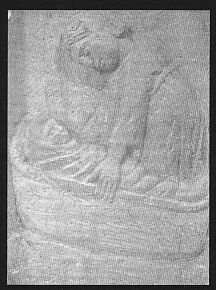
1.ábra. Mater nutrix. Kölni múzeum.
Valódi okát pontosan ma sem ismerjük, habár több elmélet is létezik az etiológiát illetően. A bölcsőhalál definíció szerint akkor kerül diagnosztizálásra, amikor a látszólag jó egészségi állapotban levő kisdedet holtan találják és az elvégzett boncolás a szokványos vizsgálati módszerek alkalmazása segítségével (lényeges a szokványos jelző kiemelése) nem tud magyarázatot adni az eseményre. Értelemszerűen, a hirtelen csecsemőkori halálnak többféle oka lehet. Veleszületett fejlődési rendellenességek, pl. szívfejlődési rendellenességek, a szív ingerületvezető rendszerének zavarai vagy veleszületett strukturális rendellenességei, anyagcserebetegségek, de akut betegségek mint pl. infectiók, mérgezések , balesetek (pl. suffocatio ), koraszülöttség, kis születési súly, dysmaturitás, anyai dohányzás a terhesség alatt vagy után mind-mind olyan tényezők, amelynek kóroki szerepe lehet a hirtelen csecsemőkori halál előidézésében.
Az alkalmazott vizsgálati módszerek finomodása mind több és több esetben tisztázza a hirtelen halál kiváltó okát. Így az ismeretlen eredetű esetek köre mindinkább szűkül, kikerülnek ebből a körből pl. a szövettanilag diagnosztizált, kifejezetten a szív ingerületvezető rendszerét érintő fejlődési rendellenességek, stb. Mindezek ellenére körvonalazódni látszik egy olyan entitás, amely esetében sokan feltételezik, hogy magát a bölcsőhalál-betegséget jelenti. Az ilyen esetek boncolása során öt fő ismérv merül fel: 1. súlyos betegség hiánya, 2. hajlamosító tényezőként jelen lehet enyhe vírusfertőzés a felső légutakban, 3. pleuralis petechiák jelenléte, 4. pulmonalis artériák muscularis rétegében megfigyelhető hipertrófia, extramedullaris erithropoiesis, barna zsírszövet lerakodása a mellékvesetokban, 5. centralis és perifériás idegrendszeri elváltozások, legjelentősebbek ezek közül a formatio reticularis és a nucleus arcuatus elváltozásai.
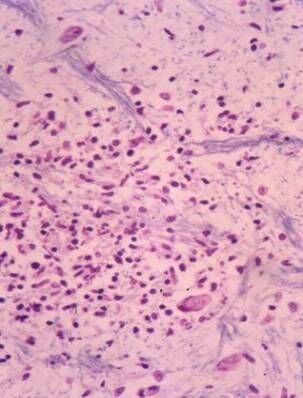
2.ábra. Gyulladásos zóna a formatio
reticularisban.
Prof. Dr. Luigi Matturri anyagából idézve.
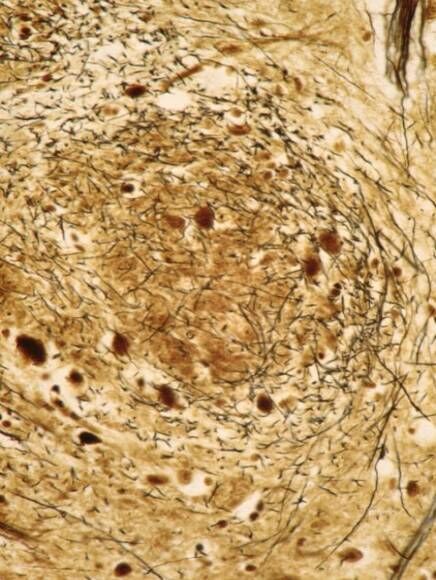
3.ábra. Necroticus zóna a nucleus tractus solitariusban, idegrostok megszakadásával.
Prof.
Dr. Luigi Matturri anyagából idézve.
Több évtizedes kutatómunka után a Prof. Dr. Luigi Matturri vezette munkacsoport a Milánói Egyetem Pathológiai Intézetében kidolgozott egy elméletet, mely szerint a „tulajdonképpeni” bölcsőhalál és a halvaszületések egy jelentős csoportja, a „stillbirth” jelölésű tünetegyüttes egy és ugyanazon entitás és tulajdonképpen egy veleszületett multiplex rendellenesség, amely esetében a domináns elváltozások a szív ingerületvezető rendszerét (WPW sy, megnyúlt QT szakasz, stb), az autonóm perifériás idegrendszert de elsősorban és meghatározó módon az agytörzs légzésszabályozó renszerét, ezn belül is a formatio reticularist (ld. alább) de főleg a nucleus arcuatust (ld. az estismertetésnél) érintik.
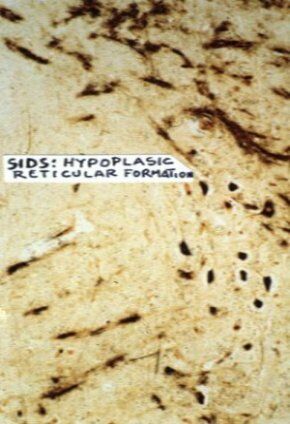
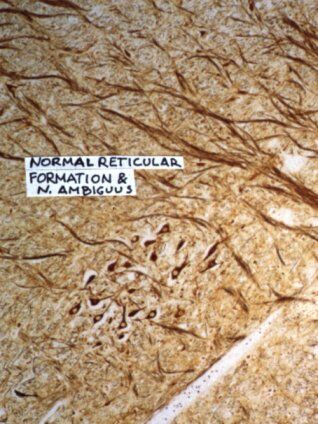
4.ábra. Hipopláziás és ép formatio reticularis. Prof. Dr. Luigi Matturri anyagából idézve.
Vizsgálataik szerint a tünetegyüttesben meghaltak
nucleus arcuatusa féloldalt vagy bilateralisan hipopláziás vagy ageneziás,
a nyúltagyi formatio reticularis pedig szembetűnően hipopláziás. Maturri
professzor a 2000 szeptemberében a Gargnano di Gardaban megtartott, bölcsőhalállal
foglalkozó kongresszuson elmondta, hogy egy hirtelen meghalt csecsemő T-limfocitás
meningitise keltette fel a gyanúját, miután a kisfokú és körülírt elváltozás
roncsolta a nucleus arcuatust és az egyetlen tünet a légzésleállás volt.Az
évek során találták meg aztán sorozatban a nucleus arcuatus elváltozásait
a bölcsőhalálban elhaltaknál és az említett halvaszületetteknél, akik esetében
nagy százalékban megfigyelhető volt a magzati légzőmozgások hiánya is.
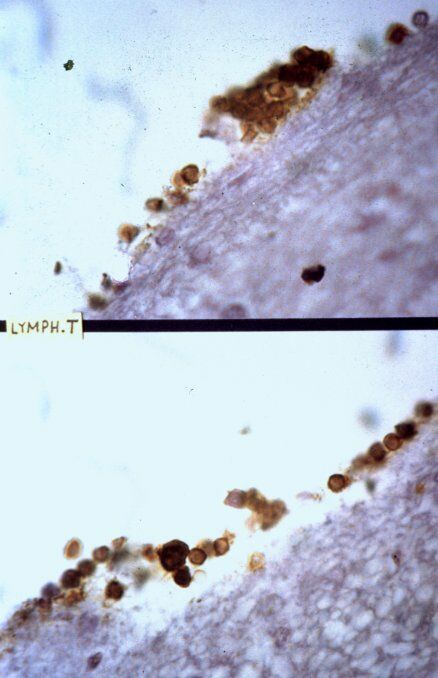
5.ábra. T-lymphocitás leptomeningitises elváltozás a nyúltvelő ventralis felszínén,
amely a nucleus arcuatusba terjed. 1000 x, immunhisztokmiai eljárás.
Prof. Dr. Luigi Matturri anyagából idézve.
_________________________________________________________________________
Honlapjukon (http://users.unimi.it/~pathol/sids.html) részletesen ismertetik elméletüket, pontos útmutatót adva a boncoláshoz, amely a szokásostól eltérő technikával történik. A boncolás technikáját illetően itt csak a nyúltagyi olivák szintjén végzett pontos harántmetszetekre utalok.
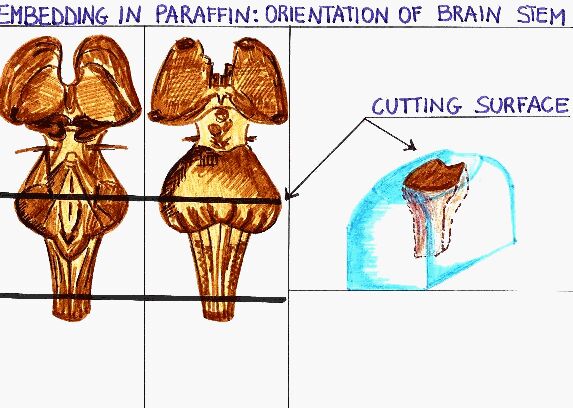
(boncnctechnikai rajz a honlapról)
________________________________________________________________________________________
Esetismertetés
Z.Z. (2001. - 2001.05.11) harmadik fiúgyermekként született g
cm Apgar-score-al. Anamnéziséből kiemelendő: a család rossz szociális
helyzetben él. Több generáció lakik együtt a község szélén álló családi
házban, gyermekszerető emberek, családjukban legfőbb érték a gyermek –
a nevelésben közösen vesznek részt, nem alkoholisták, nem tartoznak valamely
etnikai kisebbséghez. Alkalmi fizikai munkából élnek, tüzelőben, élelemben
nem szenvednek komolyabb hiányt. Majdnem minden családtag dohányzik, az
anya is végig dohányzott mindhárom terhessége során. A kisgyermekek folyamatos
felügyelet alatt vannak, nem alszanak külön. A legnagyobb fiúgyermek csecsemőkorában
apnoés epizódon ment keresztül, első esetben édesanyja élesztette újra
(a több km-re levő, éppen ügyeletes szerző által telefonon adott és jól
végrehajtott manőverek segítségével). Pozitív poliszomnográfiás vizsgálat
után két évig örzőmonitorral aludt SIDS-veszélyeztetettség miatt. Ezalatt
két komoly apnoés rohamot sikerült a hozzátartozóknak elhárítaniuk (az
egyik nagybácsi, aki fizikai munkás, korrektül képes volt alkalmazni a
cardiopulmonalisresuscitatiót). A középső fiútestvér is SIDS-veszélyeztetettnek
bizonyult és két évig örzőmonitorral aludt, de nem volt komolyabb apnoés
epizódja. Mindkét nagyobb testvér jelenleg gondozott asztmás, pszichoszomatikus
fejlődésük koruknak megfelelő. A harmadik fiútestvér, Z.Z. kétszer volt
kórházban pneumonia gyanújával, poliszomnográfiás vizsgálatát is tervezték
elvégezni, de a vizsgálaton nem jelent meg. Szerzőt mater riasztotta telefonon
2001.05.11-én rendellenesnek tűnő légzés miatt. Kb. 4-5 perc alatt lehetett
elérni a helyszínt, a beteg ekkor már apnoés és cyanotikus volt, de szívműködés
még érezhető volt. Ambu-ballonos lélegeztetés következett majd a szív leállása
miatt külső szívmasszázst is alkalmazni kellett. (A jelen lévő, jól képzett
védőnő közreműködése megkönnyítette az újraélesztést). Kb. 10 perc reszuszcitáció
után a cyanosis oldódni látszott, de kb. félóra múlva a folyamatos manőver
ellenére újra jelentkezett. Az esetkocsi időközben kiérkezett és 42 perc
sikertelen reanimáció után, az izoelektromos vonalat mutató EKG, fénymerev
pupilla, cyanosis, cardiorespiratorikus funkció teljes hiánya alapján megállapítottuk
a halál beálltát. Adminisztratív okokból (hétvége, stb.) a boncolás csak
több nap múlva történ meg (PTE ÁOK Igazságügyi Orvostani Intézet) , így
elektronmikroszkópos vizsgálatokat végezni már nem lehetett. Mindenesetre
a boncolást vezető orvos intézkedett az agy korrekt, sérülésmentes fixálása
érdekében. A kisagy HE festéses mikroszkópos vizsgálata hipoxiás károsodást
mutatott. Korábbi, elhúzódó, krónikus hipoxiára utaló gliaproliferációnak
semmilyen jele nem látszott. Az oedema jellege és mértéke egyszeri, elhúzódó,
súlyos hipoxiát jelzett, nem pedig hirtelen epizódot, ami jól korrelál
a hosszasan végzett, mégis eredménytelen reszuszcitációval. A gondosan
fixált agy további vizsgálatok céljára, a szűlők óhajának megfelelően,
a szükséges engedélyek megszerzése után a Milánói Egyetem Kórbonctani Intézetébe
került, ahol Prof. Dr. Luigi Matturri elvégezte a vizsgálatokat.
Neurohisztopatológiai vizsgálatok
Számos próbálkozás történt a bölcsőhalál etiopatogenezisének tisztázására. A Prof. Dr. Luigi Matturri vezette Kórbonctani Intézetben a Milanói Egyetemen az évek során kidolgoztak egy koncepciót, amely hangsúlyt fektet a boncolás precíz elvégzésére, többek között a nyúltagy és az agytörzs boncolására és szövettani sorozatmetszetek készítésére. Esetünkben, a Z.Z. agytörzsének szövettani vizsgálata során fény derült az agytörzsi nucleus arcuatus súlyos féloldali hipopláziájára.
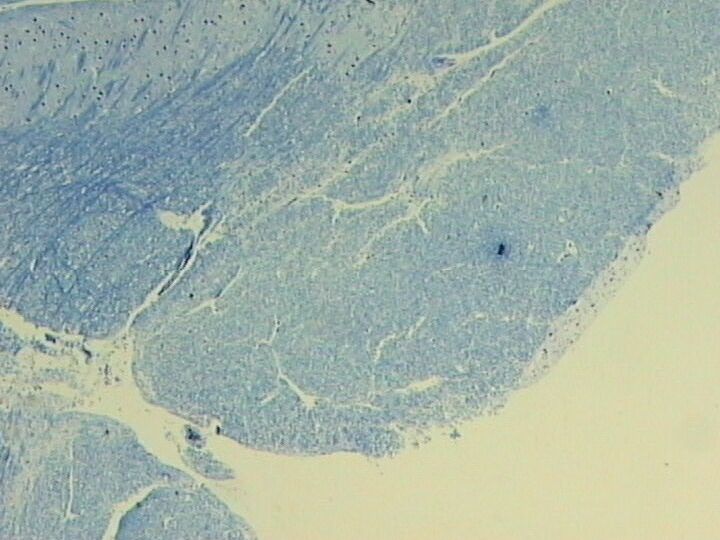
6.ábra. Z.Z. hipopláziás
nucleus arcuatusa. Saját eset. A metszet készült a Milanói Pathologiai
Intézetben.
Összehasonlításképpen bemutatunk egy féloldali nucleus arcuatus apláziát:
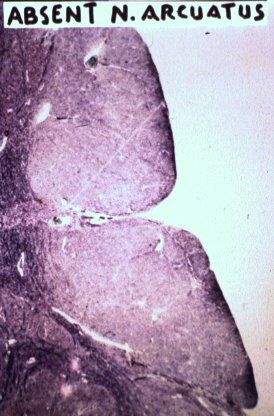
7.ábra. Nucleus arcuatus féloldali aplasiája.
Prof. Dr. Luigi Matturri anyagából .
Képalkotó eljárásos vizsgálatok
Mivel az élő testvérek már túl vannak a SIDS által leginkább veszélyeztetett életkoron ( 2,5 és 3,5 évesek), és az MR vizsgálat csak altatásban végezhető náluk, a rizikó / haszon arány mérlegelése alapján az agytörzs MR vizsgálatától eltekintettünk annak ellenére, hogy a jó minőségű MR vizsgálat esetleg kimutathatott volna látható elváltozást. A color-doppler echocardiográfia egyelőre még nem történt meg, az EKG jelentős elváltozást nem mutat.
Következtetések
Esetünkben megfigyelhető volt a SIDS családi halmozódása. A három fiútestvér közül a legnagyobb a monitoros őrzésnek és a reanimáció technikája ismeretének köszönhetően túlélt három apnoés epizódot. A második testvérnél is történt poliszomnográfiás vizsgálat és apnoe alarm monitor használata de súlyos apnoéja nem volt . A harmadik testvér az első apnoés epizód során meghalt. Kórszövettani vizsgálata során derült fény féloldali nucleus arcuatus hipopláziájára, ami korrelál a fentebb ismertetett elmélettel.
Kongresszusi beszámoló
2001 szeptemberében került sor a Garda tó partján fekvő festői Gargnano di Gardaban található Palzzo Feltrinelliben, a Milanoi Egyetem szervezésében, a bölcsőhalál témakörével foglalkozó olasz nemzeti kongresszusra, amelyre esetem kapcsán hívott meg Prof. Dr. Luigi Matturri, a Milanoi Pathologiai Intézet vezetője. A szervezés példás volt, a szállás pedig az egyetemi vendégház kategória ellenére igencsak kényelmesnek bizonyult. Mindezen túltett az olasz vendégszeretet, amelyet különösen is éreztettek a nyelvet beszélő magyar kollégával, mondván, hogy számukra ritka „madár” a helyes hangsúlyozásra legalább törekvő külföldi. Az olasz konyha finomságairól csak annyit, hogy a szervezők szerintem összekötötték a kellemest a hasznosal, a kongresszust a régi barátokkal való találkozással – mással nem tudom magyarázni a csodálatos ízek és még finomabb borok valóságos kavalkádját. Minden kifinomultságuk ellenére sem nehezek az olasz ételek, némi Meristin segítségével baj nélkül sikerült végigenni az egész menüt
A kongresszus első estéje személyes találkozásokkal telt.
Másnap délelőtt az egészségügyminiszter jelenlétében Lombardia tartomány főügyésze bemutatott egy törvénytervezetet, melynek értelmében minden gyanús eset boncolása kötelezővé vált, a hozzátartozók beleegyezésétől függetlenül. A tervezetet még aznap elfogadta a római parlament. Az indoklás szerint kifejezetten a tudományos kutatás érdekeit kell szem előtt tartani, mivel ez az egyetlen esély az előrelépésre a halálesetek számának visszaszorítása útján. Indoklásként a magas, 1-2 bölcsőhalál-eset /1000 élveszületés prevalenciát is felhozták.
Délután tudományos előadások hangzottak el, melyek közül kiemelkedően érdekes volt a nucleus arcuatus patológiájával foglalkozó blokk, melyet a professzor tartott valamint Giulio Benedetti orvosetikai-jogi előadása és Marco Vivareli közgazdász professzor, a bölcsőhalálban elhunyt gyermekek szüleinek országos egyesülete vezetőjének gyakorlati csecsemőgondozással (!!!) és megelőzéssel, civil kezdeményezésekkel foglalkozó nagyszerű és közérthető előadása. Mindezek a cikkben említett webcímen angolul és olaszul hozzáférhetőek.
A kongresszus zárónapján gyakorlati bonctani bemutató volt és szervezési kérdések kerültek napirendre. A profeszor átadta a szerzőnek az általa kzdeményezett kutatási projekthez és a kapcsolódó EU V-ös pályázathoz történő csatlakozás dokumentációját, melykésőbb magyar patológiai és gyermekgyógyászati vezető intézmények professzoraihoz került.
A magyarországról hozott eset anyagát is gondosan előkészítették további vizsgálatokra, a cikkben szereplő hisztopatológiai leletet fényképpel együtt rövidesen e-mailben továbbították is.
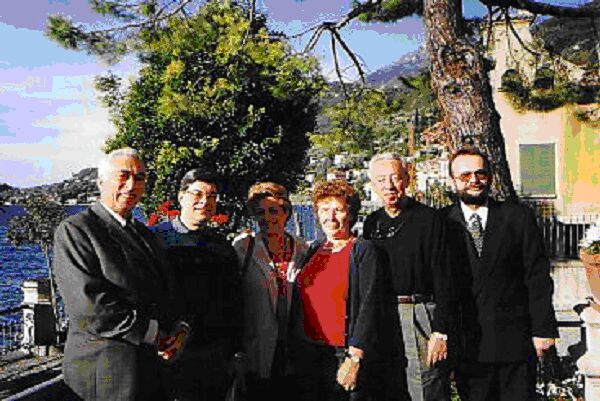
Balról: Prof. Dr. Vincent Di Carlo neurológus, Tampa Egyet. Florida, Prof. Dr.Furio Silvestri patológus, Trieszti Egyetem, feleségével valamint Prof. Dr. Luigi Matturri felesége és a professzor, a kongresszus fő szervezői és házigazdái, jobb szélen a szerzővel, a Palazzo Feltrinelli parkjában – háttérben a Garda tó.

A szerző Giulio Benedettivel (balról) aki jogi szakemberként vett részt
a kutatást előmozdító törvény megalkotásában.
A civil kezdeményezések szerepe a bölcsőhalál megelőzésében
Bemutatunk egy szóróanyagot, amelyet a böcsőhalál elleni olasz civil egyesület ad ki.
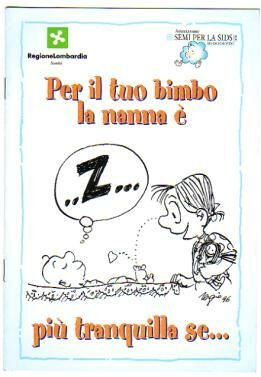
Ebben a közérthető gyakorlati tanácsok mellett minden szükséges cím és telefonszám megtalálható. Külön jótanácsként hangsúlyozták annak szükségességét, hogy Magyarországon is létrejöjjön egy, valamennyi ilyen profilú tudományos és civil szervezetet összefogó közös koordináló fórum a bölcsőhalál visszaszorítása, a poliszomnográfia elterjesztése, a szükséges örzőkészülékek célszemélyekhez juttatása érdekében.
Mindennek megszervezése túlmutat jelen cikk keretein.
Köszönetnyilvánítások
Névsor szerint:
ÁNTSZ. Baranya Megyei Intézrtének, a vizsgálatok külföldi megszervezése engedélyezésénél nyújtott támogatásáért.
Prof. Dr. Czinner Antalnak, Heim Pál Gyermekkórház, Bp., tanácsaiért és a téma értékeléséért a kapcsolódó televíziós műsorban.
Gombár Gabriellának, MTV1, Pécs, a témához kapcsolódó televíziós műsor elkészítésében való közreműködéséért.
Dr. Harangi Ferenc osztályvezető főorvosnak, Kerpel-Fronius Ödön Gyermekkórház, Pécs, tanácsaiért és a kapcsolódó televíziós műsorban történő részvételéért.
Dr. Könczöl Franciska docensnek, PTE-ÁOK Pécs, Igazságügyi Orvostani Intézet, szakmai segítségéért.
Prof. Dr. Luigi Matturri -nak, Milano, tanácsaiért, a szövettani vizsgálatok elvégzéséért és a szemléltető ábrákért.
Németh Györgyinek, MTV1, Bp., a téma televíziós ismertetéséért és a kapcsolódó műsor megszervezéséért..
Dr. Seress László docensnek, PTE-ÁOK Pécs, Elektronmikroszkópiás Laboratórium, szakmai segítségéért.
Prof. Dr. Sulyok Endrének, Kerpel-Fronius Ödön Gyermekkórház, Pécs, tanácsaiért és a jelen kutatási témában nyújtott szakmai és erkölcsi támogatásáért.
Z.Z.† családjának, akik hozzájárultak a vizsgálatokhoz és kifejezett
óhajuk volt az eredmények tudományos felhasználása a további hasonló halálesetek
megelőzése érdekében.
Bibliográfia:
1.
Severe
hypoplasia of medullary arcuate nucleus: quantitative analysis in sudden
infant death syndrome.
Matturri,-L;
Biondo,-B; Mercurio,-P; Rossi,-L
Institute
of Pathology, University of Milan, Italy. [email protected]
Acta-Neuropathol-(Berl).
2000 Apr; 99(4): 371-5
2.
Sudden
infant death syndrome: hypothalamic failure to sense elevated blood pyrogens.
Reid,-G;
Tervit,-H
New
Zealand Dairy Group, Waitoa.
Med-Hypotheses.
2000 Jan; 54(1): 84-90
3.
Sudden
Infant Death Syndrome (SIDS): a study of cardiac conduction system.
Matturri,-L;
Ottaviani,-G; Ramos,-S-G; Rossi,-L
Institute
of Pathology, University of Milan, Milan, Italy. [email protected]
Cardiovasc-Pathol.
2000 May-Jun; 9(3): 137-45
4.
Sudden
and unexpected death in infancy and the conduction system of the heart.
Anderson,-R-H
Cardiac
Unit Institute of Child Health, London, United Kingdom.
Cardiovasc-Pathol.
2000 May-Jun; 9(3): 147-8
5.
Tracing
cranial nerve pathways (glossopharyngeal, vagus, and hypoglossal) in SIDS
and control
infants:
a DiI study.
Loeliger,-M;
Tolcos,-M; Leditschke,-J; Campbell,-P; Rees,-S
Neurology
Index-Medicus
6.
Neuronal
apoptosis in sudden infant death syndrome.
Waters,-K-A;
Meehan,-B; Huang,-J-Q; Gravel,-R-A; Michaud,-J; Cote,-A
The
Jeremy Rill Center for SIDS, Department of Pediatrics, McGill University
and Montreal
Children's
Hospital, Quebec, Canada.
Pediatr-Res.
1999 Feb; 45(2): 166-72
7.
Catecholaminergic
neurons in the diencephalon and basal ganglia of SIDS.
Ozawa,-Y;
Obonai,-T; Itoh,-M; Aoki,-Y; Funayama,-M; Takashima,-S
Department
of Mental Retardation and Birth Defect Research, National Institute of
Neuroscience,
National
Center of Neurology and Psychiatry, Kodaira, Tokyo, Japan.
Pediatr-Neurol.
1999 Jul; 21(1): 471-5
8.
An association
between sudden infant death syndrome (SIDS) and Helicobacter pylori infection.
Kerr,-J-R;
Al-Khattaf,-A; Barson,-A-J; Burnie,-J-P
Infectious
Diseases Research Group, The University of Manchester, Clinical Sciences
Building,
Manchester
Royal Infirmary, Oxford Road, Manchester M13 9WL, UK. [email protected]
Arch-Dis-Child.
2000 Nov; 83(5): 429-34
9.
The
thebesian circulation to developing conducting tissue: a nutrient-nodal
hypothesis of
cardiogenesis.
Taylor,-J-R;
Taylor,-A-J
Health
Sciences Centre, Winnipeg, Canada. [email protected]
Can-J-Cardiol.
1999 Aug; 15(8): 859-66
10.
Vertebral
artery compression resulting from head movement: a possible cause of the
sudden infant
death
syndrome.
Pamphlett,-R;
Raisanen,-J; Kum-Jew,-S
Neuropathology
Unit, Department of Pathology, University of Sydney, Sydney.
Pediatrics.
1999 Feb; 103(2): 460-8
Pediatrics-
11.
Mitochondrial
DNA point mutations detected in four cases of sudden infant death syndrome.
Opdal,-S-H;
Rognum,-T-O; Torgersen,-H; Vege,-A
Institute
of Forensic Medicine, The National Hospital, Oslo, Norway. [email protected]
Acta-Paediatr.
1999 Sep; 88(9): 957-60
12.
Increase
of pulmonary density of macrophages in sudden infant death syndrome.
Lorin-de-la-Grandmaison,-G;
Dorandeu,-A; Carton,-M; Patey,-A; Durigon,-M
Department
of Pathology and Forensic Medicine, Hospital R. Poincare-University R.
Descartes, Paris-
Ouest,
Garches, France. [email protected]
Forensic-Sci-Int.
1999 Oct 11; 104(2-3): 179-87
13.
Myokarditisdiagnostik
bei SIDS-Verdacht.
[Suspected
SIDS and diagnosis of myocarditis]
Dettmeyer,-R;
Schlamann,-M; Madea,-B
Institut
fur Rechtsmedizin, Rheinischen Friedrich-Wilhelms-Universitat Bonn.
Klin-Padiatr.
1999 Nov-Dec; 211(6): 456-8
14.
Increased
mast cell tryptase in sudden infant death - anaphylaxis, hypoxia or artefact?
Edston,-E;
Gidlund,-E; Wickman,-M; Ribbing,-H; Van-Hage-Hamsten,-M
Department
of Forensic Medicine, Linkoping, Sweden.
Clin-Exp-Allergy.
1999 Dec; 29(12): 1648-54
Clinical-and-experimental-allergy
15.
Association
of primary Pneumocystis carinii infection and sudden infant death syndrome.
Vargas,-S-L;
Ponce,-C-A; Hughes,-W-T; Wakefield,-A-E; Weitz,-J-C; Donoso,-S; Ulloa,-A-V;
Madrid,-
P; Gould,-S;
Latorre,-J-J; Avila,-R; Benveniste,-S; Gallo,-M; Belletti,-J; Lopez,-R
Instituto
de Ciencias Biomedicas, Universidad de Chile, Santiago, Chile. [email protected].
Clin-Infect-Dis.
1999 Dec; 29(6): 1489-93
16.
Catecholamine
neurons alteration in the brainstem of sudden infant death syndrome victims.
Obonai,-T;
Yasuhara,-M; Nakamura,-T; Takashima,-S
Department
of Mental Retardation and Birth Defect Research, National Institute of
Neuroscience,
National
Center of Neurology and Psychiatry, Tokyo, Japan.
Pediatrics.
1998 Feb; 101(2): 285-8
17.
Digoxin-like
immunoreactivity in early infantile death.
Couper,-R-T;
Aldis,-J-J; Byard,-R-W
University
of Adelaide, Department of Paediatrics, Women's and Children's Hospital,
South Australia.
Med-Sci-Law.
1998 Jan; 38(1): 52-6
18.
Phrenic
nerves and diaphragms in sudden infant death syndrome.
Weis,-J;
Weber,-U; Schroder,-J-M; Lemke,-R; Althoff,-H
Institute
of Neuropathology, Technical University (RWTH), Aachen, Germany. [email protected]
Forensic-Sci-Int.
1998 Jan 30; 91(2): 133-46
19.
Simultaneous
death of twins: an environmental hazard or SIDS?
Carter,-N;
Rutty,-G-N; Green,-M-A
Am-J-Forensic-Med-Pathol.
1998 Jun; 19(2): 195-6
20.
Histopathology
of the conduction system in sudden infant death.
Paz-Suarez-Mier,-M;
Aguilera,-B
Institute
of Toxicology, Histopathology Section, Madrid, Spain.
Forensic-Sci-Int.
1998 May 11; 93(2-3): 143-54
Forensic-science-international
21.
Maternal
cigarette smoking is associated with increased inner airway wall thickness
in children who
die
from sudden infant death syndrome.
Elliot,-J;
Vullermin,-P; Robinson,-P
Department
of Thoracic Medicine, Royal Children's Hospital, Melbourne, Australia.
Am-J-Respir-Crit-Care-Med.
1998 Sep; 158(3): 802-6
American-journal-of-respiratory-and-critical-care-medicine
22.
Dispersione
del tessuto giunzionale e sue conseguenze in un caso di morte improvvisa
del lattante.
[Dispersion
of junctional tissue and its consequences in a case of sudden infant death]
Ottaviani,-G;
Goisis,-M; Ramos,-S-G; Matturri,-L
Istituto
di Anatomia Patologica, Universita degli Studi, IRCCS Ospedale Maggiore,
Milano.
Cardiologia.
1998 Jul; 43(7): 737-9
23.
In utero
brain lesions in SIDS.
Obonai,-T;
Takashima,-S
Department
of Mental Retardation and Birth Defect Research, National Institute of
Neuroscience,
National
Center of Neurology and Psychiatry, Tokyo, Japan.
Pediatr-Neurol.
1998 Jul; 19(1): 23-5
24.
Short
note: The fetal origins hypothesis: linking pineal gland hypoplasia with
coronary heart disease
and
stroke.
Maurizi,-C-P
Department
of Pathology, Houston Medical Center, Warner Robins, GA 31093, USA.
Med-Hypotheses.
1998 Apr; 50(4): 357-8
Medical-hypotheses
25.
Morte
improvvisa del lattante (SIDS): un caso con vie accessorie e resorptive
degeneration.
[Sudden
infant death syndrome (SIDS): a case with accessory pathways and resorptive
degeneration]
Guareschi,-M;
Ottaviani,-G; Ramos,-S-G; Matturri,-L
Istituto
di Anatomia Patologica, IRCCS Ospedale Maggiore, Universita di Milano.
Pathologica.
1998 Jun; 90(3): 294-7
26.
Hyperplasia
of the aorticopulmonary paraganglia: a new insight into the pathogenesis
of sudden infant
death
syndrome?
Ramos,-S-G;
Matturri,-L; Biondo,-B; Ottaviani,-G; Rossi,-L
Department
of Pathology, Faculty of Medicine of Ribeirao Presto, University of Sao
Paulo, Brazil.
Cardiologia.
1998 Sep; 43(9): 953-8
27.
Diagnostika
casnych fazi difuzniho axonalniho poraneni s vyuzitim imunohistochemickych
metod.
[Diagnosis
of early phase diffuse axonal injury using immunohistochemical methods]
Toupalik,-P
Ustav
soudniiho lekarstvi 2. LF UK, Praha.
Soud-Lek.
1998 Nov; 43(4): 50-4
Soudni-lekarstvi
28.
Sudden
unexpected death in infancy: epidemiologically determined risk factors
related to pathological
classification.
L'Hoir,-M-P;
Engelberts,-A-C; van-Well,-G-T; Bajanowski,-T; Helweg-Larsen,-K; Huber,-J
Psychosocial
Department, Wilhelmina Children's Hospital, University Hospital for Children
and
Youth,
Utrecht, The Netherlands.
Acta-Paediatr.
1998 Dec; 87(12): 1279-87
29.
Potential
role of microbiological agents in sudden infant death syndrome.
Csukas,-Z;
Rozgonyi,-F; Toro,-K; Sotonyi,-P; Jankovics,-I
Institute
of Microbiology, Semmelweis Medical University, Budapest, Hungary.
Acta-Microbiol-Immunol-Hung.
1998; 45(3-4): 341-8
Acta-microbiologica-et-immunologica-Hungarica
30.
Ependymal
changes in sudden infant death syndrome.
Lucena,-J;
Cruz-Sanchez,-F-F
Neurological
Tissue Bank, Hospital Clinico-University of Barcelona, Spain.
J-Neuropathol-Exp-Neurol.
1996 Mar; 55(3): 348-56
Journal-of-neuropathology-and-experimental-neurology
31.
Astrocytes
in the hypoglossal nuclei of sudden infant death syndrome (SIDS) infants:
a quantitative
study.
Pamphlett,-R;
Treloar,-L
Department
of Pathology (Neuropathology Division), University of Sydney, New South
Wales,
Australia.
Neuropathol-Appl-Neurobiol.
1996 Apr; 22(2): 136-43
Neuropathology-and-applied-neurobiology
32.
Phrenic
nerve maturation in the sudden infant death syndrome.
Pamphlett,-R;
Murray,-N; Louda,-C
Department
of Pathology, University of Sydney, NSW, Australia.
Acta-Neuropathol-(Berl).
1996; 91(4): 422-6
Acta-neuropathologica
33.
Retarded
heart growth in the victims of sudden infant death: possible implications
for lethal
mechanisms.
Kelmanson,-I-A
Department
of Paediatrics No. 3, St. Petersburg State Paediatric Medical Academy,
Russia.
Eur-J-Pediatr.
1996 Jun; 155(6): 440-4
European-journal-of-pediatrics
34.
Maternal
smoking and pulmonary neuroendocrine cells in sudden infant death syndrome.
Cutz,-E;
Perrin,-D-G; Hackman,-R; Czegledy-Nagy,-E-N
Department
of Pathology, Hospital for Sick Children, Toronto, Ontario, Canada.
Pediatrics.
1996 Oct; 98(4 Pt 1): 668-72
35.
Autopsy
cases of sudden unexpected infant deaths examined at the Tokyo medical
examiner's office,
1964-1993.
Funayama,-M;
Tokudome,-S; Matsuo,-Y
Department
of Legal Medicine, Sapporo Medical University School of Medicine, Japan.
Am-J-Forensic-Med-Pathol.
1996 Mar; 17(1): 32-7
36.
Relationship
of substance P and gliosis in medulla oblongata in neonatal sudden infant
death
syndrome.
Obonai,-T;
Takashima,-S; Becker,-L-E; Asanuma,-M; Mizuta,-R; Horie,-H; Tanaka,-J
Department
of Mental Retardation and Birth Defect Research, National Institute of
Neuroscience,
Tokyo,
Japan.
Pediatr-Neurol.
1996 Oct; 15(3): 189-92
37.
Oxidative
stress in sudden infant death syndrome.
Huggle,-S;
Hunsaker,-J-C; Coyne,-C-M; Sparks,-D-L
Sanders-Brown
Center on Aging, University of Kentucky Medical Center, Lexington 40536-0230,
USA.
J-Child-Neurol.
1996 Nov; 11(6): 433-8
38.
The
pathological approach to sudden infant death--consensus or confusion? Recommendations
from
the
Second SIDS Global Strategy Meeting, Stavangar, Norway, August 1994, and
the Third
Australasian
SIDS Global Strategy Meeting, Gold Coast, Australia, May 1995.
Byard,-R-W;
Becker,-L-E; Berry,-P-J; Campbell,-P-E; Fitzgerald,-K; Hilton,-J-M; Krous,-H-F;
Rognum,-T-O
Department
of Histopathology, Women and Children's Hospital, North Adelaide, Australia.
Am-J-Forensic-Med-Pathol.
1996 Jun; 17(2): 103-5
39.
Myelin
in SIDS: assessment of development and damage using MRI.
Lamont,-P;
Sachinwalla,-T; Pamphlett,-R
Department
of Pathology, University of Sydney, New South Wales, Australia.
Pediatrics.
1995 Mar; 95(3): 409-13
40.
Intrathoracic
and subconjunctival petechiae in sudden infant death syndrome (SIDS).
Kleemann,-W-J;
Wiechern,-V; Schuck,-M; Troger,-H-D
Department
of Legal Medicine, Hannover Medical School, Germany.
Forensic-Sci-Int.
1995 Mar 21; 72(1): 49-54
41.
Brain
stem gliosis in the victims of sudden infant death syndrome (SIDS): a sign
of retarded
maturation?
Kelmanson,-I-A
Department
of Paediatrics No. 3, St. Petersburg Paediatric Medical Academy, Russia.
Zentralbl-Pathol.
1995 Apr; 140(6): 449-52
Zentralblatt-fur-Pathologie
42.
Brain
weight and sudden infant death syndrome.
Falck,-G;
Rajs,-J
Department
of Forensic Medicine, Karolinska Institute, Stockholm, Sweden.
J-Child-Neurol.
1995 Mar; 10(2): 123-6
43.
Morphology,
immunohistochemistry and morphometry of the thyroid gland in cases of sudden
infant
death
syndrome (SIDS).
Rothfuchs,-D;
Saeger,-W; Bajanowski,-T; Freislederer,-A
Department
of Pathology, Marienkrankenhaus Hamburg, Germany.
Int-J-Legal-Med.
1995; 107(4): 187-92
International-journal-of-legal-medicine
44,
Sudden
infant death syndrome: postnatal changes in the volumes of the pons, medulla
and cervical
spinal
cord.
O'Kusky,-J-R;
Kozuki,-D-E; Norman,-M-G
Department
of Pathology, University of British Columbia, Vancouver, Canada.
J-Neuropathol-Exp-Neurol.
1995 Jul; 54(4): 570-80
Journal-of-neuropathology-and-experimental-neurology
45.
Bronchus-associated
lymphoid tissue (BALT) in the lungs of children who had died from sudden
infant
death
syndrome and other causes.
Tschernig,-T;
Kleemann,-W-J; Pabst,-R
Centre
of Anatomy, Medical School of Hannover, Germany.
Thorax.
1995 Jun; 50(6): 658-60
46.
Sudden
infant death syndrome: increased number of synapses in the hypoglossal
nucleus.
O'Kusky,-J-R;
Norman,-M-G
Department
of Pathology and Laboratory Medicine, University of British Columbia, Vancouver,
Canada.
J-Neuropathol-Exp-Neurol.
1995 Sep; 54(5): 627-34
Journal-of-neuropathology-and-experimental-neurology
47.
Commentary
on morphologic variations of the external arcuate nucleus in infants dying
of SIDS: a
preliminary
report, J. Forensic Sci., Vol. 39, No. 4, July 1994, pp.1076-1083.
Koehler,-S-A
J-Forensic-Sci.
1995 Jul; 40(4): 531-2
48.
Brain
stem nuclei in sudden infant death syndrome (SIDS): volumes, neuronal numbers
and positions.
Lamont,-P;
Murray,-N; Halliday,-G; Hilton,-J; Pamphlett,-R
Department
of Pathology (Neuropathology Division), University of Sydney, Australia.
Neuropathol-Appl-Neurobiol.
1995 Jun; 21(3): 262-8
Neuropathology-and-applied-neurobiology
49.
Coeur
et mort subite du nourrisson. Etude anatomopathologique de 100 cas.
[Heart
and sudden infant death. Anatomopathological study of 100 cases]
Pelletier-Leroy,-B;
Nomballais,-M-F; Verriele,-V; Mouzard,-A
Laboratoire
d'anatomie Pathologique A, Hotel-Dieu, CHU, Nantes, France.
Arch-Pediatr.
1995 Oct; 2(10): 965-72
Archives-of-pediatrics
50.
Sudden
infant death syndrome and superoxide/nitric oxide.
Reid,-G-M;
Tervit,-H
Med-Hypotheses.
1995 Oct; 45(4): 395-7
Medical-hypotheses
51.
An immunohistochemical
study on foetuses and newborns lymph nodes with emphasis on follicular
dendritic
reticulum cells.
Muretto,-P
Department
of Pathology, Ospedale S. Salvatore, Pesaro, Italy.
Eur-J-Histochem.
1995; 39(4): 301-8
European-journal-of-histochemistry
52.
Sudden
infant death syndrome: increased synaptic density in the central reticular
nucleus of the
medulla.
O'Kusky,-J-R;
Norman,-M-G
Department
of Pathology, University of British Columbia, Vancouver, Canada.
J-Neuropathol-Exp-Neurol.
1994 May; 53(3): 263-71
Journal-of-neuropathology-and-experimental-neurology
53.
Arcuate
nucleus hypoplasia in sudden infant death syndrome: a review.
Filiano,-J-J
Department
of Pediatrics, (Intensive Care/Neurology), Children's Hospital, Dartmouth
Hitchcock
Medical
Center, Lebanon, N.H. 03756.
Biol-Neonate.
1994; 65(3-4): 156-9
Biology-of-the-neonate
54.
A perspective
on neuropathologic findings in victims of the sudden infant death syndrome:
the triple-
risk
model.
Filiano,-J-J;
Kinney,-H-C
Department
of Neurology, Children's Hospital, Boston, Mass.
Biol-Neonate.
1994; 65(3-4): 194-7
Biology-of-the-neonate
54.
Morphologic
variations of the external arcuate nucleus in infants dying of SIDS: a
preliminary report.
Gilson,-T-P;
Balko,-M-G; Blisard,-K-S; Taylor,-K-L
Department
of Pathology and Laboratory Medicine, University of Cincinnati Medical
Center, OH.
J-Forensic-Sci.
1994 Jul; 39(4): 1076-83
Journal-of-forensic-sciences
55.
Proceedings
of "Workshop on Guidelines for Scene Investigation of Sudden Unexplained
Infant
Deaths"--July
12-13, 1993.
Iyasu,-S;
Hanzlick,-R; Rowley,-D; Willinger,-M
Centers
for Disease Control and Prevention, Atlanta, GA.
J-Forensic-Sci.
1994 Jul; 39(4): 1126-36
Journal-of-forensic-sciences
56.
Histopathological
findings of the lung and trachea in sudden infant death syndrome: review
of 105
cases
autopsied at Dade County Medical Examiner Department.
Aoki,-Y
Department
of Forensic Medicine, Tohoku University School of Medicine, Sensai, Japan.
Nippon-Hoigaku-Zasshi.
1994 Jun; 48(3): 141-9
Nippon-hoigaku-zasshi
57.
Morphological
and immunohistochemical studies of the pituitary in sudden infant death
syndrome
(SIDS).
Reuss,-W;
Saeger,-W; Bajanowski,-T
Department
of Pathology of the Marienkrankenhaus, Hamburg, Germany.
Int-J-Legal-Med.
1994; 106(5): 249-53
International-journal-of-legal-medicine
58.
Apoptosis
in the human thymus in sudden and delayed death.
Middleton,-G;
Reid,-L-E; Harmon,-B-V
Department
of Pathology, University of Queensland, Brisbane.
Pathology.
1994 Apr; 26(2): 81-9
Pathology-
59.
Pulmonary
immunopathology of sudden infant death syndrome.
Howat,-W-J;
Moore,-I-E; Judd,-M; Roche,-W-R
University
Pathology, University of Southampton, Southampton General Hospital, UK.
Lancet.
1994 Jun 4; 343(8910): 1390-2
60.
The
immunocytochemical demonstration of a relative lack of nerve fibres in
the atrioventricular node
and
bundle of His in the sudden infant death syndrome (SIDS).
Fu,-C;
Jasani,-B; Vujanic,-G-M; Leadbeatter,-S; Berry,-P-J; Knight,-B-H
Wales
Institute of Forensic Medicine, University of Wales College of Medicine,
Cardiff, UK.
Forensic-Sci-Int.
1994 Jun 10; 66(3): 175-85
Forensic-science-international
61.
Carotid
bodies in animal models of human disease: what do they teach us?
Barer,-G
Department
of Medicine, Royal Hallamshire Hospital, Sheffield, UK.
Thorax.
1994; 49 SupplS14-8
Thorax-
62.
Organ
weights in sudden infant death syndrome.
Siebert,-J-R;
Haas,-J-E
Department
of Laboratories, Children's Hospital and Medical Center, Seattle, Washington
98105.
Pediatr-Pathol.
1994 Nov-Dec; 14(6): 973-85
Pediatric-pathology
63.
[Some
findings of the lung in medicolegal autopsy cases]
Ohya,-I
Department
of Legal Medicine, Gifu University School of Medicine, Japan.
Nippon-Hoigaku-Zasshi.
1994 Dec; 48(6): 379-94
Nippon-hoigaku-zasshi
64.
The
pathology of
the adrenal glands in sudden infant death syndrome (SIDS)
Perez-Platz,-U;
Saeger,-W; Dhom,-G; Bajanowski,-T
Department
of Pathology of the Marienkrankenhaus, Hamburg, Germany.
Int-J-Legal-Med.
1994; 106(5): 244-8
International-journal-of-legal-medicine
65.
Developmental
brain-stem pathology in sudden infant death syndrome.
Takashima,-S;
Mito,-T; Yamanouchi,-H
Division
of Mental Retardation and Birth Defect Research, National Center of Neurology
and
Psychiatry,
Tokyo, Japan.
Acta-Paediatr-Jpn.
1994 Jun; 36(3): 317-20
Acta-paediatrica-Japonica
66.
Microglial
aggregation in the dentate gyrus: a marker of mild hypoxic-ischaemic brain
insult in
human
infants.
Del-Bigio,-M-R;
Becker,-L-E
Department
of Pathology, Hospital for Sick Children, Toronto, Canada.
Neuropathol-Appl-Neurobiol.
1994 Apr; 20(2): 144-51
Neuropathology-and-applied-neurobiology
67.
The
potential role of bacterial toxins in sudden infant death syndrome (SIDS).
Blackwell,-C-C;
Saadi,-A-T; Raza,-M-W; Weir,-D-M; Busuttil,-A
Department
of Medical Microbiology, University of Edinburgh, Medical School, UK.
Int-J-Legal-Med.
1993; 105(6): 333-8
International-journal-of-legal-medicine
68.
Delayed
maturation of the vagus nerve in sudden infant death syndrome.
Becker,-L-E;
Zhang,-W; Pereyra,-P-M
Department
of Pathology (Neuropathology), University of Toronto, Ontario, Canada.
Acta-Neuropathol-(Berl).
1993; 86(6): 617-22
Acta-neuropathologica
69.
Correlation
of astrogliosis and substance P immunoreactivity in the brainstem of victims
of sudden
infant
death syndrome.
Yamanouchi,-H;
Takashima,-S; Becker,-L-E
Department
of Pediatrics, Gunma University School of Medicine, Japan.
Neuropediatrics.
1993 Aug; 24(4): 200-3
70.
Proliferation
of dendritic cells in the bronchioles of sudden infant death syndrome victims.
Haque,-A-K;
Mancuso,-M-G
Department
of Pathology, University of Texas Medical Branch, Galveston.
Mod-Pathol.
1993 May; 6(3): 360-70
Modern-pathology
71.
The
interest of the neurological tissue preservation for the investigation
of sudden infant death
syndrome.
Lucena,-J;
Cruz-Sanchez,-F-F
Anatomical
Forensic Institute of Barcelona, University of Barcelona, Spain.
J-Neural-Transm-Suppl.
1993; 39193-205
Journal-of-neural-transmission.
Supplementum
72.
Unraveling
the mysteries of sudden infant death syndrome.
Brooks,-J-G
Department
of Pediatrics, University of Rochester School of Medicine, NY 14642.
Curr-Opin-Pediatr.
1993 Jun; 5(3): 266-72
Current-opinion-in-pediatrics
73.
A review
of sudden infant death syndrome.
Rambaud,-C;
Walpita,-P; Krous,-H-F
Hopital
Necker-Enfants Malades, Paris, France.
Pathology-(Phila).
1993; 2(1): 1-21
74.
The
amount of brainstem gliosis in sudden infant death syndrome (SIDS) victims
correlates with
maternal
cigarette smoking during pregnancy.
Storm,-H;
Nylander,-G; Saugstad,-O-D
Department
of Paediatric Research, National Hospital, Oslo, Norway.
Acta-Paediatr.
1999 Jan; 88(1): 13-8
75.
[Immunohistochemical
studies on neuronal changes in brain stem nucleus of forensic autopsied
cases.
II.
Sudden infant death syndrome]
Kubo,-S;
Orihara,-Y; Gotohda,-T; Tokunaga,-I; Tsuda,-R; Ikematsu,-K; Kitamura,-O;
Yamamoto,-A;
Nakasono,-I
Department
of Legal Medicine, School of Medicine, Tokushima University.
Nippon-Hoigaku-Zasshi.
1998 Dec; 52(6): 350-4
Nippon-hoigaku-zasshi
76.
A contribution
to a possible differentiation between SIDS and asphyxiation.
Betz,-P;
Hausmann,-R; Eisenmenger,-W
Department
of Legal Medicine, University of Erlangen-Nuremberg, Germany.
Forensic-Sci-Int.
1998 Jan 30; 91(2): 147-52
Forensic-science-international
77.
Subdural
neomembranes and sudden infant death syndrome.
Rogers,-C-B;
Itabashi,-H-H; Tomiyasu,-U; Heuser,-E-T
J-Forensic-Sci.
1998 Mar; 43(2): 375-6
Journal-of-forensic-sciences
78.
Ultrastructural
aspects of the alveolar wall in SIDS.
Butcovan,-D;
Mihaila,-D; Cotrutz,-C; Ionescu,-C; Petreus,-T; Mihailovici,-M-S
Disciplina
Morfopatologie, Universitatea de Medicina si Farmacie Gr.T. Popa Iasi.
Rev-Med-Chir-Soc-Med-Nat-Iasi.
1998 Jan-Jun; 102(1-2): 82-8
Revista-medico-chirurgicala-a-Societatii-de-Medici-si-Naturalisti-din-Iasi
79.
Recommended
technique for brain removal to retain anatomic integrity of the pineal
gland in order to
determine
its size in sudden infant death syndrome.
Sparks,-D-L;
Coyne,-C-M; Sparks,-L-M; Hunsaker,-J-C
Sanders-Brown
Center on Aging, Department of Pathology, University of Kentucky Medical
Center,
Lexington
40536-0230, USA.
J-Forensic-Sci.
1997 Jan; 42(1): 100-2
Journal-of-forensic-sciences
80.
Cerebellar
cortex delayed maturation in sudden infant death syndrome.
Cruz-Sanchez,-F-F;
Lucena,-J; Ascaso,-C; Tolosa,-E; Quinto,-L; Rossi,-M-L
Neurological
Tissue Bank, Hospital Clinico-University of Barcelona, Spain.
J-Neuropathol-Exp-Neurol.
1997 Apr; 56(4): 340-6
Journal-of-neuropathology-and-experimental-neurology
81.
Assessment
of pulmonary and intrathymic hemosiderin deposition in sudden infant death
syndrome.
Byard,-R-W;
Stewart,-W-A; Telfer,-S; Beal,-S-M
Department
of Paediatrics, University of Adelaide, Australia.
Pediatr-Pathol-Lab-Med.
1997 Mar-Apr; 17(2): 275-82
82.
Simultaneous
death of twins. An environmental hazard or SIDS?
Ramos,-V;
Hernandez,-A-F; Villanueva,-E
Department
of Legal Medicine and Toxicology Service, University of Granada School
of Medicine,
Spain.
Am-J-Forensic-Med-Pathol.
1997 Mar; 18(1): 75-8
American-journal-of-forensic-medicine-and-pathology,-The
83.
Intra-alveolar
pulmonary siderophages in sudden infant death: a marker for previous imposed
suffocation.
Becroft,-D-M;
Lockett,-B-K
Department
of Obstetrics and Gynecology, University of Auckland, New Zealand.
Pathology.
1997 Feb; 29(1): 60-3
Pathology-
84.
Formal
retrospective case review and sudden infant death.
Byard,-R-W;
MacKenzie,-J; Beal,-S-M
Department
of Paediatrics, University of Adelaide, Australia.
Acta-Paediatr.
1997 Sep; 86(9): 1011-2
85.
Detection
of respiratory syncytial virus nucleic acid in archival postmortem tissue
from infants.
Cubie,-H-A;
Duncan,-L-A; Marshall,-L-A; Smith,-N-M
Regional
Virus Laboratory, City Hospital, Edinburgh, United Kingdom.
Pediatr-Pathol-Lab-Med.
1997 Nov-Dec; 17(6): 927-38
86.
Comparison
of the immunohistology of mucosa-associated lymphoid tissue in the larynx
and lungs in
cases
of sudden infant death and controls.
Hiller,-A-S;
Kracke,-A; Tschernig,-T; Kasper,-M; Kleemann,-W-J; Troger,-H-D; Pabst,-R
Institute
of Legal Medicine, Medical School of Hannover, Germany.
Int-J-Legal-Med.
1997; 110(6): 316-22
International-journal-of-legal-medicine
87.
Unexpected
death in two young infants mimics SIDS: autopsies demonstrate tumors of
medulla and
heart.
Rajs,-J;
Rasten-Almqvist,-P; Nennesmo,-I
Department
of Forensic Medicine, Karolinska Institute, Stockholm, Sweden.
Am-J-Forensic-Med-Pathol.
1997 Dec; 18(4): 384-90
American-journal-of-forensic-medicine-and-pathology,-The
88.
Could
exogenous melatonin prevent sudden infant death syndrome?
Maurizi,-C-P
Department
of Pathology, Houston Medical Center, Warner Robins, GA 31093, USA.
Med-Hypotheses.
1997 Nov; 49(5): 425-7
Medical-hypotheses
89.
Pathology
of SIDS and new understandings.
Rambaud,-C
Departement
Universitaire de Medecine Legale, Faculte de Medecine Paris-Ouest (Universite
Rene-
Descartes),
France.
Pediatr-Pulmonol-Suppl.
1997; 16120-2
Pediatric-pulmonology.-Supplement
90.
Evidence
of brain ischemia in early neonatal sudden death syndrome.
Obonai,-T;
Asanuma,-M; Mizuta,-R; Horie,-H; Tanaka,-J; Takashima,-S
Department
of Mental Retardation and Birth Defect Research, National Institute of
Neuroscience,
Tokyo,
Japan.
Neuropediatrics.
1997 Jun; 28(3): 145-8
91.
New
trends in "mystery SIDS" research.
Butcovan,-D;
Mihaila,-D; Cotrutz,-C-E; Petreus,-T; Mihailovici,-M-S
Morphopatology
Department, Medicine Faculty, Gr. T. Popa University of Medicine and Pharmacy,
Iasi.
Rev-Med-Chir-Soc-Med-Nat-Iasi.
1997 Jul-Dec; 101(3-4): 123-8
Revista-medico-chirurgicala-a-Societatii-de-Medici-si-Naturalisti-din-Iasi
92.
Vagal
nerve complex in normal development and sudden infant death syndrome.
Becker,-L-E;
Zhang,-W
Department
of Pathology, Hospital for Sick Children, Toronto, Ontario, Canada.
Can-J-Neurol-Sci.
1996 Feb; 23(1): 24-33
Canadian-journal-of-neurological-sciences,-The
Pécs, 2002 május 24.
Dr. Czimbalmos-Kozma Ferenc
*

