| Tutorials |
| The Color Wheel |
 |
 |
| I'm sure your elementary school teachers always had what seemed to be a worthless poster of what is called a "color wheel." I always took it for granted, too, until I realized how useful it is. But before I get into that, I'll explain what the color wheel is. |
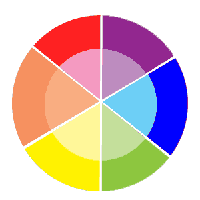 |
| This is a color wheel. It is composed of the main colors: red, orange, yellow, green, blue, and purple. Red, orange, and yellow are known as warm colors. These colors are bright and give a cheerful appearence, and are also associated with anything hot (of course, red isn't so warm of a color when you use it for a different purpose, ex. blood). Purple, blue, and green are called cool colors. They are usually used for shading techniques. |
| Color Categories Red, yellow, and blue are called primary colors. They are the basic colors that make up all the others. For example, mixing red and blue makes a result of purple (but why am I telling you this?). Mixing two primary colors makes a secondary color: orange, purple, and green. A tertiary color is created when mixing a primary color with a secondary. When equal amounts of two complementary colors (explained later) are mixed, you get a neutral color, which contains brown or grey. |
| Analogous and Complementary Colors Two colors that are adjacent, or next to each other, are called analogous colors. Such colors are red and orange, green and yellow, etc. Complementary colors are two colors diagonal from each other. Purple is a complement to yellow, orange is complement to blue, and red is complement to green. These "partners" can be matched together and look great on a scene. *Trying to match colors that are neither analogous nor complementary don't work out very well. Be aware of this! |
| Ready to learn more? Click on the arrow here to learn about using colors to their full extent. |
 |

|