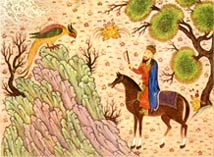
It is said that Farid-ud-Din Attar had presented to Rumi his masterpiece �Asraar Nama� while he was just a child, and was roaming with his family in Central Asia for peace, as the whole region was plunged and devastated by attack of Mongols. Attar himself had died at the hands of savage Mongols.
According to R. A. Nicholson �Rumi has borrowed, adapted, and expanded Attar�s tale of the Hindu sage and the King of Turkistan (Asrar-namah, 90, 6 sqq.), where a parrot plays the same trick with equal success. In both cases a message is sent by the captive parrot to her mates in India: on hearing it, they all (Attar), or one of them (Rumi), fall to the ground as though dead. When the news is brought to the caged parrot by the Hindu sage (Attar), or by the merchant (Rumi), she knows what to do in order to regain her liberty. She 'dies', is cast out of the cage, and immediately flies away."
The cage is but symbol of prison operating on several levels, it is body which is cage for human soul; it is worldly customs and rituals and manners which enslave human spirit, and there are the physical comforts and luxuries of this world which restricts human wisdom. The bird may be human soul at individual level, which has to learn to free itself from the shackles of worldly snares for the pursuit of higher goals. The birds are symbol of freedom that man wants to enjoy, because fish are caught in water and human being studded to earth. The birds that free themselves of this prison, by purifying their souls become akin to angels may return to their homeland in Paradise. Such are prophets and Walis � friends of Allah. However such freedom cannot be attained without Divine guidance.
Rumi have paid due reverence to renowned scholars of his time, Attar & Sanai. He has well celebrated the fact that wisdom can only be acquired through adopting proper means for it, and one must seek it in either religious codes of ethics or through scholars who have been placed at high ranks by God, the most exalted Himself. He had not just cursed the tongue, it was the abundant use of discursive logic by scholars of his time that he has attacked, which parts the Philosophy and theology; it is the reason which divides science and religion. And following either of extremes, we loose touch with knowledge itself.
Sometimes, it is the scholar�s own knowledge which leads him to self-conceit. In giving sermons and lectures, he fells in love with his own voice, and begins to exalt himself. One who stops being humble, falls prey to flattery and public idolatry, he has but lost the way, and only repentance and severe atonement can deliver him back to the Right Path.
An Aalim (scholar or a teacher) must be very careful in both his deeds and thoughts because a genre of whole new generation has to learn from him and follow him. Teaching is not just passing out information and propagating certain ideas. It casts strong moral, social and psychological influence on students in their personality development and character building. Therefore a teacher/scholar must be mindful of his social customs, careful in his life style, and watchful in his public bearing. He must develop a vivid sense of �right� and �wrong� in the most virtuous manner, and be �self-righteous� before claiming the right of public esteem and self-respect. And indeed it leads us to: |