PIN
Link to the Wikipedia
definition and examples
Pin is a tactical idea used to immobilize opponent's piece and
possibly capture it later with advantage. A piece is said to be pinned whenever it is in the line of fire but
unable or reluctant to move away because there is an even more valuable target hidden behind it.
There are 2 varieties of Pin:
- Absolute Pin - King is located behind a pinned piece. In
this case a piece is completely immobilized and unable to move away.
This is because under no circumstance can the King be put in danger of being
captured.
- Relative Pin - Piece different from the King is hidden behind a
pinned piece. In this case this piece can move away risking a loss of the
valuable target behind it.
Examples:
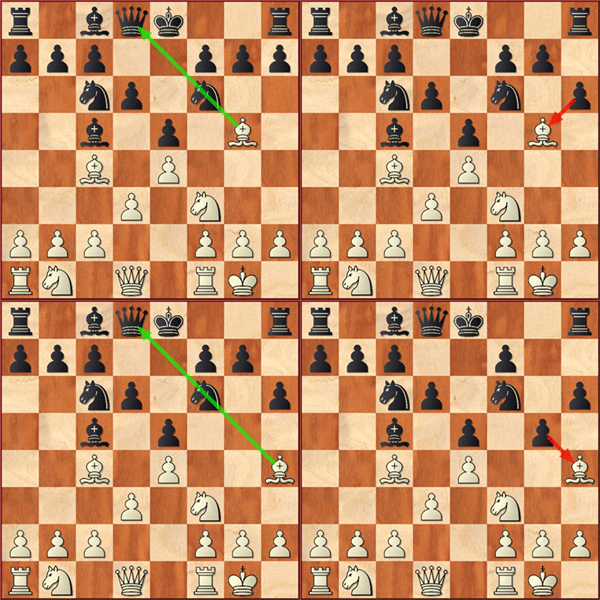
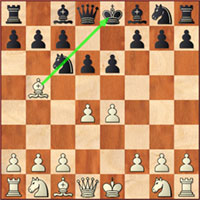
| Absolute pin. Black Knight
on c6 is being pinned by white Bishop on b5 and is completely immobilized.
It cannot move away since that would put black King on e8 in danger. (in
check) |
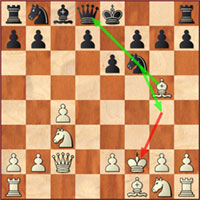
Relative pin. Black Knight
on f6 is pinned by White Bishop on g5. If it moves away black will
lose a Queen for a Bishop. However Knight from f6 moves to g4 with check
(and a double attack on King and Bishop). White has to defend the
King first and has no time to capture the Queen. |
|
 |
Taking advantage of the pin:
- Pinned piece is not a good defender. If it moves away a valuable
piece behind it is lost.
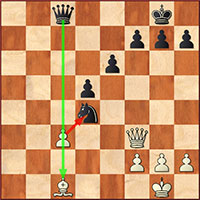
In this example black Knight just captured white pawn on d4. If white pawn
recaptures the Knight then black Queen captures white Bishop on c1 with mate.
- It is almost always better to put more pressure on the pinned than
to exchange it. It is unable to run away anyway.(unable only in case of
absolute pin, unwilling rather)
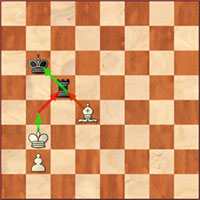
In this example instead of capturing black Rook that is pinned white just brings their King to b4 to attack it again and capture it for free.
Defending against the pin:
- Destroy, attack or distract the piece that does the pinning.
In this example black defends by first attacking the Bishop-h6. White tries to keep the pin-Bh4.
Black breaks the pin by interjecting their Pawn between the Bishop and their Knight-g5.
- Interject a less valuable piece or move away the valuable target presently
behind the pinned piece.
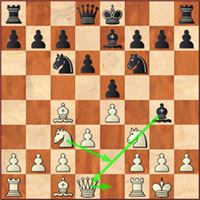
In this example white can avoid the pin from the black Bishop on g4 by moving their Queen away from behind the Knight on f3 or
by moving their Knight from c3 to e2.
- Unpin the pinned piece by moving it away and attacking a target
more valuable than the piece we leave unprotected (see example given above).
This is impossible when we deal with absolute pin.
In this example black Knight is pinned and attacked twice. If it moves away black Queen is lost.
Yet black sacrifices the Queen, seeing that they can win it back in the next move.