 |
|
|
|
|
|
|
|
|
|
|
|
|
|
|
|
|
|
|
|
|
|
Introduction to Spiny Mice |
|
|
| So you're in a pet store, looking at supplies, or maybe you were looking for a little female mouse companion for your lone one at home. Suddenly you stop, stare at what LOOKS like a mouse, but you know something's not right.. look at those ears! The huge eyes.... the... sharp, pointy fur? That's not a normal mouse! No, it isn't. It's one of the exotic species of mice being kept nowadays. This is the Spiny mouse. Out of zebra mice, pygmy mice, striped mice and the likes, I'd say the spiny mouse is the most intriguing, calmest, and most intelligent of the whole lot. |
|
|
| Intro: There are many different species of spiny mice that exist, and scientists STILL haven't sorted them out, yet. It's uncertain how many species, subspecies, or just mutations of the different spiny mouse exist. They are known for inbreeding even in the wild, sticking only with their family group. There are possibly around 8 different species, with subspecies as well in existance. The most commonly kept spiny in captivity, however is the Cairo (or egyptian) spiny mouse. They are many times called egyptian, but aren't true egyptian spiny mice. Cairo are a goldish brown color, with white patches under their eyes, and a white belly. True egyptian spiny mice are greyish in color, and differ in size. Despite the name Cairo, they are NOT restricted to just that area of Africa. They are found everywhere, and are one of the more common rodents. |
|
|
Acomys cahirinus - Cairo spiny mouse.
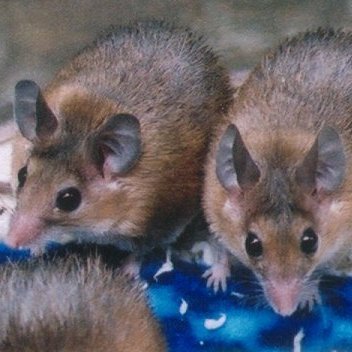
Large ears, nocturnal large eyes, and a beige-brown color top with a white cream belly. Patches of white under the eyes and on the feet. Their ears and tail are dark in color, with light coloring on the tail's underside. Whiskers are long and dark, except in satin spiny mice, where they're slightly curled (pictured on the right are two of my satin spiny mice). Their tail is thin, and VERY brittle. They use this as a defense mechanism, and will drop their tail if predators (or a human) grabs them by it. Extreme caution should be used when handling them, be sure NOT to pick them up by their tails, and to cup them in your hands. If handled daily, they'll stay tame. If not, they get hand shy after a while. Mealworms have been the best treat, I've found, for winning back their trust. They're EXTREMELY intelligent, and are escape artists. They're also very destructive, and will chew up everything plastic or cardboard in the cage. A chew guard on the water bottle and ceramic food dishes are definitely recommended. |
|
|
 |
|
|
|
Latte and Mocha. 2003. |
|
|
|
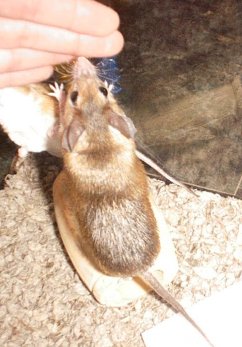
Behavior: In general, spiny mice are fairly docile pets. Remember that these are still fairly wild animals, and haven't been in the pet trade for that long (since the 80's, I believe). They are, basically, just tame captive bred wild animals. They need to be handled pretty much daily to keep them friendly. Mealworms as a treat seem to gain their trust, as do yogies (picked up in the small animal section. I DO NOT, however, recommend very many of them used, because they contain a lot of sugar, and spinies are known to become diabetic). Spinies handled since birth make the best pets, and will actively seek you out and climb right into your hand. They can even be trained to come.
However, not all is well with spinies. Sometimes you'll get that nasty little mouse who was never handled, who is still fairly wild, and will bite you at every chance it gets. Even the most tame spiny may nip your finger when they've had enough of handling. They're rather known for being a bit "bloodthirsty". With plenty of treats, however, and patience, eventually the spiny will gain your trust and will come to you. For the tame spiny who nips to be let down, do NOT let them have their way! They are very intelligent, and will learn quickly that bite = going back into cage where I want to be. If they bite, continue handling them, make a loud EEP noise so they know that hurt. This usually gets the message across that they aren't going to get their way. If not, there's one method I'm testing. I'm trying out a way to "punish" the nippers I have, so they learn they aren't going to get their way. |
|
|
 |
|
|
Those with Prairie dogs know that if a PD nips you, you place them in a "time out" spot. Usually in a large, empty trash container, so they can't see anywhere but up. Be sure you're near by and make noise so they know you're there. Eventually they'll be begging to come out, grabbing for you with outstretched hands, feeling very sorry for what they've done. Well, I've tried this with spinies, and it has worked so far. Some of my satins were taught early in life (when I was still learning about their behavior, just beginning to keep spinies) that if they bit me, they went back to their cage. These mice, normally, love to be held and they love interaction. They actively seek me out and climb right into my hand, but when they've had enough, they let me know with a very painful bite, now. At first it was a nip, but it has evolved into a nice little bloody wound, making me fear them a bit. Now, I've tried the "time out" punishment for one bites me. I've had great success, so far, and they rarely bite me as much anymore. When one bites me to be let down, I put her in a small plastic bin, so all she can see is up. This bin has to be smaller than the tank they're kept in to work right. Eventually she's reaching with outstretched hands and climbs right up my hand, begging to be let out. This sounds a bit cruel, but it's better than letting them bite me constantly, and they do learn from it. This method, however, is still in test and I won't know the results for a while. It also seems to only work with those who I've handled since birth, who already trust me. |
|
|
|
|
Cleopatra, my original Spiny mouse, 2002. |
|
|
|
|
|
|
Do's and Don'ts:
DON'T pick them up by their tail- Spiny mice have adapted tails that fall off VERY easily to escape predators. Once lost, it does NOT grow back.
DO keep them in same-sex pairs or groups- Unlike domestic mice, both males and females get along together. They are extremely social animals and need the company of other mice. Also, spiny mice MATE FOR LIFE. I made the mistake of seperating my first mated pair of spinies, and the female went nuts and began barbering her babies' fur, as well as her own, when the male was taken away. I also currently have some offspring of a female who chewed off their tails and even their ears!
DON'T use pine or cedar- BIG no-no for any animal. Pine and cedar contain phenols, and are toxic. I use, personally, either carefresh, carefresh ultra, yesterdays news (found in the cat section of pet stores), or walnut bedding (found in the bird section). There are also many, MANY other choices out there.
DO handle babies from day one- These guys need to be held for a couple hours a day, or multiple times throughout the day, since the day of birth to keep them tame. If you miss a couple days, it's not going to impact their behavior as much as missing a couple weeks, but it's still best to handle them daily.
|
|
|
| Color and Fur mutations: |
|
|
 |
|
|
| There are now various mutations available to the pet trade. Some of these mutations are harder to find than others. ? I personally have agouti, satin, cream, and white spotting. Shown above are from left to right, Mauser (agouti, carries satin and cream), Citrus (cream), and Latte (satin agouti). |
|
|
 |
|
|
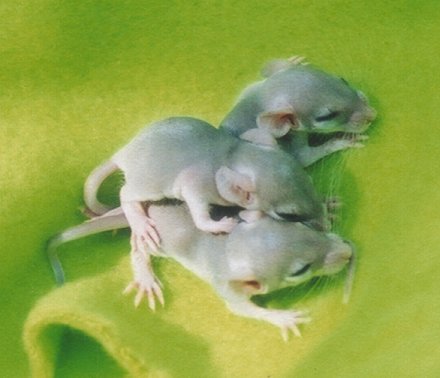
In my cream line, white spotting has shown up, as seen to the left. I hope to further breed out the piebald/white spot but so far these three babies were the only three born with it. The mother was Dew, the father was Mellow Yellow. Shown to the left are Citrus, Lemon, and Lime.
Cream: Cream spiny mice should be a pale color, with generally no tipping at all. Unfortunately to keep them from too much inbreeding, you have to introduce agouti into the line somewhere, which creates tipping in the line. They're still paler than the agouti, but it makes for a harder to see color difference. |
|
|
|
Satin: Satin spinies have curled whiskers, and a shiny darker coat than their usual color. The agouti appear a rich chestnut color, and I have yet to achieve a cream satin spiny, but we'll see eventually what they'll look like.
White Spot: These mice should have a nice white spot on their forehead. Unfortunately what is common with the gene, they fade as they age. Almost like a "fading star" in gerbils. The larger the spots, the more they retain their color at maturity. |
|
|
|
BACK | MAIN |
|