| Beer � 1577
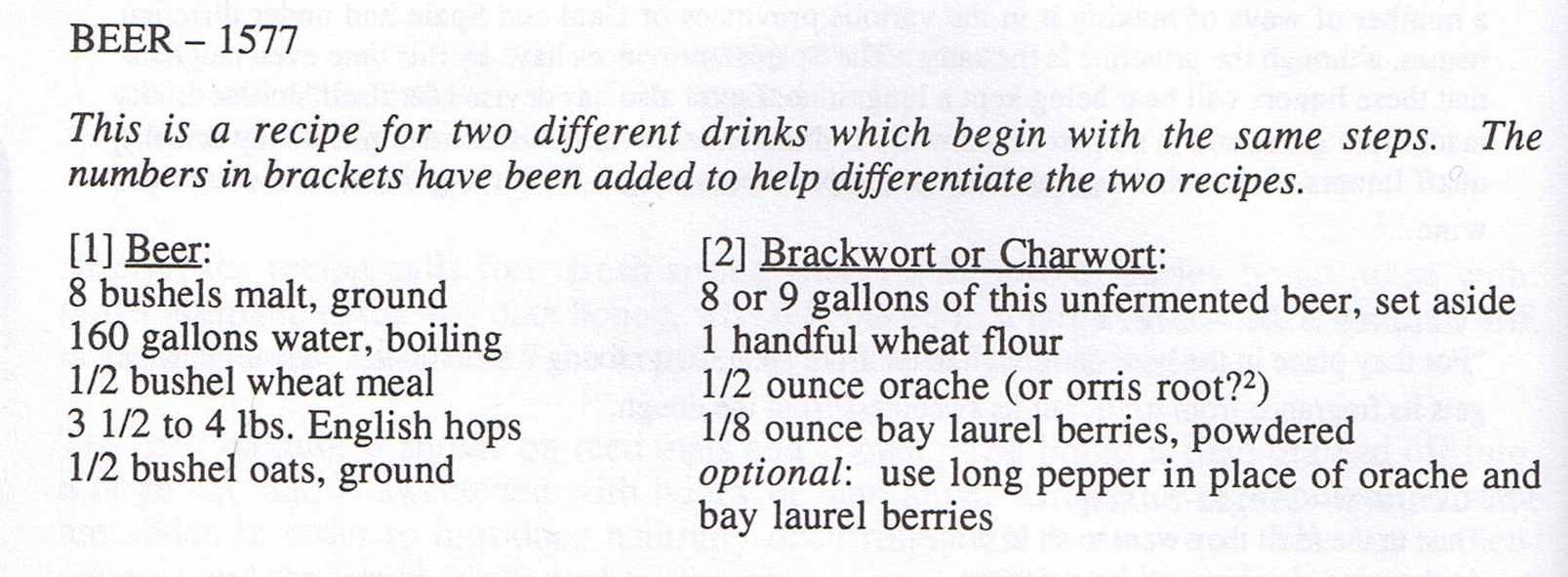
Karl Haraldsson Now known as Nordskp Brewery's "Pinnacle Ale" Here is the Original recipe from �A Sip Through Time� by Cindy Renfrow. She states that she found it in �The Description of England� by William Harrison, 1577. I decided to do an extract version instead of an all grain. Here is my redaction of the beer recipe [1], above: 1, 3.3 pound, can of Coopers liquid Amber Malt 2 pounds English Pale Malt 1 pound Oats 1 pound Dry Wheat Extract 1 ounce UK Kent Goldings Bittering Hops 1 ounce UK Kent Goldings Finishing Hops 10% total hop alpha acids Approximately 30 IBU�s 1 11 gram package Danstar Windsor dry yeast 1 5 ounce package primimg sugar ABV � unknown as no specific gravity was taken. The biggest problem was finding a way of converting bushels of grain into the unit we use today, which is pound. I used the web for this search and found 2 websites that were rather close in their numbers. One listed barley at 48 pounds to the bushel and oats at 32 . The other website gives the same numbers for barley and oats but also adds, more for brewing, malted barley at 34 pounds . I used the malted barley measure which gave me (34*8) 272 pounds or 1.7 pounds per gallon. At 32 pounds a half bushel of oats would be 16 pounds or .1 per gallon. A half bushel of wheat at 60 pounds would be 30 or .19 per gallon. If brewing Ale was a matter of simple ratios then a 5 gallon batch of this recipe would contain 8.5 pounds of malt, 1 pound of oats and .94 pounds of wheat. Brewing Ale doesn�t lend to that simple of a conversion. My redaction called for one can malt extract is equal to 6-8 pounds of grain therefore I had the equivalent of 8 to 10 pounds of grain. My wheat and oats was rather close to the simplified so I stayed at 1 pound each, this was also because that was the package size. At 3.5 to 4 pounds of hops for 160 gallons I came up with 2 ounces for a 5 gallon batch. The original recipe doesn�t mention adding any agent to facilitate fermentation. We know today that yeast needs to be introduced into the wort for an active fermentation, therefore the addition of the package of Windsor yeast. The priming sugar is a modern addition to give bottled beer/ale carbonation. Using standard extract with grain procedures I added the English pale malt and oats into a standard brewing bag and steeped them in 170 degree water for 60 minutes. After removing the grain bag I brought the liquid to a slow boil. As it began its boil, I removed it from the burner and added the liquid malt. Removing from the heat source during this operation helps prevent the malt from caramelizing on the bottom of the brew kettle. Then the dry wheat extract was added and the pot was placed back on the heat source and brought back to a boil. As the liquid started to boil again, I added my bittering hops for a 60 minute boil. At 50 minutes into the boil, I added my finishing hops. At 60 minutes I removed the kettle and started the cooling process. When the liquid reached approximately 70o F, I transferred the liquid into the primary fermenter and pitched the yeast. At 8 days, I transferred the liquid into a secondary fermenter where it stayed for another 10 days. At the end of this time, I added priming sugar to the bottling bucket, transferred the Ale and bottled. Gave finale brew 4 weeks in bottle before tasting. Observations: First remember to take specific gravity readings. The wort cooled so fast on this batch that I missed doing this and didn�t remember until several days later therefore was unable to give an approximate ABV. This is also why there is only an approximate IBU value. After tasting I will reduce the amount of hops in the next batch. As it stands it�s a fine ale, though heavily hopped. My personal preference is for lightly hop ale. Bibliography: �A SIP THROUGH TIME�, by Cindy Renfrow, USA, 1994 �COMPLETE JOY OF HOME BREWING� 3rd Edition,by Charlie Papazian, HarperCollins, 2003 �THE ART OF MAKING BEER�, by Anderson and Hull, Hawthorn/Dutton, 1971 �HOMEBREWING FOR DUMMIES� by Marty Nachel, Wiley Publishing, 1997 |
 |
 |
| Back |