Herb Magick
*
Herbal Medicines Dictionary
*
Magical Herbs Dictionary
*
Kitchen Herbs & Spices
*
Herbal remedies (recipes)
*
Herbal Crafts
*
History of herbs
*
Herbal Teas
*
Herbal Gardens
*
Safety with Herbs
*
Herbal Healing for Pets
*
Herbs for Women
*
Herbs for Men
*
Herbal Links
This is to be used as a reference, a guide in which one can ask or speak to professional or one's doctor before undertaking any herbal remedy.
Acacia
(Acacia Senegal)
Folk Names:
Cape Gum, Egyptian Thorn, Gum Arabic Tree, Kikwata, Mkwatia, Mgunga, Mokala
Gender:
Masculine
Planet:
Sun
Element:
Air
Deities:
Osiris, Astarte, Ishtar, Diana, Ra
Powers:
Protection, Psychic Powers
Ritual Uses:
The wood is used as fuel in sacred fires in India and is also used in building temples.
Magical Uses:
A sprig of the tree placed over the bed wards off evil, as it does when tucked into the turban in Eastern countries. When the wood is burned with sandlewood the psychic powers are stimulated. Acacia is also used in money and love spells, slthough in the latter case the outcome would be a platonic love.
PART USED
Dried gummy exudation from the stems and branches; complex of sugars and hemicelluloses
LOCATION
Africa
CHEMICALS & NUTRIENTS
Calcium, D-Galactose, D-Glycuronic Acid, L-Arabinose, L-Rhamnose, Magnesium, Potassium
DRUG INTERACTIONS
Reduces the aborption rate of drugs taken orally.
INCOMPATIBILITIES
Precipitates with solutions of ferric salts, borax, lead subacetate, alcohol, sodium silicate, gelatin and ammoniated tincture of guaiac.
USES:
Origin of Gum arabic
Scientific:
Medicinal use:
Lore/History:
The material on this page is to be used as a reference and before using this herb or any other one should consult a prefessional and helath care provider first.
Magical/Spiritual Uses:
Any plant of the large leguminous genus Acacia, often thorny shrubs and trees of the family Leguminosae (pulse family). Chiefly of the tropics and subtropics, they are cultivated for decorative and economic purposes. Acacias are characteristic of savanna vegetation and are especially numerous in the South African bushveld. The foliage often appears feathery because of the many small leaflets, but in some species leaflike flattened stems contain chlorophyll and take the place of leaves. Various Old World species (especially A. arabica and A. senegal ) yield gum arabic; other species, chiefly A. catechu, yield the dye catechu. Blackwood (A. melanoxylon) is valued in Australia for its hardwood timber. Other members of the genus are valuable for lac, for perfume and essential oils, and for tannins; some are used as ornamentals. The Australian acacias are commonly called wattles�their pliable branches were woven into the structure of the early wattle houses and fences�and Wattle Day celebrates the national flower at blossoming time. Many wattles are cultivated elsewhere, particularly in California, as ornamentals for their characteristic spherical, dense flowers. The Central American bullhorn acacias (e.g., A. sphaerocephala) have large hollow thorns inhabited by ants that are said to feed upon a sweet secretion of the plant and in turn guard it against leaf-eating insects. The most common acacia indigenous to the United States is the cat's-claw (A. gregii) of the arid Southwest. The biblical shittim wood is thought to have come from an acacia. Various species of locust are sometimes called acacia, and acacias may be called mimosa; all are of the same family. Acacia is classified in the division Magnoliophyta, class Magnoliopsida, order Rosales, family Leguminosae.
Gum: Acacia senegal and its close relatives are the defined source of commercial gum arabic for food purposes. A. senegal produces the only acacia gum evaluated toxicologically as a safe food additive (Anderson 1989). The gum from other Acacia species (A. seyal etc.) is available commercially as gum tahla (approx. 10% of au acacia gum marketed) for technological applications. Gum arabic has been used for at least 4,000 years by local people for preparation in food, in human and veterinary medicine, in crafts, and as a cosmetic. Today, gum arabic's applications are manifold. Formerly the international trade market largely absorbed all gum available, though recently international demand has declined together with gum prices. Gum arabic is used in the food industry as a flavor fixative and emulsifier, to prevent crystallization f sugar in confections, as a stabilizer in frozen dairy products, for its viscosity and adhesive properties in bakery products, and as a foam stabilizer and clouding agent in beer. In pharmaceutics, it is used as a stabilizer for emulsions, binder and coating for tablets, and as an ingredient in cough drops and syrups. A soothing and softening agent, gum arabic is extensively employed in folk medicines. Among many other uses, it is used internally for coughs, diarrhea, dysentery, hemorrhage, and externally to cover inflammed areas. Gum arabic is used in cosmetics as an adhesive for facial masks and powders, and to give a smooth feel to lotions. Industrially, gum arabic is applied as an adhesive, as a protective colloid and safeguarding agent for inks, sensitizer for lithographic plates, coating for special papers, sizing agent for cloth to give body to certain fabrics, and coating to prevent metal corrosion. Gum arabic is also used in the manufacture of matches and ceramic pottery. Wood: Acacia senegal wood is locally valued for fuelwood and charcoal although biomass yield per unit land area is not sufficient to plant A. senegal purely for fuelwood. Wood is used in local construction for poles and fenceposts, the light-colored wood for tool handles and dark heartwood for weaver's shuttles. Strong ropes are made from the bark fibers of the tree's long surface roots. Food and fodder: Dried and preserved seeds of A. senegal are used by people as vegetables. The foliage and pods are browsed by sheep, goats, camels, impala, and giraffe. Leaves contain 10%-13% digestible protein and 0.12%-0.15% phosphorus, while the pods contain 15% digestible protein and 0.12%-0.14% phosphorus.
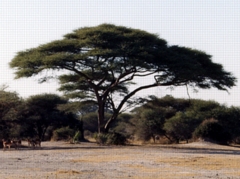
Umbrella Thorn Acacia is one of the most recognizable trees of the African savanna. It grows in sand dunes and rocky grounds of Africa's grasslands. Acacia's grow in areas with annual rainfall as low as 4 cm. This tree can survive in 122� F temperatures during the day, and freezing temperatures at nights. The savanna that the Acacias live in is hot and dry in the respective summer of the Southern Hemisphere, although at night the temperature can go below 0� F. During the winter months the savanna gets a lot of rain. The Umbrella Thorn grows up to 20 meters high and has a spreading, flat-topped crown that gives it its name. The bark on the Acacia is black to gray in color and feels rough. The branches on the Acacia are gnarled. The Umbrella Thorn has two types of thorns on the branches; long, straight, brownish thorns and shorter, hooked thorns that grow alongside each other. The thorns grow in pairs and disguise themselves in the clusters of flowers that grow on the Acacia. The flower clusters have up to 400 white, puffball flowers that grow on a twig on the Acacia. The Acacia's leaves are composed of small alternate leaflets on a central rib. The acacia's leaves are 2.5 cm long and 1 mm wide. The seeds are 8 to 12 cm long twisted pods. The Acacia's belong to the family "Mimosaceae", and until recently was known as the " Mimosa Tree". One of the Umbrella Thorn's adaptations to hot and dry conditions is a deep taproot, which can reach 115 ft under the ground. This adaptation helps it get the water during the dry spells. A second set of roots spread out just under the ground about twice the area of the crown. The little leaves of the Umbrella Thorn prevent water loss. The acacia's umbrella-shaped tops enable the tree to capture large amounts of sunlight with the smallest possible leaves. The thorns are used to keep the savanna animals away from eating the leaves, flowers, and seedpods. The only animal that is immune to the thorns is the giraffe. The Acacia provides shade for the animals of the savanna. The trunk of the tree makes very good charcoal and firewood. The flowers on the Acacia provide a good source of honey in some regions. The stem of the tree is used to treat asthma, and diarrhea. The bark of the acacia is used as a disinfectant, and the pods are used to make porridge. The Acacia is not endangered, and it is actually plentiful. There are over 700 species of the Acacia in Africa.
Gum arabic is a tree gum exudate and has been an important article of commerce since Ancient times. It was used by the Egyptians for embalming mummies and also for paints for hieroglyphic inscriptions. Traditionally the gum has been obtained mainly from the Acacia senegal species. The trees grow widely across the Sahelian belt of Africa situated north of the equator up to the Sahara desert and from Senegal in the west to Somalia in the east. The gum oozes from the stems and branches of trees, usually five years of age or more, when subjected to stress conditions such as drought, poor soil or wounding. Production is stimulated by �tapping�, which involves removing sections of the bark with an axe taking care not to damage the tree. The sticky gummy substance dries on the branches to form hard nodules which are picked by hand and are sorted according to colour and size. There are two species now acceptable within the Codex Alimentarius Specification of Gum Arabic, namely Acacia Senegal and Acacia seyal. In Sudan the gum from Acacia senegal and seyal are referred to as hashab and talha respectively, The former is a pale to orange -brown solid which breaks with a glassy fracture and the latter is darker, more friable and is rarely found in lumps in export consignments. Hashab is undoubtedly the premier product but the lower priced talha has found recent uses which have boosted its value. It is difficult to identify precisely the exact balance between these two products in the market place since it is continually changing.
(This information is being provided as discussion material only; use at your own risk. You should always check with your doctor first before trying herbal preparations, as they can be just as dangerous to mis-use as any other drug.) Acacia gum forms a protective, soothing coating over inflammations in the respiratory, alimentary and urinary tracts. It is helpful for coughs, sore throat, colds, and catarrh, as well as diarrhea and dysentery. In folk medicine, gum arabic has been used to treat gonorrhea and hemorrhage. "The sweetened mucilage has been sometimes been used to treat the early stages of typhoid fever." (The Herb Book, John Lust, 1974). Gum arabic is usually dissolved in water to create a mucilage, which can also be used as a vehicle for other medicines. Dissolve 1 teaspoon gum arabic in 1 cup boiling water. Dose is 1-4 teaspoons per day. To make a syrup, mix 1 part mucilage with 3 parts syrup. Dose is 1-4 teaspoons per day. Ingested orally, acacia is nontoxic. However, some people are allergic to its dust and develop skin lesions and severe asthmatic attacks when in contact with it.
Gum acacia contains neutral sugars (rhamnose, arabinose, and galactose), acids (glucuronic acid and 4-methoxyglucuronic acid), calcium, magnesium, potassium, and sodium. Its complex structure is still not completely known. Its backbone chain consists of D-galactose units, and its side chains are composed of D-glucuronic acid units with l-rhamnose or l-arabinose as end units. The molecular weight has been reported to be between 200,000 to 300,000 and as high as 600,000.
�To cause a woman to stop being pregnant, be it one, two or three years: part of acacia, colocynth, dates, finely ground in a hin of honey, fibers are moistened therewith, introduced into her vagina� - The Ebers papyrus Ancient Egyptians made a mixture of gum arabic, crocodile dung, honey and natron, which was kneaded together with fibers and inserted into the vagina as a type of contraceptive sponge. Actually, this isn't as bad an idea as it first appears - crocodile dung is highly acidic; sticky honey acts to slow sperm's progress; natron is a natural salt; and gum acacia, when dissolved, produces lactic acid, an effective spermacide. One supposes that the scent of crocodile dung was also a pretty effective contraceptive! Acacia gum was also used in compresses as a mild antiseptic. The Egyptians included acacia in their religious lore. Isis and Horus searched for Osiris' body in a boat built of acacia wood. Osiris' coffin was made of it. In an ancient tale of two brothers, the youngest hides his heart in an acacia tree. The wood of the acacia tree is highly aromatic and may be burned alone or in combination with other ingredients as an incense. In today's Egypt, and from time immemorial, women have used a paste made of sugar, gum arabic and lemons as a type of hair-removal wax (said to be much less painful than the western products used for waxing). Acacia gum is used in a variety of contemporary manufactured products, including cosmetics, medicines, foods... even soda. Acacia wood was sacred to the Herbrews. Jehovah commanded Moses to build the Ark of the Covenant and the Sacred Tabernacle out of it. "And you shall make the walls of the Mishkan (Tabernacle) from acacia wood standing up." (Exodus 26:15) It is believed that the Old Testament's burning bush, through which Jehovah spoke to Moses, was also an acacia. Noah's Ark, as well as the Greek Deucalion's Ark, were made of this wood. The acacia tree has been associated with the legendary "Arabian Tree," on which the people of Mecca hung their weapons and garments at an annual pilgrimage. This mystical tree was thought to be the home of the phoenix, which lived anywhere from 500 to over 1,000 years before bursting into flame and re-birthing itself from the ashes. In India, acacia is honored, used in sacred fires and in the building of temples. It is believed that placing a sprig over one's bed wards off evil.
Language of Flowers/Herbs: Secret Love Pagan Festival: Lammas (Lughnasadh) August 1st Acacia wood (or dried gum) incense is burned to induce a meditative state, to clear one's mind and invoke calm, logic and rationality. Burn with sandalwood to promote psychic powers and when seeking illumination. Used in a sachet, it provides protection against negative influences, especially in combination with agrimony. It can be used in money or love spells, but the love thus invoked would be platonic. To dream of a loved one who has passed over, burn an incense made of acacia wood (or dried acacia leaves, or dried gum) together with star anise, myrrh and dried althaea leaves before you go to sleep. As you breathe in the fragrance, hold an image of the person you wish to dream about in your mind. Picture them coming towards you, answering your invitation. When you've meditated enough, be sure the incense isn't burning anymore before you go to bed (always be safe and use common sense). Place a fresh piece of acacia or gum arabic in a sachet under your pillow.