 |
|
|
|
|
|
|
|
|
|
|
|
|
|
|
|
|
|
|
|
|
|
|
|
|
|
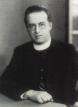
Father Georges-Henri Lemaitre |
|
|
|
Born on July 17, 1894 in Belgium, Georges-Henri Leamitre, would become the first face of the Big-Bang theroy. |
|
|
|
 |
|
|
|
Lemaitre was only seventeen when he entered the field of civil engineering at The University of Leuven, after studding humanities at a Jesuit school. During his studies at Leuven he took time off to join the Belgian army during World War One, where he was awarded with the Military Cross with palms. After the war he began to study physics and mathematics with a passion few ever have. |
|
|
|
After his thesis l' Approximation des fonctions de plusierrs variables r`eelles (Approcimation of functions of several real variables) he earned his doctorate in 1920. Three years later he was ordained as a priest. Though he was now a priest, he still contemplated about the universe, and became a master of the theory of relativity rather quickly. Later in 1923, Lemaitre was invited to a modern stellar astronomy and numerical analysis, by Arthur Eddington. While at the analysis, Lemaitre reviewed the general theory of relativity. While he was reviewing the came to the conclusion that the universe was ever expanding. He came to this conclusion after observing a reddish glow surrounding the objects outside of our galaxy, known as a red shift. Einstein said that "Your calculations are correct, but your grasp of physics is abominable." In the following years he worked at Harvard to earn his doctorate in sciences. |
|
|
|
In 1927 he published a report titled Annales de la Societe Scientifique de Bruxelles masse constante et de rayon croissant rendant compte de la vitesse radiale des rnbuleuses extragalactiques (A homogeneous Universe of constant mass and groing radius accounting for the radial velocity of extragalactic nebulae). This report was about his new idea about how the Universe was ever expanding. After reading this paper many scientists believed that the universe was expanding, but they didn't believe that the world had never been there. In 1931, Lemaitre suggested that before the world had come to be there had been one concentrate point at which all matter and energy had been. |
|
|
|
Finally, in 1933 Einstein stood up and applauded for Lemaitre and his theory, after one of Lemaitres seminars. Soon after Lemaitre was awarded the Fracqui Prize, in Belgium and was inducted into the Pontifical Academy of Science by Pope Pius XI. Though the people loved to read about him and his theory, there were some problems with the theory. One was the expansion rate. If the expansion rate was accurate than there would not have been enough time for the stars an planets to form. He solved this problem by using the cosmological constant, discovered by Einstein. Einstein said that the constant was the worst mistake of his career and was appalled that it was used a such a fudge factor. |
|
|
|
 |
|
|
|
<- EGG |
|
|
|
|
Lemaitre then suggested that the universe was like and egg ready to explode at the brink of time. Some scientists referred to this as the "Big-Bang" theory as a snotty remark towards the theory. |
|
|
|
In 1964 there was a breakthrough. While playing with a radio telescope, Bell Laboratories discovered a microwave interference. No matter where they pointed it the signal was just as strong as the last point. After this Lemaitre realized that there was some sort of background radiation. This would be a side effect of the Big-Bang. But Lemaitre would not get to do any research on this radiation because he died in June of 1966. |
|
|
|
So what does this have to do with Chemistry? |
|