Supermassive black holes spin at speeds approaching the speed of light, new research suggests.
Nine huge galaxies were found to contain furiously whirling black holes that pump out energetic jets of gas into the surrounding environment, according to a study using data from NASA's Chandra X-ray Observatory.
"We think these monster black holes are spinning close to the limit set by Einstein's theory of relativity, which means that they can drag material around them at close to the speed of light," said Rodrigo Nemmen, the study's lead author and a visiting graduate student at Penn State University.
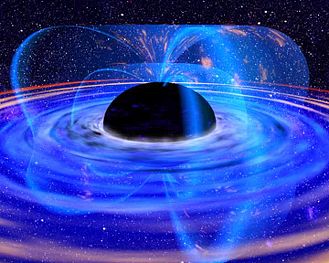
Einstein's theory suggests spinning black holes would make space itself rotate. The overall effect makes gas spiral in toward the black hole, and also creates a magnetic field that shoots inflowing gas back out as a jet.
Researchers previously found that the greater the amount of gas falling into supermassive black holes � known as the accretion rate � the greater the energy of the jets shooting out. Leading theories suggest that the same jets drive the rotation of the central black holes in galaxies.
"By comparing observations of massive elliptical galaxies with current theories of jet formation, we are able to get the spin of supermassive black holes," Nemmen told SPACE.com, explaining how his group ran computer simulations and compared the results with Chandra's observations of the nine objects.
Black holes can't be seen, but their existence and mass are inferred by their gravitational effects on material around them and by the energy released from all the activity.
The observed jet power and accretion rates were huge � one black hole ate 10 Earth masses per month and, from its surroundings, spat out 50 times the annual energy of our sun per second. That allowed Nemmen and his colleagues to estimate that the spin of the black holes approaches Einstein's speed-of-light limit.
"Extremely fast spin might be very common for large black holes," said co-investigator Richard Bower of Durham University. "This might help us explain the source of these incredible jets that we see stretching for enormous distances across space."
The jets produced by such high-speed spins heat the surrounding gaseous atmosphere and can help trigger the birth of stars. However, such powerful jets could also destroy the atmospheres of neighboring planets.
Back to ariticle choices
�
�

 neighborhood!