|
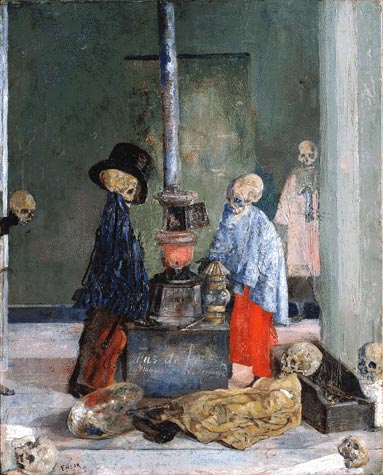
FORMAL ANALYSIS OF Skeletons Warming Themselves |
|
Section I: INTRODUCTION |
|
BACKGROUND INFORMATION |
|
Student(s) evaluating work: Leean Strehlow, Nick Tobler, April Tovar, AJ Vasquez, Jaimie Whitworth, Jason Wingo, and Nick Wright. Students who did not submit their work: AJ Vasquez. |
|
"Skeletons Warming Themselves" |
|
Artist(s) involved in the work: James Ensor |
|
Location of work (exhibition site, such as the name and address of the museum that houses the piece): Kimball Art Museum. |
|
Date(s) involved in producing the piece: 1889 |
|
Was the piece commissioned? No; he was a starving artist. |
|
Price asked/received for the sale of the work: We were unable to obtain this information from the museum. |
|
SECTION II: DESCRIPTION |
|
THIS SECTION OF THE ANALYSIS IS RESERVED TO MAKE NO "VALUE JUDGMENTS", ANALYSIS OF HOW THE WORK WAS MADE (AND WHETHER OR NOT YOU SEE THE ARTISTIC EFFORT AS "SUCCESSFUL"), OR INTERPRETATION OF THE CONTENT. A "DESCRIPTION" MERELY ANSWERS THE QUESTION, "WHAT DO WE SEE"? |
|
Objective/naturalistic (has a subject matter which is "representational of how it looks in nature"): Naturalistic; it depicts a natural process of people warming themselves. |
|
Objective/Abstract (has a subject matter which is PURPOSELYU distorted, often into basic, geometric shapes rather than appear as it does in nature): No. |
|
Non-Objective (has nor ecognizable objects pertaining to the planet Earth): No. |
|
CATEGORY OF EXPRESSION |
|
Two-dimensional painting (watercolor, gouache, fresco, tempera, acrylics, oils, alkyds, enamel paints, etc.) Yes, it is oils. |
|
Medium/media AND TOOLS used to create the effort: Oil, canvas, and brushes. |
|
Dimensions (please list WIDTH X HEIGHT X DEPTH): (W) X (H) X (D) 29-1/2 x 23-5/8 in. (74.8 x 60.0 cm) |
|
SECTION III: ANALYSIS |
|
THIS SECTION ANSWERS THE INQUIRY, "HOW DID THE ARTIST CREATE THIS WORK?", GOING INTO WHY THE ARTIST(S) USED CERTAIN FEATURES TO CONVEY SPECIFIC IDEAS |
|
ELEMENTS OF DESIGN |
|
THIS SECTION IS TO NOTE THE ELEMENTS USED AND HOW THE DESIGN VARIES THE USE OF THE ELEMENTS |
|
What types of LINE are used (explain where you might see lines, such as trees as "vertical lines", lightning as "diagonal" lines, a baseball heading toward home plate as a "psychic" line, thin line to thick line, etc.) The canvas on the left and the stove in the middle are both made up of vertical lines. |
|
How is SPACE manipulated by the media? There are three (3) skeletons in the foreground with a stove and another skeleton in the background, creating depth. |
|
Are SHAPES seen (organic, geometric, etc.)? Geometric and organic shapes are evident. |
|
How does the element of LIGHT affect the piece? Should it be viewed under certain light? Did the artist simulate an artificial light source, in the work, s/he wanted us to have consistent for viewing purposes? There are two light sources, the sunlight from the window on the right, which is muffled by the curtain and the light from the fire at the stove. There is a contrast with the light and shadows. |
|
Was the TEXTURE "tactile" (can be touched) or "simulated" (visual illusion of how something might feel)? This is an oil painting and therefore the texture is tactile. |
|
Black-and-white imagery only? No. There is a variety of color in this painting, from bold, primary colors to darker, less defined shades of color. |
|
Monochromatic (one main color altered by "shades" and "tints" of that hue)? No. However, the artist does use several different shades of blue to depict a dark, spooky atmosphere. |
|
Complementary color scheme (colors directly across from each other on the color wheel)? No. There are many different colors and shades used. The main subject, the two skeletons standing by the stove, are wearing blue and red clothes to direct your attention to them. |
|
Analagous color scheme (colors side-by-side on the color wheel, such as yellow, yellow-orange, and orange)? No. There are very few side-by-side colors used in this painting. |
|
Triadic color scheme (three colors, equally spaced apart on the color wheel)? No. There are many different colors and shades used in this piece. |
|
Primary colors only? No. There is a great deal of shading. |
|
Secondary colors used? No. The two skeletons standing by the stove are wearing blue and red (primary) colored clothing. |
|
Intermediate (tertiary) colors utilized? No. However, there are intermediate (tertiary) colors utilized as hues in this work which are blue-green blue-violet along with different shades of blue. |
|
Color discord color scheme used? No. The colors in this piece flow depicting a dark shadowy atmosphere. |
|
Arbitrary color scheme (artist randomly selects colors based on "artistic license")? Yes. It appears the artist wanted the subject or main focus of the painting to be the two Skeletons warming themselves by the stove, which is why they are wearing bold Colored clothing. He also used shadowing and dark shading to convey the feeling of death and destitute. |
|
Local colors (colors as they would appear under sunlight)? No. The curtain muffles the sunlight trying to come through the window. |
|
Colors as they would appear under "incandescent" lighting? No. |
|
Colors as they would appear under "fluorescent" lighting? No. |
|
What are some of the various "values" seen in the work? Some of the various values are a light coming from the stove, so it would be natural lighting. The are some gradations, in the left corner is a little dark then starts to go to light as it is goes to the middle of the painting. |
|
How was the "color intensity" varied in the piece? The color intesity in this piece varies from warm colors to cold colors. We have bright red, yellow, pink and orange. The cold colors vary from a range of different shades of blue to green. |
|
Does "simultaneous contrast" (change a subject's base hue due to a reflecting color from another source) exist in this piece? No. |
|
PRINCIPLES OF DESIGN |
|
THIS SECTION IS TO NOTE THE PRINCIPLES OF DESIGN UTILIZED AND HOW THIS AFFECTED THE OVERALL WORK |
|
"Open form"? Yes, everything is happening within the room of the painting. |
|
"Closed form"? Yes, in the corner in the left, the skeleton appears to be peaking in the room, also on the right another skeleton seems to be coming in from another room. |
|
What is the "ground" in the work? An artist's studio. |
|
What is/are the "figure(s)" in the piece? Looks like a family of skeletons warming themselves in a home. |
|
Work demonstrates a lack of "perspective"? No. |
|
Use of "mathematical/linear perspective" to give the appearance of a 3-D feature in a 2-D plane? yes. |
|
Use of "atmospheric perspective"? Yes, the fron is brighter than the back. |
|
"Symmetrical balance"? No; there are more skulls on the right side of the painting than on the left. |
|
Is it so balanced the sides are mirror images of one another, or "bilateral symmetry"? Yes, equal skeletons on each side. |
|
Does the design radiate out from a central point, like a snowflake, using "radial balance?" Yes. |
|
"Asymmetrical balance"? Yes. Central-outward, right-left. |
|
"Crystallographic" ("allover" pattern) balance like Pollock's "Abstract Expressionism" works? No. Not everything is equal throughout the painting. |
|
What did the artist use to create "Emphasis" (lines of force, focal point, contrast, relative size, etc.)? He used a furnace in the center of the room. |
|
How is "unity" obvious, or missing, in this work? All skulls are around the furnace as if warming themselves. |
|
What did the artist use as "variety" to break up the unity of the piece? Some skulls on clothes, one with a hat and another skull just lying around. There is another that is upside down. |
|
Are there any unusual "proportions" in the work? No. |
|
What "scale" is this in comparison to a full-size human adult? About 1/20. |
|
What are the size relationships between shapes/forms in this work? All proportional. |
|
Section IV: "READING BETWEEN THE LINES" |
|
THIS SECTION IS WHERE YOU BEGIN TO LOOK MORE CLOSELY AT THE WORK AND TRY TO FIGURE OUT WHAT "CONTEXT" THE WORK WAS MADE UNDER, THE EXTERIOR FORCES WHICH EFFECTED THE CREATION OF THE EFFORT, AND WHAT "HIDDEN MEANINGS" THERE ARE TO FIND |
|
Art era during which the work was produced: Renaissance Era. |
|
Applicable history behind the work's meaning, if any (Mythological theme? Historical subject? A piece made to glorify a king? Etc.): The artist was obsessed with death. He wanted to show paticular types of professions. He had in the painting a full of skulls to represent failed efforts. Underneath this painting is an original painting of a girl. If you x-ray this work you can see that he painted on top of a painting that he made of a girl. |
|
What are the most-distinctive features of the work, and why do you think the artist(s) made these so obvious? Skeletons, representing that death is cold and that they are trying to warm themselves. Also possibly that they were poor artists that eventually died of starvation. |
|
Is the medium used in a typical manner, or did the artist breach the natural expectations of the medium (and why would the artist do such a thing)? (I.E.--using acrylic paints in a watercolor manner; painting transparent watercolors like acrylic paint; etc.) The artist used oil paints. |
|
What was the way your eye traveled through the work ("composition", such as "triangular")? What did the artist(s) do that moved your eye in that way? The path my eye traveled through the work started in the middle of the painting. The reason is the main theme is in the middle. This works design pattern is triangular. Because the main focus is in the middle and you have two skeleton heads at the bottom, if you follow that design it makes a triangle. |
|
Was there any "movement" displayed and, if so, how did the artist show it? No, there was no simulated of suggested movement. |
|
VERY IMPORTANT: What was YOUR emotional reaction to the piece? Did it change the longer you looked at the piece? Leean Strehlow: My initial emotional reaction to the piece was sadness. It appeared to me that the artist gave a lot of thought to death. Not only his, but several other peoples as well. Second Question: Yes, my opinion did change after looking at the piece for a while, it became more interesting. I began to wonder, what are they doing, how many are there, could the skeletons peaking into the painting be skeletons in the artist's closet? Nick Tobler: "I thought it was depressing." Second question: " It still seemed depressing the longer I looked at it." April Tovar: "I felt king of Uneasy the first time I saw it, kind of scared and curious." Second Question: " After I looked at the painting longer It seemed a little more sad than scary. After reading about the painting I do see how it could be starving artist, and what made me think that he was represnting that death was cold was because the artist was obsessed with death, so he made death try to warm himself." AJ: ????? Jaimie Whitworth: " I thought it was thought provoking. Made me think of poverty. The paint pallet made me think they were starving artists." Second question: "After looking at it longer it did not seem as depressing as before." Jason Wingo: "I thought it was comforting." Second question: " I still found the painting comforting the longer I looked at it." Nick Wright: "I was shocked and very interested the first time I saw the painting." Second Question: " Yes, after looking at it longer and reading about it my view was changed." |
|
SECTION V: INTERPRETATION |
|
THIS IS THE FINAL PART OF OUR FORMAL ANALYSIS. HERE, YOU ARE TO ANSWER THE QUESTION, "WHY DID THE ARTIST CREATE THIS PIECE AND WHAT DOES IT MEAN (IN TERMS OF POLITICAL, SOCIAL, CULTURAL, OF INTELLECTUAL HISTORY)?" |
|
What is the "main idea" and overall "meaning (sometimes hidden)" of the piece (in short, what is the "content")? The main idea is that the artist can bring life to canvas. The skeletons are Artist of all different time. One a convential painter, a musician and a writer. I discovered by reading about the work and the artist has hints of a paint pallet, a violin and a lamp. Maybe to make it a little more obvious is to have a half way done painting in the background. |
|
What sources, or traditions, influenced the artist? He was really poor, he had to paint over another work because he could not afford canvas. He was also obssesed with death. For a very religous time it was very non-religous. |
|
What is the "purpose" of the work? The purpose of the work was to show the vanities of certain professions such as musicians, painters and writers. I beleive this work is narrative, because it tells a story of starving artists trying to warm themselves, that supposedly their work has not been finished. |