|
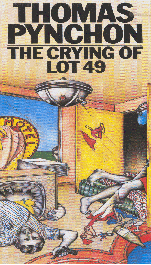
An early Pynchon novel, and more accessible than his immense, Gravity´s Rainbow. The style is, however, already well formed in The Crying of Lot 49, as the characters lurch from one absurd situation to the next. They possess the amiability of American quiz show hosts, and their actions are as understandable as zapping through 100 channels of cable TV. Yet Pynchon manages to engineer moments of clarity through the madness, cultural relativity, and lack of definition. The message is that at the base of decrepitude some relationships still remain intact. |
||
|
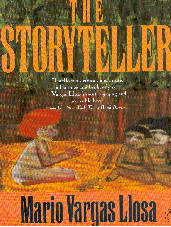
A more serene and mannered novel by one of South America's most prolific and influential writers. I disagree with Llosa's politics, yet in the Storyteller, his writing is at its magical best. This novel is extremely satisfying because it charts and provides a bridge between the modern life in a city in Peru, and the ancient life of a shaman. An anthropologist becomes obsessed by the Indian storytellers; and disappears from society. At the same time the narrator explores the same ideas and goes in search of the anthropologist... |
||
|
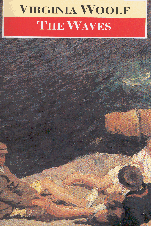
Virginia Woolf was at her most political and feminist when she wrote The Waves (1931). It is a novel which takes the reader into sensuality and an emotional circle that sits strangely with the educated English characters. The way in which the characters become entwined with one another and the world around them, points to the fact that Woolf was at her most sensitive and aware. The Waves is eroticised English sensibility. |
||
|
|
||