
French (1811-1832)

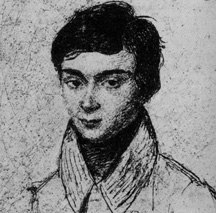
Evariste Galois, perhaps one of the greatest mathematical geniuses of all time, is regarded as the father of modern algebra. While still in his teens, he showed that polynomial equations of degree higher than four are not soluble in terms of a finite number of rational operations and root extractions. He was always misunderstood and ignored by the scientific community. Only decades after his death his works were retaken and given their real value. He died tragically at the age of 21, not before leaving work of fundamental importance. One of the most fascinating and commentated lives in the history of mathematics, his deeds are often wrapped with mysticism.
Galois suffered the additional misfortune of having his work not only ignored, but completely misplaced by its caretakers on several occasions. When Galois gave Cauchy a paper containing his most important results to present (without keeping a copy himself), Cauchy proceeded to lose it. When Galois submitted a paper for the Acad�mie's prize in math, Fourier took the paper home to peruse, but died shortly thereafter and this paper was also lost. Poisson returned a second paper, which contained important results in group theory as incomprehensible.
Galois, always a radical, joined the National Guard, but was subsequently imprisoned in 1831 after proposing a toast interpreted as a threat to the King. On the night before his death in 1832, Galois wrote a letter to his friend Auguste Chevalier, setting forth his discovery of the connection between group theory and the solutions of polynomial equations by radicals. After writing the letter, Galois was shot to death in his intestine in a gun fight. The exact circumstances of his death are not well established, and various accounts hold that he was shot by a rival in a feud over a woman, that he was challenged by a royalist who objected to his political views, or that he was killed by an agent of the police.
