
I worked in two closely related fields Kinetics and Spectroscopy.
Radicals play a significant role in various economically and environmentally important systems including atmospheric processes, combustion, interstellar and biologic systems. A better understanding of these and other reaction systems requires a thorough understanding of the underlying elementary reactions.
Experimental investigations of the reactivity of such radicals is hampered by:
a) their high reactivity which demands for fast time resolution,
b) their small absorption cross sections for visible or near UV light and
c) their structureless bands which make identification problematic.

Most of the gas phase reactions of radicals with closed shell molecules face sizable barriers, and thus have negligible rate constants at the very low temperatures found in interstellar clouds where the chemistry is dominated by barrier less reactions governed by long range attractive forces. Some radical-molecule reactions do have large rate constants at low temperatures; a notable example being the reaction of the cyano radical with ammonia, CN+NH3, with k(100 K) = 1 x 10⁻¹⁰ cm3 s-1. This large rate constant and its unexpectedly
sharp decrease with increasing temperature has been of recent interest to experimentalist and theoreticians. So, we studied reaction of C2H with ammonia.
Combustion Chemistry
Reaction of C2H radicals (pulsed laser photolysis/chemiluminescence)
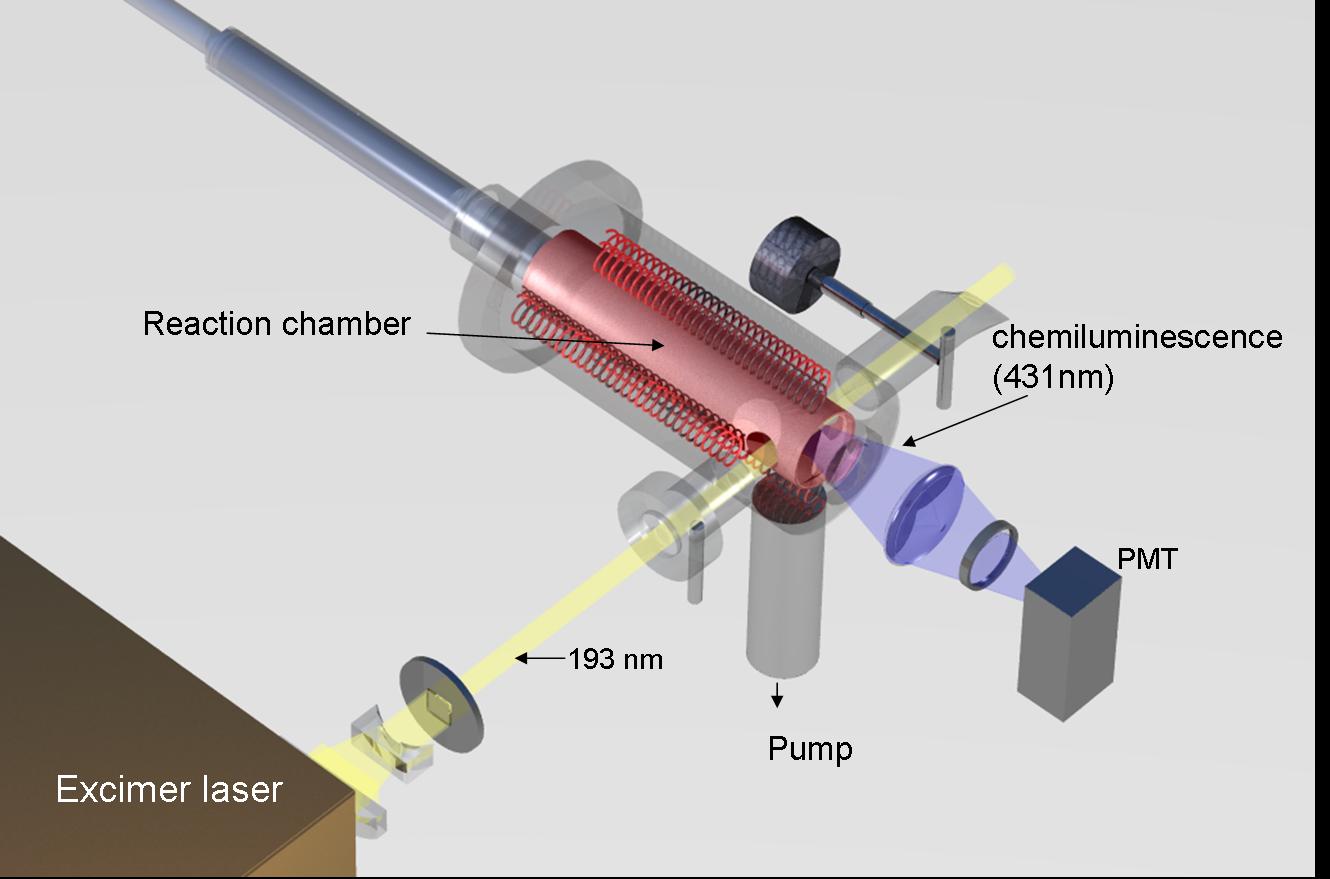
C2H radicals are important precursors in the formation of larger, poly-unsaturated hydrocarbons in combustion systems (polyacetylenes, soot precursors). We study the reacions of C2H radicals with molecules such as H2O, NH3, O2, NO, H2, and alkanes.
Reactions of HCCO radicals (Pulsed laser photofragment/LIF)
HCCO radicals are important intermediates in the combustion of many hydrocarbons, and play a crucial role in e.g. the formation of NOx in combustion systems, and the reduction of NOx emissions by the reburning technology. We study the reactions of HCCO with numerous other molecules and atoms, such as NO,
O2, O, H, and N.(1)HCCO and C2H are found in combustion environments, where they are both
closely related to the ubiquitous oxidation reaction of acetylene.(2) HCCO is a direct product of this reaction whereas C2H is formed in several further steps(3) C2H is thought to play a particularly important role in formation of aromatic rings in hydrocarbon combustion, because of its ability to rapidly
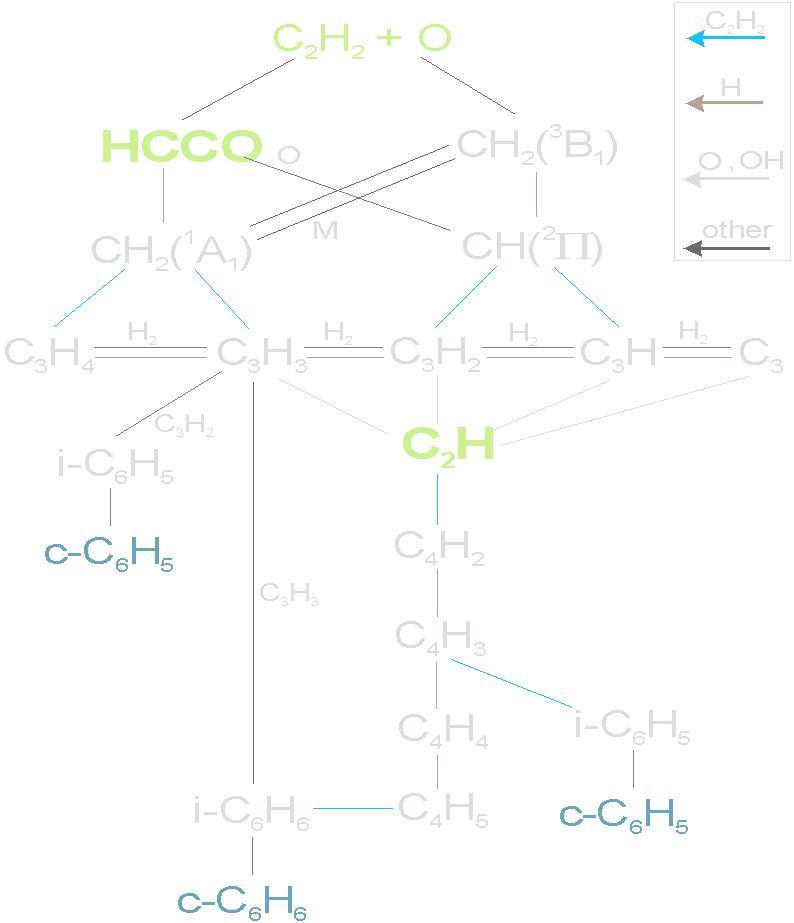
react with closed shell species (C2H2).
from ketene.
(5) C2H is present in interstellar regions and planetary atmospheres
Branching ratio (Pulsed laser Photolysis/IR chemiluminescence)
The study of infrared chemiluminescence which is emitted when polar diatomic molecules are formed chemically in vibrationally excited states has been developed into a powerful technique for discovering vibrational product distributions from chemical reactions. These distributions can be related to the dynamics of the molecular collisions in which reaction occurs. The vibrationally excited products formed in the reaction were studied using infrared emission spectroscopy, from this branching ratio of concerned reaction can be obtained.
Plasma-etching with CF2 radicals pulsed laser photolysis/ chemiluminescence)
The study of the kinetic behaviour of excited triplet-CF2 is situated in the
field of plasma-etching chemistry. This technique, which allows smaller etching
features and imposes less harm upon the environment compared to the classic wet
etching technique, is been increasingly used in the production of
micro-electronic circuits. The study of triplet-CF2 will try to determine the reactivity of the radical with several components to bring us closer to unravelling the complex processes that
occur in an etching plasma.
Supersonic Jet Spectroscopy
Supersonic jet expansion of seeded molecules in mono atomic buffer gas cools them to the internal temperatures of 5-10K while in gas phase. This has not only allowed the vibronically resolved spectroscopy of large polyatomic molecules, but also the studies on their van der Waal�s and H-bonded clusters with noble gases, and solvent molecules such as water, methanol etc. Due to the low internal temperatures the clusters that are once formed in the beam remain intact and makes it possible to study them under isolated conditions. The basic issues that are addressed are the type and the strength of bonding that is involved, the spectroscopic signatures of their structures, and probing the dynamics of the intracluster phenomena such as isomerization, intracluster vibrational energy redistribution, vibrational predissociation, and the reactive encounters such as proton transfer etc.
Cavity enhanced absorption or Integrated cavity out put spectroscopy (ICOS)
The approach for measuring absorption in the cavity is based on the excitation of a dense spectrum of transverse. ICOS is less technically demanding than CRDS, because, it does not require fast time-resolved measurements, high laser-pulse energies, or narrow cw laser linewidths. Off-axis ICOS (OAICOS) was proposed and implemented in near-IR because it provides increased spectral density of cavity modes and thus minimizes the noise in the resulting absorption spectra.3�5 In OA-ICOS the laser beam is directed at an angle with respect to the cavity axis
Kinetic modelling
Kinetic modelling simulates the reaction by calculating the time dependent
concentrations of the reactants and products, based on a chemical model. This
chemical model consists of a list of the chemical compounds in the reaction system, all chemical reactions that can occur in this system, and the rate at
with which these reactions will proceed by the relevant temperature and
pressure. This model leads to a set of differential equations describing the
change in concentrations caused by the chemical reactions. By means of numerical
integration, the time dependent changes in the reaction mixture can be
calculated, given a certain starting situation.
