 Central Pennsylvania Championship Finals 2002
Central Pennsylvania Championship Finals 2002
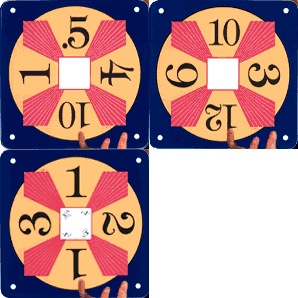
The 24 Challenge is an exciting game that develops strong math skills. For more game 24 information, visit http://www.math24.com/.
CONGRATULATIONS to Pranay Soni, who is the School Street Elementary champion for the year 2002! Pranay and others will be honored at our year-end awards’ assembly on June 6. In the meantime, Pranay has earned the right to advance to the 11th annual Central PA Championship, which will be held at Penn State on May 7, 2002. Because we must arrive no later than 9:30 AM, we will be leaving at 6:00 AM from the School Street Elementary parking lot. I will be driving Pranay and the runners-up to the competition. Parents are invited to accompany their children. If you plan to attend or have any questions, please call me at 368-4974.
FOOD & MISCELLANEOUS - We will stop at McDonalds in Phillipsburg for a restroom break and a quick snack. After the competition, the university provides a luncheon. We hope to return to Bradford around 4:00 PM. Please read all of the information on these pages, sign the attached permission slip, and return it as soon as possible.
SEATING
- Students sit three or four to a table, by grade level or section level (e.g. 4th
& 5th grades combined).
PUTTING CARDS INTO PLAY - A proctor puts a card into play by
“cupping” the card in the palm of one hand. The proctor places the
“cupped” card into
 the
center of the table and then withdraws the hand to reveal the numbers.
the
center of the table and then withdraws the hand to reveal the numbers.
STUDENTS’ HAND POSITION -
During play, students’ finger tips should be no closer than 8 inches from the
center of the table - where the cards are placed. If a special tournament
playing mat is used, students must keep their hands on the blue area only.
MAKING A DECLARATION - When a student has a solution, he/she declares
by touching the card. The student may touch anywhere on the card but with no
more than three finger tips. This prevents students from slapping hard with the
whole hand as a way of dominating play. The first student to make a valid
declaration is allowed to give the solution. If the answer is correct, the
student takes the card and places it in front of him. The proctor then puts the
next card into play. At the end of the round (when all cards have been claimed)
proctor tallies all the points on the cards each student has won.
GIVING THE SOLUTION - Proctor determines first student to touch the
card. That student must announce the pattern (last step of the solution to make
24; i.e. “3 times 8” or “15 plus 9”) within 3 seconds of touching the
card. The final solution (all three steps) must be completed within 15 seconds.
A student cannot change the pattern that he states within the first 3 seconds,
and must complete his solution using this same pattern. A student may correct
himself and change the first and second steps of his solution until he
“fixes” the solution by saying “equals, makes or is 24”.
PENALTY FLAGS - If a student cannot give the solution or gives an
incorrect solution, he/she receives a penalty flag (use Post-it brand notes or
tokens). Students who receive three penalty flags in a round, during rounds 1
and 2, are disqualified from further play during that round. Students are
allowed only two penalty flags in a round during Rounds 3 and 4. Disqualified
students keep the points they scored up to the point of disqualification. They
are eligible to play in any subsequent rounds and start without any penalty
flags. [NOTE: In their eagerness to win, students sometimes touch the card first
and then try to solve it. This may turn the play into a “slapping match”.
This penalty rule disqualifies students who continue this approach.] The card is
taken out of play when a student gets a penalty flag and put into the middle of
the deck they are dealing from to be played again later.
FIVE WAYS TO DRAW A PENALTY FLAG: 1) Does not announce a pattern
within three seconds. 2) Does not complete solution within 15 seconds. 3)
Solution given is incorrect. 4) Touches card with more than 3 finger tips. 5)
Student touches proctor’s hand before it is withdrawn. STUMPED CARDS - If all
students at the table agree that they are stumped, or if no student makes an
attempt to answer a card after 15 seconds, the proctor removes that card
for later play.
NUMBER OF ROUNDS PLAYED - Tournaments are usually played with four
rounds, each lasting 10 to 15 minutes. Points won by each student in Rounds 1
and 2 are added to determine who advances to the Semi-final Round 3. Semi-final
Round 3 and Final Round 4 are face off rounds with the highest scoring student
at each table advancing forward. Students should be given an 8 minute break
between rounds. If the players at a table finish early, they should sit and wait
for the round to end at other tables, so as to not disturb other students.
NUMBER OF CARDS PLAYED - A fixed number of cards are played in each
round. This approach is preferred over a “timed round” because it is not
dependent upon the speed with which proctors put the cards into play and does
not put a table with a “slow” proctor at a disadvantage.
ROUND
1- Play for 48 cards. Take the first half of a 96-card deck of single
digits and flip the cards so that all the red sides (color of center square on
the cards) are facing up. (The first half of the deck will give you 12 one
point, 24 two point and 12 three point cards.) Shuffle the cards and you are
ready to begin. Make sure that all tables are using the same cards. All students
play.
ROUND 2 - Play 48 cards of double
digits. Students change tables to get a chance to play with different players in
their own grade or section level. All students play. SCORING - Proctors tally
points at the end of each round. Remember to count points and not just the
number of cards, as a difficult card may be worth three points (look for the
number of dots in the card’s corner to determine the point value). Proctors
enter each student’s score on his/her score card. Scores from Rounds 1 & 2
will be added together. The sixteen highest scores from each grade or section
level advance to the Semi-final Round 3. Semi-finalists are seated four to a
table.
Semi-final ROUND 3 - Play for another
48 cards (single and double digits). This third round is a “face-off” round.
Only the points earned in this round are used to determine the winners, the
scores from the previous rounds are disregarded. The highest scoring student at
each semi-final table advances to the Final Round 4 to determine the
grade/section level champions.
FINAL ROUND 4 - Flip over the above 48
cards and play the white side. The highest scoring student in this final round
is the overall grade or section level champion. As in Round 3, all previous
scores are disregarded.
It
is critical to keep practicing daily with the best 24 players you can find.
If you succeed
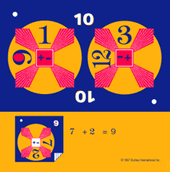 in the single and
double digits, you may see some cards similar to the one at the right. In addition to practicing with your friends and family,
please plan to spend some time from 3:00 – 3:30 PM in my room to practice.
in the single and
double digits, you may see some cards similar to the one at the right. In addition to practicing with your friends and family,
please plan to spend some time from 3:00 – 3:30 PM in my room to practice.
Please complete the permission slip below
and return it to me no later than Friday, May 3. If you have any
questions, please call 368-4974 and leave a message or email me at [email protected].
Thanks.
Permission
Slip
_______________________________________
(pupil name) has my permission for him/her to travel with a group of
students participating in the school sponsored Challenge
24 Competition on May 7, 2002 at Pennsylvania State University.
I hereby authorize medical personnel to treat my child in the event
of an emergency. ____________________________________________ Parent/Guardian’s Signature |