Stand in the door!!!
 This
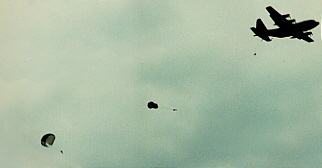
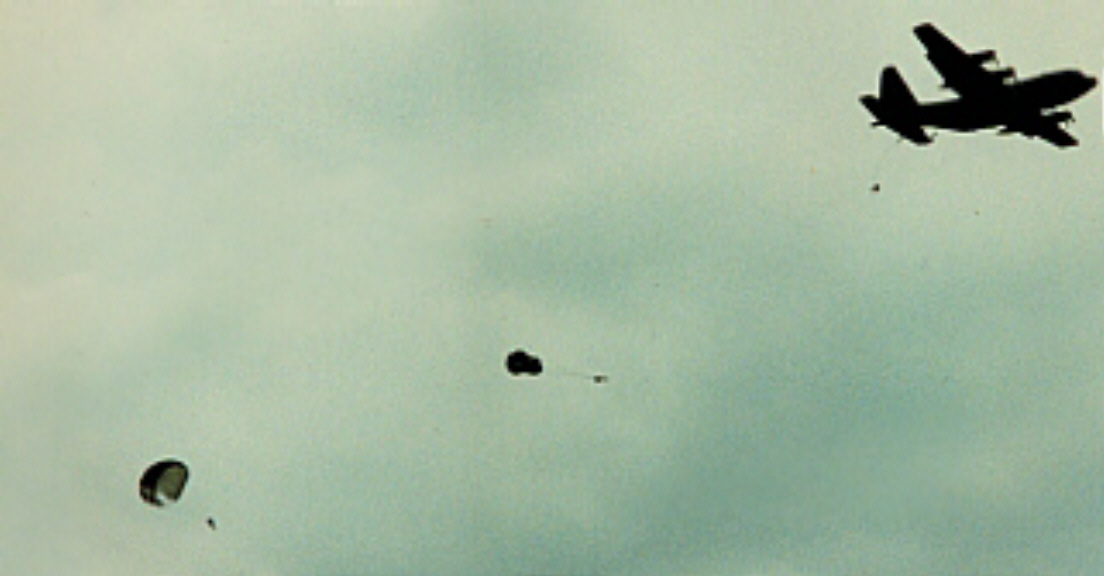
photo was taken by a friend of mine, Pat Fogarty, the day I graduated from Airborne school. Above you can see jumpers exiting
the air craft and the different stages of parachute deployment. (Click on this image for a larger
picture) If you look very closely you can see a jumper just coming out of the door on the left side
of the craft. He is located inside the up-side-down V formed by the tail of the aircraft. Just behind him is a jumper who has
exited slightly before him. His parachute is in the process of being extracted from the deployment bag (D-bag) and he is still
attached to the plane at this point. Like I said before, this is a violent experience. The plane pulling your static line from
your pack tray jerks your body in the direction in which the plane is travelling. Four seconds after you exit the aircraft the
parachute inflates and you are jerked in the opposite direction (illustrated by the jumper in the center of this photo). Basically
you are slowing from 180-200 mph forward motion to almost 0 forward motion in 4 seconds.
This
photo was taken by a friend of mine, Pat Fogarty, the day I graduated from Airborne school. Above you can see jumpers exiting
the air craft and the different stages of parachute deployment. (Click on this image for a larger
picture) If you look very closely you can see a jumper just coming out of the door on the left side
of the craft. He is located inside the up-side-down V formed by the tail of the aircraft. Just behind him is a jumper who has
exited slightly before him. His parachute is in the process of being extracted from the deployment bag (D-bag) and he is still
attached to the plane at this point. Like I said before, this is a violent experience. The plane pulling your static line from
your pack tray jerks your body in the direction in which the plane is travelling. Four seconds after you exit the aircraft the
parachute inflates and you are jerked in the opposite direction (illustrated by the jumper in the center of this photo). Basically
you are slowing from 180-200 mph forward motion to almost 0 forward motion in 4 seconds.
There is probably more time spent on preparing for each jump than there is actually doing the jump. First
the jumpers gather for roll call and are assigned a stick number, which determines where they are located in the aircraft and at
what point they exit. They are also inspected to make sure that they have their identification and dog tags. You can use your
imagination and figure out why they do that. Then jumpers gather and perform pre-jump training before every jump. This consists of
practicing landings as well as practicing in-flight procedures and aircraft exit using a full-size mock-up of an aircraft.
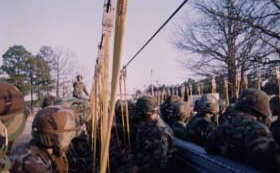
After the pre-jump, jumpers are issued their parachutes and under-go jump master pre-inspection of them
and their equipment. The "Riggers" (personnel that pack/maintain/repair the parachutes) often add some of their morbid
humor during issue by telling you "if this one doesn't work, bring it back and we'll give you another one."
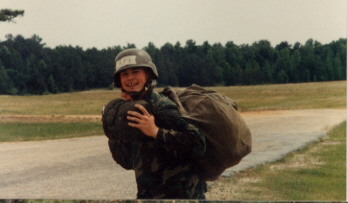 This is yours truly trotting off of Fryar Drop Zone on
graduation day (April 1990). I'll still remember my roster number, #244 (posted on my helmet). All of the old timers I know
say that you never forget that one. My main canopy is inside the aviator kit bag on my back and my reserve is hooked to the
handles and thrown over my shoulder (standard way of carrying your chute off of the field). Anyway, I look at this picture and
can't believe I was ever this young. I also have to wonder how I managed to live this long.
This is yours truly trotting off of Fryar Drop Zone on
graduation day (April 1990). I'll still remember my roster number, #244 (posted on my helmet). All of the old timers I know
say that you never forget that one. My main canopy is inside the aviator kit bag on my back and my reserve is hooked to the
handles and thrown over my shoulder (standard way of carrying your chute off of the field). Anyway, I look at this picture and
can't believe I was ever this young. I also have to wonder how I managed to live this long.
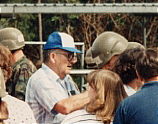 This is my late grandfather, Nelson VanHook.
He was pinning my wings on at jump school at our graduation ceremony. My other late grandfather, Robert Robinson, attended my
graduation from Advanced Individual Training (AIT) a couple of months before and had pinned my new rank on when I was promoted at
that ceremony.
This is my late grandfather, Nelson VanHook.
He was pinning my wings on at jump school at our graduation ceremony. My other late grandfather, Robert Robinson, attended my
graduation from Advanced Individual Training (AIT) a couple of months before and had pinned my new rank on when I was promoted at
that ceremony.
<--------------------------Back
 This
photo was taken by a friend of mine, Pat Fogarty, the day I graduated from Airborne school. Above you can see jumpers exiting
the air craft and the different stages of parachute deployment. (Click on this image for a larger
picture) If you look very closely you can see a jumper just coming out of the door on the left side
of the craft. He is located inside the up-side-down V formed by the tail of the aircraft. Just behind him is a jumper who has
exited slightly before him. His parachute is in the process of being extracted from the deployment bag (D-bag) and he is still
attached to the plane at this point. Like I said before, this is a violent experience. The plane pulling your static line from
your pack tray jerks your body in the direction in which the plane is travelling. Four seconds after you exit the aircraft the
parachute inflates and you are jerked in the opposite direction (illustrated by the jumper in the center of this photo). Basically
you are slowing from 180-200 mph forward motion to almost 0 forward motion in 4 seconds.
This
photo was taken by a friend of mine, Pat Fogarty, the day I graduated from Airborne school. Above you can see jumpers exiting
the air craft and the different stages of parachute deployment. (Click on this image for a larger
picture) If you look very closely you can see a jumper just coming out of the door on the left side
of the craft. He is located inside the up-side-down V formed by the tail of the aircraft. Just behind him is a jumper who has
exited slightly before him. His parachute is in the process of being extracted from the deployment bag (D-bag) and he is still
attached to the plane at this point. Like I said before, this is a violent experience. The plane pulling your static line from
your pack tray jerks your body in the direction in which the plane is travelling. Four seconds after you exit the aircraft the
parachute inflates and you are jerked in the opposite direction (illustrated by the jumper in the center of this photo). Basically
you are slowing from 180-200 mph forward motion to almost 0 forward motion in 4 seconds.