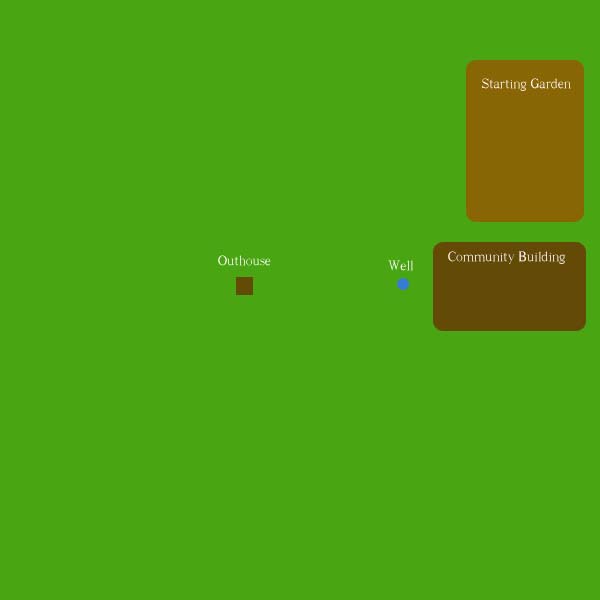
The first step is always the rough one, and naturally it is going to cost the most. The garden will probably be an acre, which isn't a small feat figuring the land it will be on will probably be forest. The outhouse is a simple 'dug-pit' style like many American's had not to many year's ago. The well will probably be hammered in by hand, which takes plenty of patience, but will save plenty of money from a professionally drilled well.
The community building is crucial to all the steps, but especially to stage one. It will be used as initial housing for the first few pioneers, a place to hold meetings, a place to cook and eat food, and a place to drink and be merry. We envision it as either a strong concrete monolithic dome or a nice aluminum barn. It greatly increases the price when compared to self-hewed log construction, but stability and longevity is what our main concern is for this critical building in our community. I'd would also like to make it have a loft if it is a barn structure, but with that comes an even heavier price tag and I'm sure we can make do without it.
|
Birds Eye Layout
(pop-up) -
|
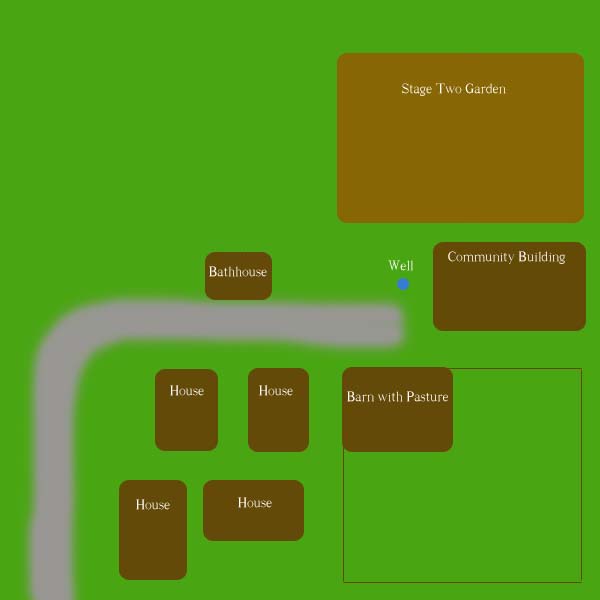
Once stage one is up and running smoothly, stage two comes into effect once the money/support has become great enough to warrant it. It includes a barn made of community forested logs, and pasture, and it will be used to house the sheep, dairy goats, and whatever animals the community decides to keep. The garden is enlarged to be able to feed the growing community.
The outhouse makes way for a larger, two story bathhouse. Around four or more eco-toilets will be installed on the second floor, with their one inch septic lines running down into what was the old outhouse's dug pit for sanitary waste, and their drain pipes running down to two human waste composters on the first floor. The roof will be lined with black PVC pipe with a hand pump to fill it with water to act as a gravity solar water heater to be used for a shower or two. The gray water from the showers will be used as irrigation in the garden By using a community bathhouse we eliminated the need for each individual house to have its own eco-toilet, composter, and sanitary drain.
Along with stage two comes individual family houses. This allows people to get away for awhile and relax away from the rest of the community when needed. It also removes living space in the community building, to have more room for food storage and mess hall. Each individual house will have as many bedrooms as needed (depending on family size), and a wood heating stove. House sharing (multiple families living in the same dwelling) will also be encouraged, as it saves building materials, and heating materials.
|
Birds Eye Layout
(pop-up) -
|
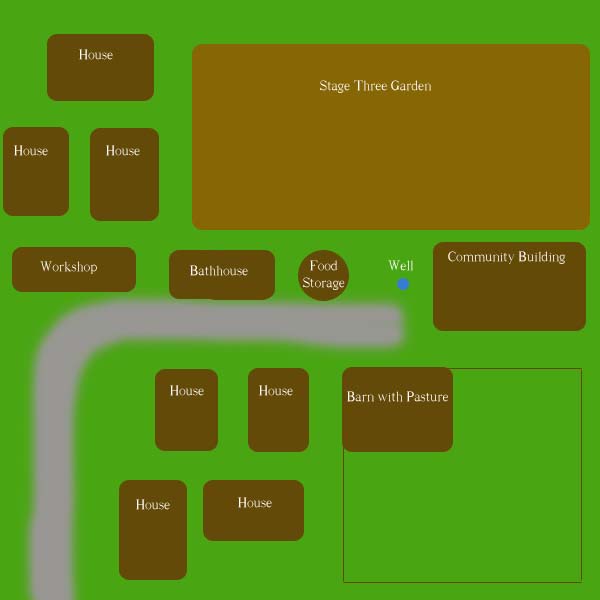
Finally, we have come to stage three. While this is the final development stage we have so far, we don't plan on stopping growth right here. This is simply the milestone that will make us a completely self-reliant community. Of course, the garden is enlarged to continue to grow enough food to support the population and livestock and by this stage will be around 5 acres (drawing is hardly to scale). The bathhouse will be enlarged, to fit a few more eco-toilets and another shower or two.
With stage three comes workshops. With the need for things like clothes becoming bigger than what a few people can handle in their homes, workshops will be built with big enough equipment to be able to make raw materials that will be used to make finished goods that the community needs. Cotton will be taken from the sheep, to the workshops where it will be spun and sewn into clothing and blankets. Eventually the need for other workshops will become a reality. Things like a sawmill to continue to repair, and build better, stronger dwellings.
With the garden being so big, and the winters being so long and the community building needing to fit a higher and higher capacity for breakfast, lunch, and supper a root cellar/food storage building will be constructed with stage three. This will be able to hold all the vegetables and grains of the garden to be able to last the growing community all winter.
Where does the community go from here? No one knows, and why get so far ahead of ourselves we lose our way back?