

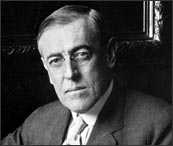
In 1919, Woodrow Wilson envisioned a world free of of war and intimately united against imperialistic advances and nations who threaten peace. His tool to reach this vision was his 14 points post-war peace plan. For this to work, however, international co-operation and German acquiescence. The 14 points would make all covenants open to the global public, allow free navigation in international waters and and allow free trade amongst the nations, make armament reductions to ensure domestic safety, have evacuations of occupied territories and impartial readjustment of colonial claims, and the creation of an international government body, soon to be known as the League of Nations. Wilson had idealistic views of a world that allowed nations, large or small, to participate in world affairs. Each nation would be equal in their own self- determination, sovereignty, liberty, and security. No nation in the New World Order would have dominance over any other or be allowed to draw the world again into war.
Wilson's post-war diplomacy attempted a utopian society where international democracy and liberty allowed for world peace. Growing up in post-civil war America imposed upon Wilson the tragedy of war and he worked hard to ensure that no nation would suffer through that tragedy. He wanted a better world where inequities were righted and humanistic ideals were upheld.
Despite his good intentions, there were serious flaws in his diplomacy which lead to the failure known as the Treaty of Versailles. The key authors of the treaty were Britain, France, and the U.S. However, absent from the writing of the treaty was Germany, who had been winning the war but signed the armistice in good faith of Wilson's 14 points. The British and French harbored a vindictive attitude towards the Germans and the treaty was used to punish the Germans. They sought to assume Germany's colonial claims for their own benefits and to impose ridiculous financial reparations, which would lead to economic ruin for Germany. Wilson's failure to stick to his initial plans for a peaceful and equitable settlement, his failure to fight Britain and France's vindictiveness, and his attachment to the League of Nations caused serious harm to the Germans. The demilitarized and disaffected Germans would soon find a leader and confidence in Adolf Hitler.
Wilson's diplomatic failure continued at home. Members of congress, known as the irreconcilables, lead by Henry Cabot Lodge, wanted to return to isolation from world affairs. They were in opposition to the treaty and began to demand amendments that would in effect make the treaty benign. Lodge especially wanted to make changes to the League of Nations. Wilson, perhaps tired of negotiation, would refuse to compromise on the treaty and especially the League of Nations. The more firm he was in his stance, the less favorable the Treaty of Versailles was to the public. Wilson decided to campaign for his treaty and his League across America to turn public opinion in a favorable way. A stroke would cut his efforts short and his stubbornness would lead to the Senate's refusal to ratify the treaty. Wilson's League of Nations would involve nations across the Atlantic, not the U.S.. The League would be devoid of U.S. military and economic strength which would cause it to fall into Chamberlain's pattern of appeasement and its eventual failure.
Perhaps this analysis is too critical of Wilson. There certainly were some obstacles before him that may have doomed his idealistic visions. France and Britain had both suffered tremendous losses and damages. Their citizens were not interested in making peace and forgiving those who they felt were entirely responsible for the war. Clemenceau and George had to respond to this anger by using the treaty to punish the Germans. Therein, Wilson's vision of a peaceful post-war settlement was ignored by his allies and the treaty was doomed to failure.
At home, Wilson had a country who felt like nothing had been accomplished by the Great War. Men were killed abroad, others came home shell shocked or physically disfigured. But for what purpose? This only gave reason for the country to ostracize itself from world, especially European, affairs. This was not a public who would share Wilson's dream of a New World Order. This was Wilson's greatest obstacle, and it proved to be too challenging.
Hindsight, as the cliche goes, is 20/20. It is too easy to look back and point out flaws or comment on how things could have been done differently. For example, had Wilson not been so idealistic, then maybe he could have been more successful in his role of drafting the Versailles Treaty. Wilson, it seemed, had abandoned his initial plan for the post-war settlement and gambled on the success of his League of Nations. Looking at this we can say that it was in vain because his compatriots would never agree to such a global inter-connectedness. Likewise, had Wilson insisted that the Germans take part in the drafting of the treaty then maybe they would not have been singled out as the guilty party and therefore responsible morally and financially. Perhaps it would have been an equitable treaty, not a notoriously vindictive treaty, and peace would have followed. Not to sound redundant, but if Wilson had allowed some room for comprise in the treaty with the Senate then maybe they would have ratified it. All of this conjecture rests on the word maybe. Wilson did not have the benefit of our hindsight and he had to play the cards he was dealt as he saw fit.
Political idealism is all very well and nice, but when other nations rely on political realism the former politic is going to be walked on. The problem with political idealism is that it trusts that human nature is inherently good and therefore those in government will do what is good for the betterment of the world and the people. This sort of thinking, though ultimately desirable, has no place in today's politics. Corporations, money, elite interests, and the sort have jaded politics and forced political realism upon all of us. Wilson had the best of intentions with his idealistic views, but they could not compete with the harsh reality of life after war.