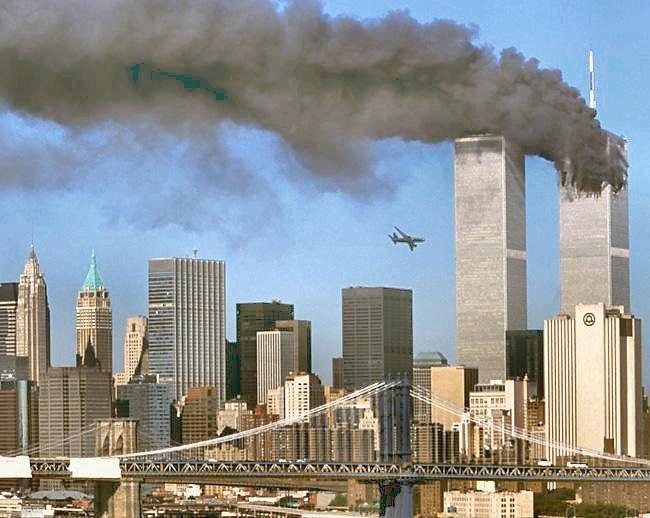
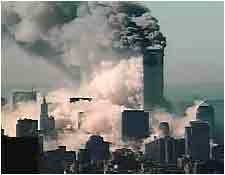
But first we need to look at 9/11 because it happened so fast that there were never any questions asked, other than "Why?". We need to look before 9/11, to the Clinton administration. Let's take a look into the question of Oil.
There was a study done in 1997 that revealed that Eurasia, land east of Germany, has 60% of the world's GNP, 75% of the world's population, and 3/4 of the world's natural resources (Brzezinski). That means that any nation that could have superior hegemony in this region would in effect control a large part of the world. This fact was known by President Clinton, President Bush, and all major corporations. US Foreign policy, therefore, has been focused on diplomatic and, more recently, militaristic manuevers to promote American interests.
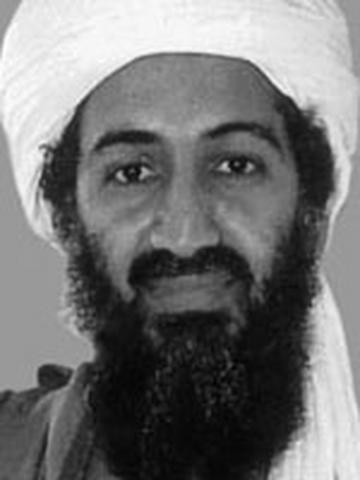
9/11 Mastermind

During Clinton's administration, a war plan was put together in which the Taliban would be overthrown and the terrorist networks destroyed. The plan was to be put into effect as soon as the FBI and CIA could verify that bin Laden was responsible for the terrorist attack in the Port of Yemen against the USS Cole. But Clinton's term ended and he never was able to put it into effect. Sandy Berger, Clinton's Security Advisor, gave this contingency plan to his successor, Condoleeza Rice. He told her about the plan, personally, and told her about the threat bin Laden posed to our nation. Apparently, it went in one ear and out the other because she recalls no such meeting. At this time, nations were giving the new President warnings, even Putin. The FBI and CIA were warning of an imminent attack by Bin Laden. Richard Clarke, the former terrorist czar on the President's National Security Council, has since come forward and said that the President refused to listen to his warnings and the warnings of former-CIA director George Tenet, particularly during the summer before the attacks. He also alleged that the President and his advisors were quick to connect the 9/11 attacks with Iraq, but the lead voices in that discussion were Donald Rumsfeld, Paul Wolfowitz, and Richard Perle. Another person that was not heard was an FBI agent named John O'Neill, who was so frustrated with Bush's inability to pay attention to the facts (he said because of oil lobbyists) that he quit. He soon found a new job, however, as Head of Security at the World Trade Center. He was killed on September 11, 2001. But did he and the other three thousand die because of Bush's ignorance?Or was it his incompetence?
President Roosevelt put Japan into a position where it's only choice would be retaliate with military force. FDR was president of a country where 80% of the people did not want war. After World War 1 we returned to an isolationist nation, and European affairs were none of our business. But FDR, by preventing trade with Japan, which they desperately needed, and demanding they withdraw from China, prompted Japan to attack us on December 7, 1941 at Pearl harbor. This created such a damaging atmosphere of fear that virtually all Americans supported Roosevelt's declaration of war. FDR was able to push a reluctant citizenry into war under the pretext of defense. Was this a tactic used by Bush? I don't think he's that clever. However, by ignoring advice that he focus on terrorism, and by pursuing the interests of the oil industry, President Bush is responsible for the failure to prevent the attacks on 9/11. He is also fully responsible for using 9/11 as a pretext for invading Iraq, a country with absolutely no connection to the events of 9/11.
Bush was well aware that there was a high potential for a terrorist attack because he had been warned on many occassions. 9/11 allowed Bush to overthrow the Taliban and put in a government he liked so that he could have UNOCAL's pipeline built. Did Bush allow the terrorists to attack us on that day so that the American people would support military action in Afghanistan? Again, this is a theory I do not support, but the evidence in support of such thinking is plentiful. Instead, I argue that his own greed and his pro-business mentality (not to mention his lackluster inelligence and knowledge of foreign policy) overruled any consideration for protecting us against terrorists. It was pure incompetence and greed that allowed a window of opportunity for the terrorists on 9/11. This greed continues even to this day. He put Hamid Karzai as president of Afghanistan, allegdly a former UNOCAL consultant (Pike). The American envoy to Afghanistan is a UNOCAL employee. Bush, I'm sure is happy, as are his oil buddies.
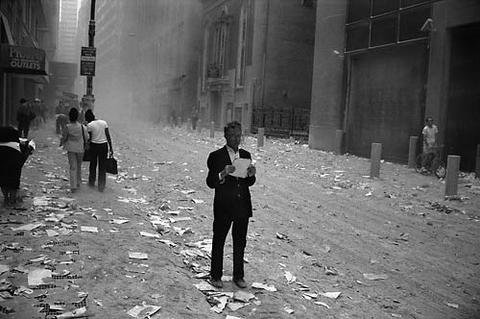
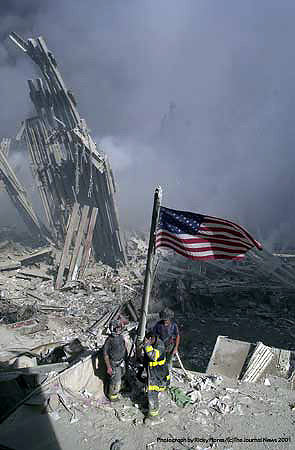
The following is an account of the events on 9/11, which can be found in the 9/11 Commission's report.
Between 7:45 to 8:15 am, an unprecedented event occurred: Four airplanes were hijacked nearly simultaneously. According to Federal law, when an airplane should alter from it's course it is to be met by fighter jets within five minutes. How do they know when a plane has altered course? Well, they are on radar. And those four planes were on radar as well, but no fighter jets intercepted these planes. It would take an executive order to shoot down the planes. Had Federal law been followed, maybe these planes would have been destroyed before they reached their targets.
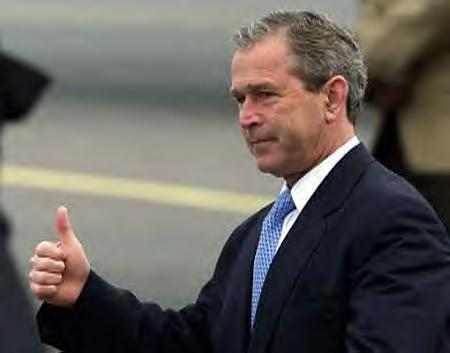
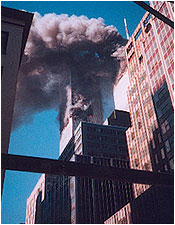
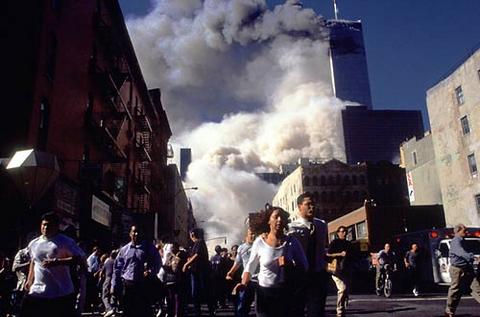
At 8:45 am, American flight 11 flew into the first tower of the World Trade Center. It was thought, at first, to be an accident. Bush is now at a school for a photo op, and he will not be told about the events for another half hour.
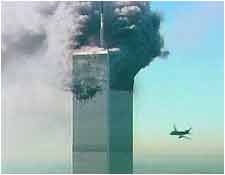
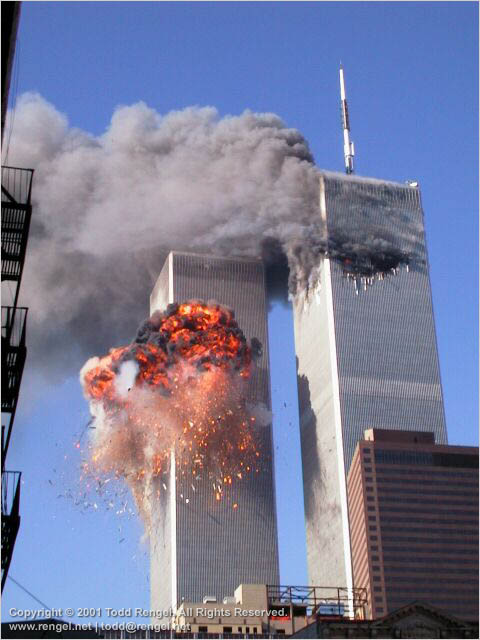
At 9:03 am, United Airlines flight 175 flew into the remaining tower of the World Trade Center. This should have been evidence enough to launch the fighters against the two remaining planes, still on radar, still going in the wrong direction.
9:05 am, Bush is made aware that the United States is under attack. He looks bewildered, yet somber. But he does not cancel his photo op and take his role as commander-in-chief.
9:30 am, Bush finally tells the public what they already know: We are under attack.
9:35 am, American Flight 77 takes a two minute nose dive into the Pentagon. Later, the fourth plane is crash landed into an open field in Pennsylvania. It's target was apparently the White House. The passengers took more initiative to stop the terrorists than their own government.
Why weren't these planes intercepted by fighter jets, as Federal law demands? There are many bases along the East coast, so why, in the highest alert situation weren't Fighter jets intercepting these wayward planes?!
With the attack, Bush was able to have a united American public to go into Afghanistan and overthrow the Taliban regime. He used Usama Bin Laden as an evil figure who needed to be taken out along with his evil Al-Qaeda (I do think both are evil, but I'm trying to emphasize that they were used for his purpose), but once he had in place an Afghani government he was able to pursue his intended target: Iraq and Saddam Hussein. Notice how we went from wanting Usama dead or alive, preferably dead, to suddenly changing direction and now saying Saddam had something to do with 9/11 and needed to be overthrown. What happened to capturing bin Laden? Sure we're still looking for them, but most of our resources are put into the war on Iraq. Now, in Afghanistan, the Taliban is on the rise, with Al Qaeda support, and they are causing us more deaths now than they did during the war. Ask yourself these questions and ask if those who died, did so for the sake of oil and money. Bush is a former oil man himself. His whole cabinet is full of people who were oil men (and women-- Condoleeza Rice is a former Chevron employee). Cheney himself was CEO of Haliburton oil. The pursuit of middle-east oil and domination of the Eurasian natural resources is crucial to understanding where we are headed as a nation. We are in war mode no, so expect perpetual war. Can we afford to get locked into a war with Iran? No. Will we? Only God knows.

Brisard, Jean-Charles and Guillaume Dasquie. Forbidden Truth: US-Taliban Secret Oil Diplomacy and the Failed Hunt For bin Laden. Paris: Thunder's Mouth, 2002.
Brzezinski, Zbigniew. A Geostrategy for Eurasia.September/October 1997. Council on Foreign Relations. 20 June 2007 <http://foreignaffairs.org/19970901faessay3795/zbigniew-brzezinski/a-geostrategy-for-eurasia.html>.
Pike, John. Hamid Karzai. 27 April 2007. GlobalSecurity.Org. 20 June 2007 <http://www.globalsecurity.org/military/world/afghanistan/karzai.html>.