
NAME
"Duklja", the name of the region during the early period of the Roman Empire, was termed for an early Illyrian tribe. The Roman Emperor Diocletian hailed from this region. In later centuries, Romans "hyper-corrected" the name to Dioclea, wrongly guessing that an "I" had been lost due to vulgar speech patterns. "Duklja" is the later Slavic version of that word. The actual city of Dioclea was located at present-day Podgorica.
GEOGRAPHY
Duklja (roughly Montenegro today) bordered the Byzantine Theme of Dyrrachion to the east, at the City of Bar and Travunia to the west. From the Skadar Lake at the east its territory sprang down the river of Zeta all the way to the river of Piva to the west. Afterwards, Skadar became the capital of the state until the end of the Middle Ages. The Royal Capital of Duklja was Ston. It had only three major settlements: Gradac (Old Budva, the ancient Serbian capital), Novi Grad and Lontodoclea. The most important City was Diocleia (after which the entire Archonty was named), but that city was in ruins by the 10th century from numerous invasions.
EARLY HISTORY
It was one of the four southern Dalmatian Slavic principalities. Although Slavs populated the regions of Dioclitia since as early as the 5th-6th century, the greater waves of Slavic migrants (traditionally classified as Serbs) came in the 630s by the White Serbs under the Unknown Archont. The land was given by the Byzantine Emperor Flavius Heraclius Augustus to settle and accept his supreme rule. During the Slavic intrusions, the City of Diocleia was mostly ransacked. Many were baptised during Emperor Heraclius' missions on baptising the Serbs by missionaries from Rome.
In 732, Eastern Roman Emperor Leo III the Isaurian took the region of Doclea from the suzerainity of the Bishop of Rome Gregory III and gifted it to the Ecumenical Patriarch of Constantinople, Anastasius, thus quelling the previously dominant Latin culture and restoring the dominance Hellenism. The Latin language and culture remained only in the old coastal Romanized cities. The Principality of Doclea was subjected to the Grand Principality of Rascia, under Grand Prince Vlastimir of All Rascias, but kept endorsing its semi-independence. The Slavic pagans of Doclea were fully baptised together with all Serbs under Grand Princes Stefan and Petar in the 9th century.
Prince Ceslav of Klomir of the House of Vlastimir, last descendant of the Unknown Archont, created a Realm of Serbia and managed to excerpt control over more than 70% of Doclea's territory. The Byzantine enclaves of Kotor, Bar and Ulcinj had to pay taxes and sometimes were even governed by the Doclean rulers.
The death of Prince Ceslav brought an opportunity for a more independent Doclea. In the middle of the 10th century, the Travunian Princes have fought long wars against Doclea's Ban. Eventually, Doclea was conquered and Travunia and Doclea were united under one ruling family. Folk tales call their rulers "Kings", when in fact, they were nothing more than mere Princes. "King" Predimir is the first known ruler - and he ruled his "Kingdom" from his capital at Onogo�t.
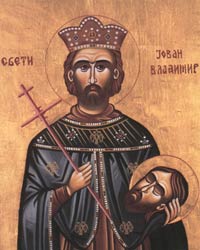
Saint Jovan Vladimir fought the Arbanass tribes that menaced the eastern territories. Skadar was subsequently formalised as the heart of Duklja. The Bulgarian Tsar Samuil invaded Doclea and took the Prince as a prisoner. As a result of a subsequent marriage between Jovan Vladimir and the Bulgarian princess Kossara, Jovan Vladimir was allowed to return and rule as a Bulgarian vassal. After the successful plot of the last Czar of the Bulgarian Empire Ivan Vladislav, Jovan Vladimir's life was taken on 22 May 1016. Saint Jovan Vladimir expanded his pretensions greatly by also becoming the ruler of Tribalia and Serbia. Vladimir's seat was at Katrkol, below the Church of Precista Krajina. His remains were shifted from monastery to monastery until they were finally placed in the Monastery of Saint John in Elbesan in Albania.
CLICK HERE TO SEE JOVAN VLADIMIR
HIGH MIDDLE AGES
The anarchic ages that followed the dawn of the 11th century were crucial for Duklja. The people of Kotor rebelled and lynched the Doclean Prince Dragomir in 1018, and the Byzantine forces occupied Doclea to restore order. Dragomir's son Dobroslav goes into poverty. Dobroslav acted twosome: he was constantly praising Byzantine rule and at the same time rousing up the people against the Emperor.
In 1034, Dobroslav, also called Stefan Vojislav, son of Dragomir, who was among the Serbian Travunian gentry, was elected to lead a movement to liberate the Serbs in the Adriatic coastlands. By the time of the rebellion, Voislav already had 5 sons with his wife, a cousin of Tsar Samuil. While Voislav was preparing for war, he played nice with the Byzantines, assuring them that he was their faithful subject. He gained the nickname "Stefan" from the Greek word Stephanos meaning "crowned" to resemble his independent power and proclaimed himself Achont of Serbs. In 1035 he led the Serbs into an uprising, but the Byzantines have quickly manage to impose peace terms. Voislav was taken hostage to Constantinople in the summer of 1036 and the uprising was quelled, and the task of occupying Duklja was given to Serbia's strategos Theophilos Erotikos. Voislav managed to escape imprisonment in 1037 and retake the land of the Serbs, where he withdrew to the mountains and maintained guerilla resistance with an ever-growing group of highlanders. There he started to attack and take over leadership among the neighbouring Serbs, Tribals the tribes in the "Illyrian mountains" that recognized Byzantine supreme rule throughout 1038. He succeeded in pushing the fight to expel strategos Theophilos from Serbia and briefly create an independent territory from the Skadar lake to the Hum mountain, seated at Scutari. He also helped the neighbouring uprising of Slavs that quickly expanded from Belgrade across Naissus to Skopje led by Petar Delian, as well as the Tihomir's Slavic uprising in Dyrrachion. Those involved in the uprising even reached the ruins of Thebes on one occasion, so the Byzantines left Duklja untroubled for some time.
Around 1050 (as early as 1046 or as late as 1055) Voislav died, and was buried in the Church of Saint Andrews in his capital at Prapratna. He was succeeded by his son Mihailo. Mihailo immediately had to face a rebellion of the people in Travunia under Domanec and quelled it by force and installed his brother Saganek in 1052/4 as the new Prince of Trebinje. However, the legend tells how Dobroslav split his realm to all his five sons: Gojislav, Mihailo, Saganek, Radoslav and Predimir, with Gojislav as the eldest the head together with his mother and Voislav's wife, the relative of Czar Samuil, ruling together from Trebinje.
LATE HISTORY
The Byzantines gave numerous lands of the Grand Principality of Rascia to Stracimir, son of Prince Zavida of Zahumlje, who ruled in the name of his oldest brother, Grand Prince Tihomir of Rascia as a vassal of the Byzantine Empire since 1166. The majority of Duklja was included in his lands.
Out of Diocleia Ribnica arose, which was the birthplace of Prince Stracimir's brother, Prince Nemanya, another of the sons of Prince Zavida of Zahumlje. Up to 1168 Nemanja ascended to the throne as Grand Prince of Rascia after he defeated Tihomir. Stracimire initially supported Tihomir in the fight, but drew back as soon as Tihomir started to lose.
Stracimir's other brother, Prince Miroslav of Zahumlje had to call off his military expeditions against Kor?ula and Vis, because of the losing war against the Republic of Dubrovnik in 1184 in which Stracimir offered military assistance. Miroslav eventually drew from the war, while Stracimir didn't want to advance alone, so abandoned the conquest of the Republic too. Stracimir got the job to take the islands Kor?ula and Vis in 1185. The smaller part of his force managed to raid heavily Vis. Stracimir's galleys landed his forces on Kor?ula and took the island, but did not manage to control it, so they raided the island's fertile regions on the western part. The inhabitants of Kor?ula hailed the Dubrovnik Republic for assistance and it managed to capture all of Stracimir's galleys. Prince Stracimir managed to sign an agreement with the island's inhabitants: he guaranteed that the island will have autonomy, separated from Zahumlje; while the islanders agreed to help his forces set sail back to the mainland.
Although Prince Stracimir was the factual ruler of Duklja, Prince Mihailo of the old ruling Voislav family and Stefan Nemanja's nephew remained as the titulary ruler. After Stracimir's passing away, Mihailo had claims to rule Duklja in the name of the Byzantine Emperor, rather then the Serbian Duke. In 1186, while Stefan Nemanja was at war with the Byzantine Empire, he went on a military campaign to incorporate Duklja into his realm. He besieged Bar which was under the leadership of the local Archbishop, Grgur. Grgur wrote the Chronicle of the Priest of Duklja in 1172-1196 to boost the morale of the people, attempting first to keep Duklja independent, and then only to mark its former glory. He predicted the return of the old regal power in Duklja, but his hopes were all in vain. Stefan Nemanja demanded 800 perpers of ransom to abandon the siege of Bar, while Prince Mihailo of Duklja was under attack by Nemanja's brothers. Stefan Nemanja gave Duklja in 1186 to his oldest son, Vukan, who asserted to power with the old regal title of King of Duklja and Dalmatia. In 1189, Prince Mihailo died and his Princess Desislava escaped with the remaining loyal nobility of Duklja and the Archbishop of Bar in her two ships to the Republic of Dubrovnik. Desislava then moved to Omis, where she died. Archbishop Grgur was exiled and his post temporarily abolished after Nemanja's capture of Bar, so he continued his chronicles in exile.
Vukan of Nemanya maintained good relations with the Papacy, as he married the Pope's relative and accused Bosnia's Ban Kulin of heresy to the Pope. Vukan was enraged that he didn't inherit from Stefan Nemanja the Grand Princely throne which was contrary to the traditional system of primogeniture, so he rebelled against the new Grand Prince Stephen II the First-crowned of Nemanya with the help of the Dukljan nobility and managed to assess to the Grand Princely throne in 1202, but was deposed in 1204 by Stephen II with Bulgarian assistance. Vukan withdrew to Duklja where he continued to rule and kept fighting the Grand Prince.
Around this time, the name Zeta replaced the ancient name of the region (name deriving from the river of Zeta). Its population is henceforward defined as Serbian.