As Reactor Four was to be shutdown for routine maintenance on the 25 April 1986 it was decided to take advantage of this to run a test. The test was to check whether, in the event of a shutdown enough electrical power to operate the emergency equipment and core cooling pumps until the diesel power supply came online.
As the reactor shutdown proceeded, the reactor operated at approximately half power when the electric load dispatcher refused to allow further shutdown. As part of the test the emergency core cooling system was switched off and the reactor carried on at half power. At about 23:00hrs on 25th April the grid controller agreed to a further reduction in power.
For the test the reactor was to be stabilized at 1,000MW prior to shutdown, however, due to operational error the power fell to about 30MW where the positive void coefficient became a problem. The operators tried to raise the power by freeing all the control rods manually and at 01:00hr on 26 April the reactor stabilized at 200MW.
Excess
steam pockets in the RBMK design lead to increased power generation this is
known as a positive void coefficient. This excess power causes additional
heating thus producing more steam and means less neutron absorption causing the
problem to escalate. This all happens very rapidly and if it is not stopped
quickly it is very hard to stop as it supplies itself.
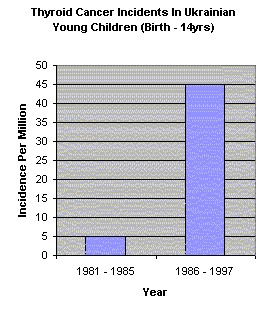
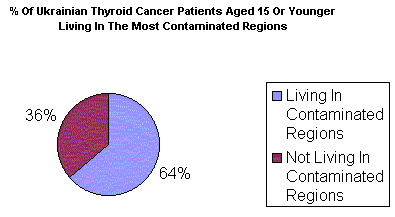
| Both sets of figures are based upon a Ukrainian study in CANCER published on 1st July 1999. |
30 lives were lost during the accident or within a few months after it. Figures from the Ukraine Radiological Institute suggest that over 2,500 deaths were caused by the Chernobyl accident.
There have been significant increases in psychological health
disorders and incidence such as:
These were a result of the lack of public information available after the accident, the stress and trauma of evacuation and concerns of the people affected and about their children's health. Furthermore there is much understandable skepticism over official statements as people were not told the truth until several years after the accident.
Shortly afterwards an increase in coolant flow and a drop in steam pressure occurred requiring the operators to withdraw nearly all the rods. The reactor then became very unstable and the operators had to make adjustments every few seconds to maintain a constant power.
At this time the operators reduced the flow of feedwater to maintain the steam pressure. Also pumps that were powered by the slowing turbine provided less and less cooling to the reactor. This created additional steam in the cooling channels (positive void coefficient) and the operators could not control a power surge estimated to 100 time the nominal power.
The sudden increase in temperature caused part of the fuel to rupture, fuel particles then reacted with the water creating a steam explosion which destroyed the reactor core. A second explosion added to the destruction two minutes later.
·
Control measures limit
industrial and agricultural activities reducing the range of products the area
was able to export. This would have lead to a fall in local incomes. Furthermore
reduced investment occurs due to a perception of an unsafe “lifestyle” within
affected areas.
·
Following the accident
116,000 people had to be evacuated and between 1990 and 1995 an additional
210,000 people were resettled. This created a need to build a new town named Slavutich for
the personnel of the Chernobyl power plant.
·
Villages had to be decontaminated
and major work had to be carried out on infrastructure for example water and
gas. The closure of Reactor 4 and the “freeze” on construction of new reactors reduced
the availability of electricity supplies.
· Demographic indications in 'contaminated' areas suggest that these areas are experiencing a decline as:
o The birth rate has decreased
o The work force has migrated from contaminated areas to uncontaminated areas thus in turn resulting in a shortage of labour and professional staff.
· The effected areas suffered major disruption to normal life and economic activity in particular with regard to agriculture and forestry production.
· $12.8 Billon of disruption occurred to the Soviet Economy.
· A “victim” mentality has occurred in the area due restrictions of activities making life difficult and unsettling.
