5. MAGNETIC FIELD UNDER OVERHEAD TRANSMISSION LINES
5.1 Transmission Line Model
The model used is the overhead vertical-type transmission line. Because of limited space and relatively cheap price to put up, this type is commonly used in Japan. There are 6 line currents arranged to form a hexagonal shape. Since three-phase 60-Hz source is used, the line currents exhibit different phase angles differing by (360/3) 120 degrees.
5.2 Adapted Calculation Conditions and Methods
The following are the conditions and methodology were adapted in the process of creating the program calculations.
1. The current direction is taken as going towards the -y-axis or towards the user's direction. From this, we can deduce that the electromagnetic field will have no y-axis component.
2. The axis of symmetry of the tower (tower center line) was considered the zero-point position for the x-axis and the ground as the zero-point position in the z-axis. Thus XX will range from -50 to 50 meters and z-axis from zero to the height of the ground wire of the transmission line.
3. Point P is measured 50 meters left and right of the tower center line and a meter above the ground incrementing by one meter.
4. The transmission line were taken to be straight and does not exhibit drooping. Drooping is a condition in wires where they bend due to their gravitational weight. This condition is neglected, since it has no or very minimal effect on the magnetic field.
5. The value of total magnetic flux density is obtained from simulating the strength equation with ( t incrementing by 1 degree from 1 to 360 degrees. Since the path of B describes an ellipse, the total magnetic flux density corresponds to the magnitude of the major semi-axis of the ellipse.
The program is simulated by varying the arrangement of phase angle of the transmission lines. With this variation, the magnetic field distribution is then compared. Magnetic fields are also calculated and observed setting one side of the transmission line currents to a value lower than the other.
5.3 Calculation Results
Using the default values presented in Table 5.1, the magnetic field distribution obtained from using the software presented either a symmetrical curve or a non-symmetrical one. Symmetrical curve graphs show evenness in the left and right of the tower center line. The curve's peak point (Ym) is located exactly at the tower's axis of symmetry. Non-symmetrical curve's peak point, on the other hand, lies either at the +3-meter or -3-meter mark of the x-axis. Refer to Table 5.2 for the summarized form of the results.
With regards to the magnetic field density's peak magnitude, a non-symmetrical curve showed the lowest amount of all. Among the symmetrical curves, the configuration with the 2nd and 5th line current being equal exhibited the lowest amount.
Magnetic fields were also calculated with one side of the transmission line currents set a value lower than the other part. The left side line currents are set to 1000A and the right side set to 200A. With these conditions, all the curves showed a non-symmetrical graph and their peak point is located at the side where the line currents are higher. Table 5.3 shows the results with the irregular line current conditions. Figures 5.1 to 5.6 shows the graphical analysis as obtained from the software.
5.3 Discussion of Results
Under the default conditions, the symmetrical curves were due to the fact that the phase angles of two line currents with the same distance from the ground were the same. Non-symmetrical curves gives much lower magnetic flux density compared to the symmetrical ones. From this, we can conclude that a non-symmetrical yielding configuration must be adapted to lessen the magnetic field produced by a transmission line.
Under the irregular conditions, peak values, as expected, were located at the side where line currents are high. Also, since the magnetic field is directly proportional to the line current and one circuit of the line current values were decreased, the magnetic field peak value will also decrease.As a conclusion, the value of magnetic field can be lessened by altering the line configurations. With the magnetic field distribution known, utilities can be developed to lessen magnetic field dissipation in transmission lines[6].
6. CONCLUSION
The magnetic field graph obtained from using the software presented either a symmetrical curve or a non-symmetrical one. Symmetrical curves show evenness in the left and right of the tower center line. Non-symmetrical curve's peak point, on the other hand, lies either at the +3-meter or -3-meter mark of the x-axis.With regards to the magnetic field density's peak magnitude, a non-symmetrical curve showed the lowest amount of all. Among the symmetrical curves, the configuration with the 2nd and 5th line current being equal exhibited the lowest amount.
Magnetic fields were also calculated with one side of the transmission line currents set a value lower than the other part. With these conditions, all the curves showed a non-symmetrical graph and their peak point is located at the side where the line currents are higher.
As a conclusion, the value of magnetic flux density can be lessened by altering the line configurations. With the magnetic field distribution known, utilities can be developed to lessen magnetic field under the transmission lines.
With the remarkable results obtained above, MFTL software has proven to be very useful in determining the magnetic field distribution under the vertical-type transmission line. Since straight general analysis can be deduced from the graphical representation, different conditions can be simulated easily. Because of it's user-friendly GUI, anyone can easily use the software.
In the future, the software is, therefore, recommended for revisions to include the calculations about the horizontal-type transmission and the consideration of the electric fields in the calculations.
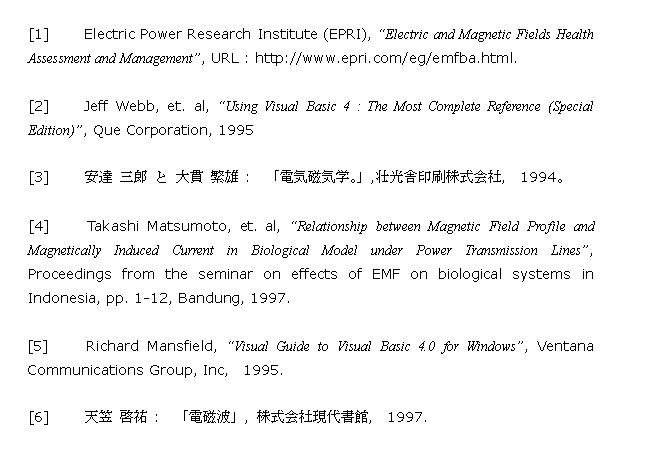
REFERENCES
ACKNOWLEDGEMENTS
This paper wouldn't have been possible without the help of several people. I may not be able to name them all due to time shortage, but from my heart I am very grateful.First of all, I'd like to thank Mr. Takashi Matsumoto, our research professor, who has been very supportive not only to me but to all of us in the group; my research group mates who in a way made writing this paper fun and interesting. And a lot of other persons who in their own way contributed a part in the preparation and programming process of this research.
Lastly, to Ameer Az Mat Yasir for being a good friend and an inspiration and to my supportive family.
APPENDIX
A. FORTRAN Program Listing