Key Release Methods
Icecube Release.
The ice cube method is the simplest and most reliable release
method. The idea is simple: Use the fact that an
icecube melts, to keep the keys out of your reach for a while.
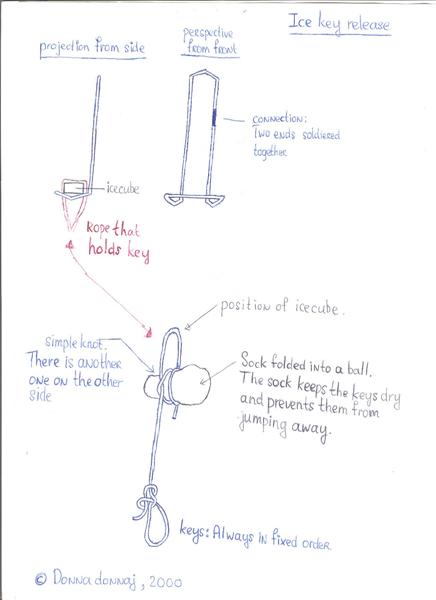
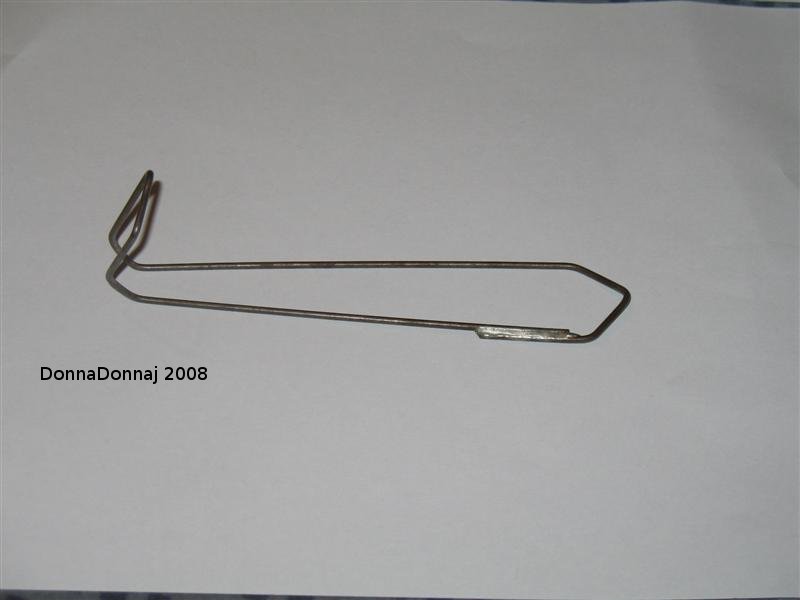
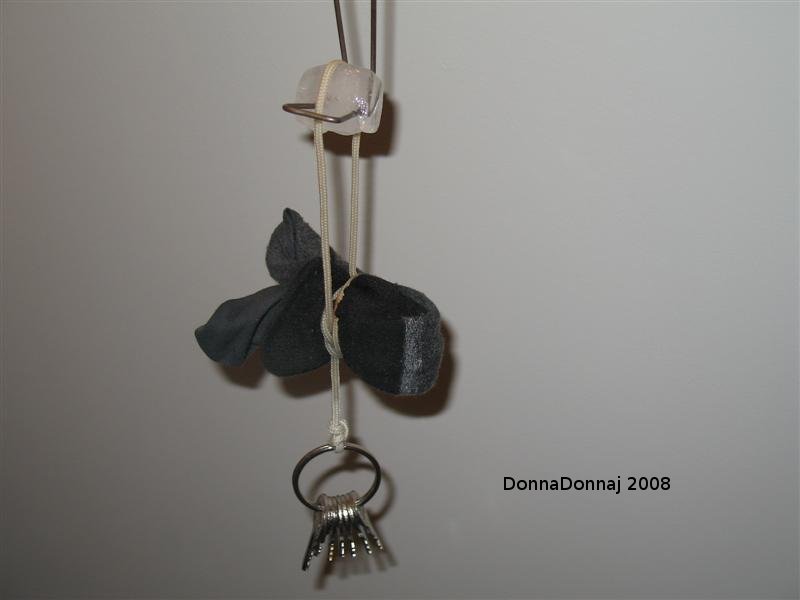
I nearly always use the construction shown on the drawing and
pictures below. I made a kind of hook out of welding wire
(See the drawing below), in which I put the ice cube.
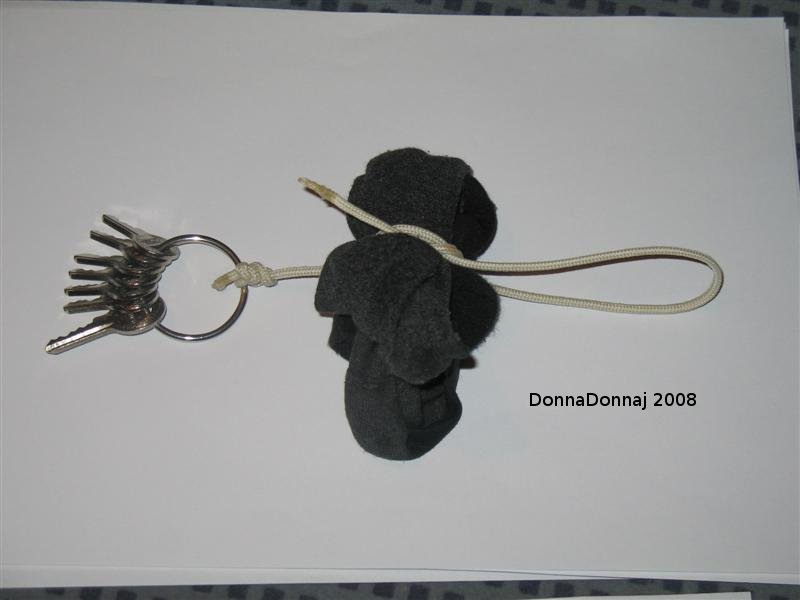
To the keys, I have connected a rope with a length of approximately
50 cm. Using this rope, I make a noose by tying it twice around a sock.
(See drawing and picture).
This noose can be put over the ice cube.
When this is done correctly, the noose will touch only
the ice (and not the hook).
Because of this, this method is very reliable.
The main disadvantage of this method is that one does
control over the time. It takes approximately
60 minutes in winter, and 40 minutes in summer for the keys to drop.
The melting time is fairly constant. The only gradually
fluctuates through the
year. For me, these times are enough. If you want longer times,
you can use electricity cable (with isolation) instead of
welding wire. It is also possible to put two icecubes
on the hook.
There is no need to drill holes in the ceiling.
Because the
construction has little weight, you can use tape
to connect the metal hooks to the ceiling.
You can also find a place where the ceiling is made from wood,
and beat a nail in the ceiling.
It is important to attach a sock to the set of keys
in order to make sure that they will not bounce away when
the fall. An additional advantage is that the sock
will aborb the water that falls from the melting ice,
so that the keys will not get wet.
Old Fashioned Mechanical Alarm Clocks.
These things appear to be designed for our purpose. On the
top they have a button with which you can switch
off the alarm bell, when it rings.
It is usually possible to attach a thin rope to this
button, with which the alarm clock can hanged to the
ceiling. On the back, the alarm clock has 2 keys, one for
the clock work, and another one for the bell. When the
bell rings, the key for the bell rotates in the
opposite direction into which it is wound up.
On this key, you can put a clothes-peg, and then
hang your set of keys on this clothes-peg with a
little hook. When the alarm bell rings, the set
of keys will fall down. Make sure the hook is on the
right side. That is the side that does down
when the alarm bell rings, i.e. the side that goes
up when you wind it up.
Make sure they keys are sufficiently wound. Always
use two alarm clocks.
I consider this method not reliable enough. I have used
it in the past, but always in combination with a soldering iron.
This is the method that I describe next.
Soldering Iron with Metal Hook.
Take a soldering iron. Lay it down on a table in such
a way that it is stable, and that the hot end does not
touch the table. Switch it on and wait
for 10 minutes.
Now you can lay a metal hook on the tip, (made from thick,
massive electricity cable, or welding wire),
put a little bit of tin on the connection, and pull
the plug of the soldering iron. After 10 minutes the
tin is solid, and the hook is connected quite strongly
to the soldering iron.
Now you can hang the soldering iron by its wire on
the ceiling, and hang a set of keys on the hook.
You can use an electronic timer to switch on the
soldering iron. Approximately 2 minutes after the soldering
iron is switched on, the hook will come down. The hook
won't be very hot, so it won't burn holes
in you, or in your carpet.
This method alone is not reliable, because it depends on
complex technology, and public electricity. I always combine
it with the alarm clock method as follows:
On the hook of the soldering iron, I hang the alarm clock.
On the alarm clock, I hang the keys. The time of the electronic
timer is set approximately 20 minutes later than the time of the
alarm clocks.
If the alarm clock works, I have enough time to free myself, and
to save the alarm clock from falling. If the alarm clock does
not work, then there is the soldering iron as a back up.
Final Remarks
I use nowadays use almost only the ice cube method, because I do not
want to be tied up very long anymore. In the basic position,
3 hours is no problem. In the BPBH, I would not go over 90 minutes.